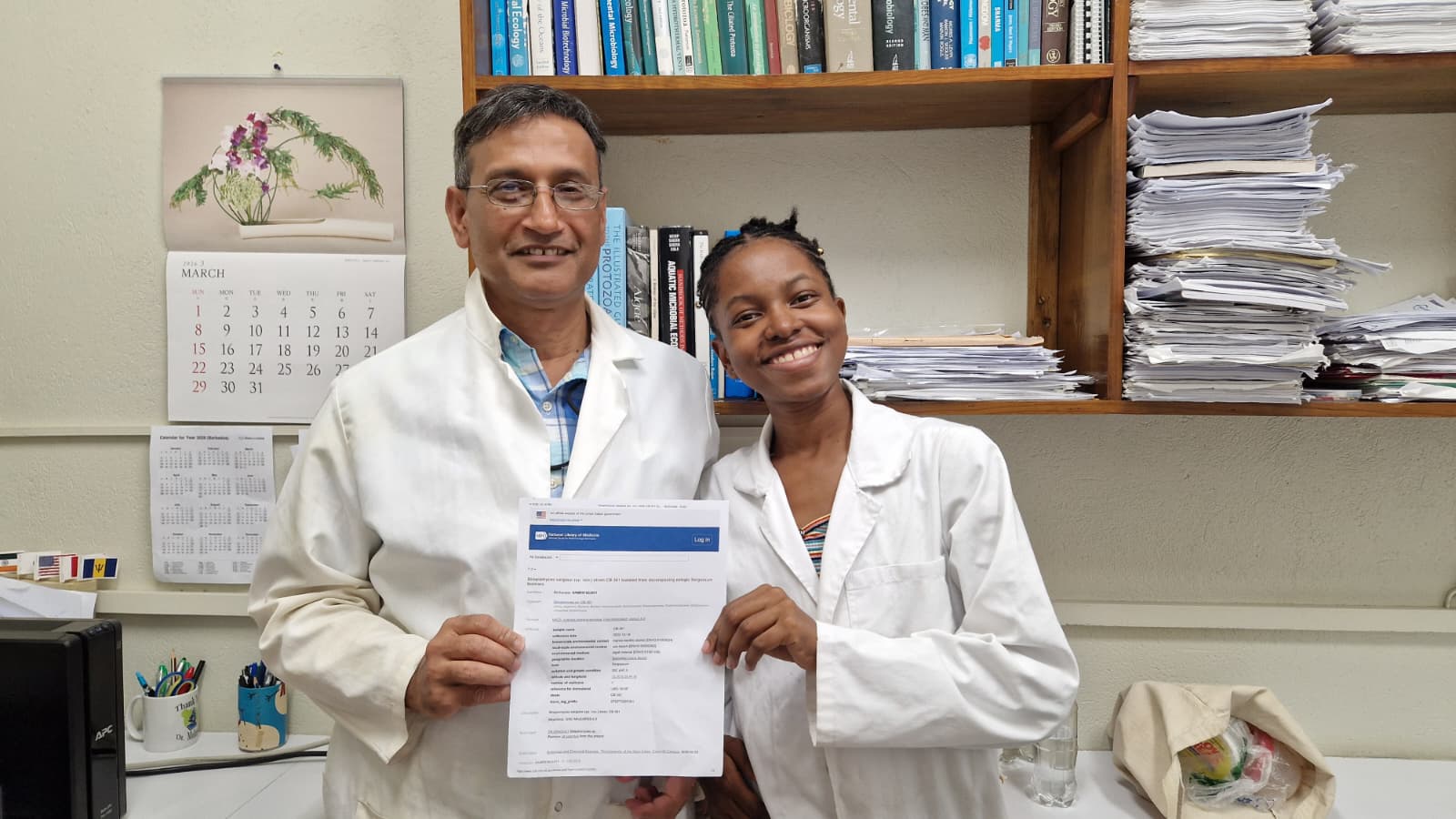
For years, massive accumulations of decomposing sargassum have been treated as a stubborn blight on Barbados’ coastlines, smothering beaches, deterring tourists and creating costly cleanup headaches for local authorities. But a decade-long, self-funded research project by a University of the West Indies Cave Hill scientist has upended that narrative, uncovering a hidden biological treasure that could launch a homegrown Caribbean biotechnology industry.
Dr. Bidyut Mohapatra, the lead researcher behind the work, has officially identified and validated three previously unknown species of microorganisms living within decomposing sargassum collected off Barbadian shores. In a generous gesture that prioritizes national recognition over personal acclaim, Mohapatra chose to name the new species after Barbados, marking the first time any microorganism has carried the island nation’s name. “I could have taken my name, but I prefer to give credit to the country first. That is the important one… we have to give credit to the country,” he explained in an interview.
The groundbreaking findings have already received formal validation from leading global scientific institutions, including the United States’ National Centre for Biotechnology Information (NCBI) and specialized culture collections based in Belgium and Germany, confirming the discovery’s scientific legitimacy. This marks a historic milestone for Barbados’ scientific community, being the first discovery of its kind for the island nation.
Among the three new species, Streptomyces sargassi stands out as the most promising, with far-reaching applications spanning medicine, environmental remediation and sustainable energy. Mohapatra describes the microbe as a natural “cell factory” capable of producing more than 20 entirely new antibiotic compounds, a development that could offer a critical new line of defense against growing global antibiotic resistance. Unlike many specialized microbes, it simultaneously produces both therapeutic antibiotics and valuable industrial enzymes, doubling its practical utility.
Beyond healthcare, the newly discovered bacterium offers solutions to two of the modern era’s most pressing environmental challenges: plastic pollution and renewable energy production. The microbe naturally consumes plastic waste, opening new avenues for low-cost, eco-friendly plastic degradation. It also enables fully sustainable breakdown of excess sargassum, converting the invasive algal mass into usable biofuel and agricultural inputs, turning a costly environmental problem into a valuable resource.
Addressing widespread public concern about the safety of working with newly discovered microbes, Mohapatra emphasized that all three species are naturally occurring, non-pathogenic members of Barbados’ existing soil and coastal ecosystem. “It is not a pathogen. It doesn’t produce toxins or anything like that,” he said. “It is a part of the soil ecosystem. Since the bacteria were isolated from sargassum already on Barbadian shores, they are already a safe, integrated part of the environment.”
The global scientific community has quickly recognized the significance of the discovery. The American Society for Microbiology has selected Mohapatra as one of only six international fellows invited to present his findings at an upcoming conference in Washington D.C. next month, a rare honor that underscores the research’s global impact. The work also answers a direct call to action from 2022 Nobel Prize-winning chemist Professor Morten Meldal, who recently urged Caribbean scientists to pursue sargassum-focused scientific innovation to turn regional ecological challenges into economic opportunities.
Despite receiving widespread outreach from international industrial entities looking to acquire the rights to the discovery, Mohapatra, who funded the entire 10-year research project using his own personal “pocket money,” remains firmly committed to advancing Barbados’ national development. “Many industries are approaching me to go but my main goal is to do something for Barbados. Not to give it to some other countries and they can go ahead and do that,” he said. Working alongside a team of young local scientists including Rachel Sobers and close colleagues, his core goal is to keep the economic benefits of the breakthrough within the Caribbean region.
While Barbados currently faces infrastructure barriers, with “very limited facilities” for large-scale biotech manufacturing, Mohapatra has set an ambitious commercialization timeline, aiming to launch the first commercial applications as early as this August. His long-term vision is to transform Barbados into a leading global research hub for microbial genomics and sargassum-based biotechnological innovation.