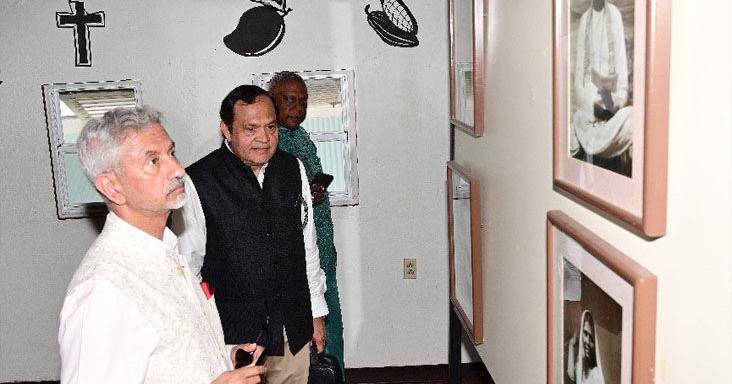
A planned renaming of Trinidad and Tobago’s Nelson Island, announced by Prime Minister Kamla Persad-Bissessar during a joint visit with Indian External Affairs Minister Dr. Subrahmanyam Jaishankar, has drawn broad approval from local historical experts—though many are calling for the new title to honor the site’s full, multifaceted past rather than centering only its connection to Indian indentureship.
Persad-Bissessar framed the change as a long-overdue tribute to the so-called jahaji legacy, marking the entry point for more than 143,000 Indian indentured laborers who arrived at the island between 1845 and 1897, after the abolition of chattel slavery in the British colony. To guide the process, the Prime Minister announced a steering committee led by Natasha Barrow, Permanent Secretary in the Office of the Prime Minister, in partnership with the National Trust of Trinidad and Tobago. A public-facing website will also be launched to open the naming process to community input, allowing residents to submit their own suggestions for the island’s new title.
In her announcement, Persad-Bissessar did not ignore the island’s other layers of history, noting that long before the indentureship era, enslaved Africans were forced to build British military fortifications on the site. In the 1930s, it served as a detention camp for Jewish refugees fleeing rising Nazi persecution in Europe, and it later held prominent Trinidadian labor leaders including Tubal Uriah “Buzz” Butler and George Weekes. Still, the Prime Minister emphasized that the island’s core historical identity is most strongly shaped by the hundreds of thousands of indentured laborers who passed through its quarantine and processing facilities before being dispatched to work on Trinidad’s sugar and cocoa plantations.
Leading local historians have broadly praised the initiative to replace the current name, which derives from 19th-century island owner Dr. Thomas Neilson, a figure historians agree made no lasting meaningful contribution to Trinidadian national life. “There is no problem in setting aside his name,” noted retired history professor Bridget Brereton, one of the nation’s most prominent scholars of colonial Caribbean history. Brereton called the renaming plan “quite appropriate,” arguing that the site’s central role in processing indentured immigrants makes a name honoring that legacy fitting. “Thousands of indentured immigrants from India went to the island to be inspected, examined, and in some cases quarantined before they were sent out to the plantations,” she explained. For her own suggestion, Brereton proposed “Arrival Island,” a simple title that acknowledges the moment that shaped the ancestry of a large share of modern Trinidad and Tobago’s population. She added that while it is impossible for any single name to capture every chapter of the site’s past, a title centered on the arrival of indentured communities is a reasonable and respectful choice.
Other historians, while supportive of the renaming as a whole, have pushed for a more inclusive approach that accounts for the island’s full timeline of use. University lecturer Dr. Jerome Teelucksingh commended the government for moving to preserve and elevate the island’s history, but emphasized that the site’s story stretches back long before the indentureship era, starting with its original occupation by Trinidad’s First Peoples. In addition to the Jewish refugees and colonial-era labor leaders detained there, Teelucksingh noted the island was also used to incarcerate Black Power movement leaders including Khafra Kambon and Makandal Daaga in the 1970s. “Nelson Island isn’t just about indentureship; it goes further than that,” he explained. “I support the name change, but whatever name the committee comes up with has to encompass the broad history that reflects the island.”
History lecturer Dr. Sherry-Ann Singh echoed that call, urging the process to be carried out responsibly to honor all layers of the site’s past. While she acknowledged that the island served its longest and most prominent role during the indentureship era, it functioned for other critical purposes before and after that period. Done correctly, she said, the renaming will become a meaningful commemoration of a core part of Trinidad and Tobago’s shared national history.
Historian Dr. Aakeil Murray also welcomed the government’s move, framing the renaming as an opportunity to reflect the modern identity of Trinidad and Tobago’s diverse population. “It is necessary that a change in name reflects who we are becoming and who we are now as a people,” he said, adding that the new title should account for the island’s diverse history rather than being tied exclusively to the arrival of Indian indentured laborers.