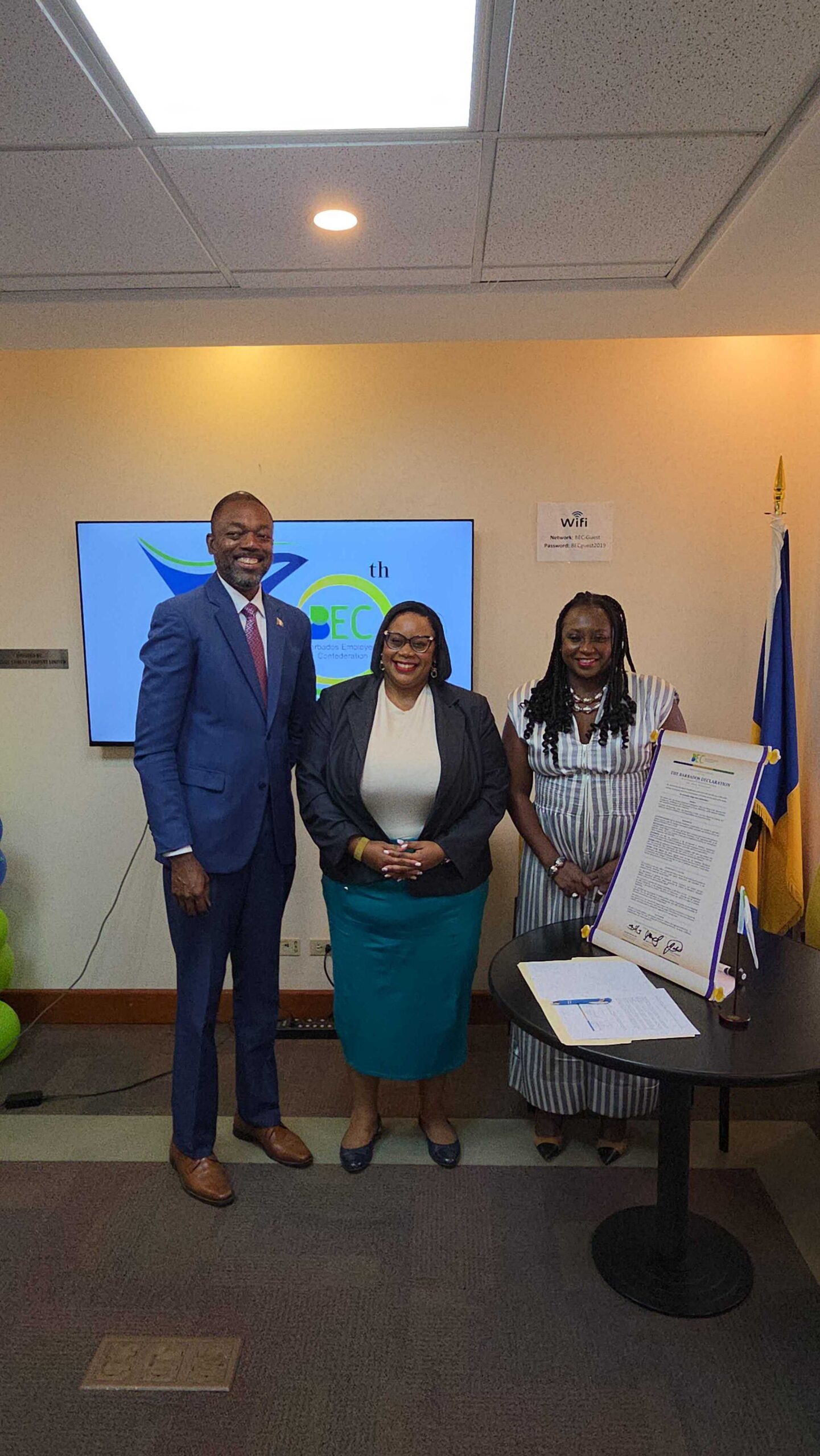
BRIDGETOWN, Barbados – On a landmark Monday gathering marking seven decades of operation, the Barbados Employers’ Confederation (BEC), a cornerstone of the island nation’s industrial relations framework, cemented its forward-looking vision with the signing of the game-changing Barbados Declaration. This formal, multi-stakeholder pledge commits the organisation to advancing collaborative social dialogue and resilient, sustainable economic growth amid the accelerating disruptions of global technological transformation.
Founded in 1956, the BEC has grown from an emerging collective of forward-thinking business leaders into one of the three core pillars of Barbados’ renowned Social Partnership model. Monday’s platinum anniversary event brought together key stakeholders including Barbados’ Minister of Labour Colin Jordan, senior trade union leaders, and top private sector executives, blending a retrospective look at the organisation’s 70-year legacy of shaping industrial relations with the launch of a clear roadmap for the next chapter of Barbados’ economic development.
At the heart of the anniversary celebrations was the official signing of the Barbados Declaration, a document that outlines five binding core commitments spanning employer advocacy, the evolving future of work, and the strengthening of collaborative ties between businesses and their workforces. BEC Executive Director Sheena Mayers-Granville emphasized that the declaration is far more than a symbolic ceremonial gesture, framing it instead as a concrete “statement of intent” to guide the organisation’s work in the decades ahead.
Reflecting on the BEC’s origins, Mayers-Granville recalled that the organisation’s founding visionaries recognised 70 years ago that without a seat at the decision-making table, critical policies shaping Barbados’ economy would be crafted without input from the business community. “Seventy years later, we are still at the table,” Mayers-Granville affirmed. “Dialogue is not a weakness. Sitting across the table from a trade union or a minister of government and seeking a shared solution is not a concession—it is the only pathway to sustainable outcomes.”
Addressing the long-standing tensions that often characterise labour-capital relations, Mayers-Granville offered a unifying perspective: “The interests of workers and the interests of employers are not opposites; they never were. A business that cannot grow cannot create jobs, and a workforce that is not supported cannot sustain growth. These truths are not competing; they are the same truth seen from different angles.”
BEC President Gail-Ann King framed the 70-year milestone not as a simple celebration of longevity, but as a moment to reaffirm the organisation’s central role in upholding national economic and social stability. “Today is not simply a celebration of longevity. It is a moment of reflection, recommitment, and renewal,” King said. “For 70 years, the BEC has advocated for enterprise development, sound industrial relations, and productive dialogue in the national interest. We are particularly proud of our contribution to the social partnership model, which remains one of the defining features of Barbadian democracy.”
Against a backdrop of global shifts toward digital transformation and the transition to climate-resilient economies, King noted that the BEC’s leadership has never been more critical. “The next decade will require adaptability, innovation, and collaboration,” she added. “Employers must continue investing in people while embracing digital transformation and strengthening productivity.”
Minister of Labour Colin Jordan extended official congratulations to the BEC on its platinum anniversary, specifically praising the organisation for bringing much-needed structure and stability to Barbados’ industrial relations ecosystem. Looking back at the labour unrest of 1926 and 1937 that predated the BEC’s founding, Jordan observed that the organisation’s formation catalysed a fundamental shift away from unilateral employer decision-making toward intentional, inclusive engagement with all stakeholders.
Jordan also used the high-profile platform to issue a public call for more Barbadian businesses to join the confederation, noting a clear gap in how BEC member organisations and non-members approach labour dispute resolution. “In my ministry, we recognise a difference between BEC members – those who allow the BEC to be their advocate – and some others,” Jordan said. “We see a difference in the approach to dealing with people. We need organisations like the BEC to bring some order, stability, and confidence.”
As the BEC enters its eighth decade of operation, the Barbados Declaration has been positioned as the official benchmark against which the organisation expects its performance to be measured. Facing growing systemic challenges ranging from the integration of artificial intelligence into the workforce to shifting national demographic trends, the BEC has made clear it will remain an active, solution-focused participant in national policymaking rather than a passive observer.
As Mayers-Granville put it: “70 years is a long time, but it’s not a reason to slow down. The BEC intends to be here for more than 70 years in the future.”
The five core commitments laid out in the Barbados Declaration are: Advocacy to foster an environment where businesses can thrive rather than just survive; active leadership in shaping AI integration, digitalisation, and workforce skills frameworks for the future of work; protection and preservation of Barbados’ homegrown model of mutual respect and collective negotiation in industrial relations; contribution to national sustainability and universal decent work goals; and ongoing commitment to collaborative social dialogue across all sectors.