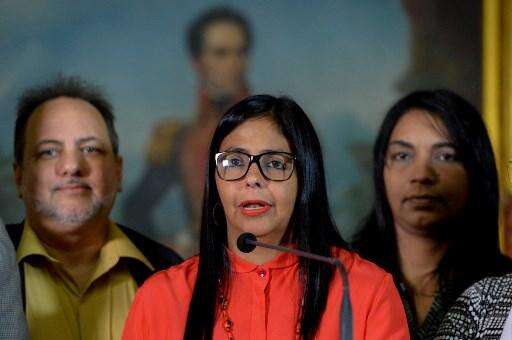
THE HAGUE, Netherlands — In a clear and firm statement to reporters following a International Court of Justice hearing on Monday, Venezuelan Acting President Delcy Rodriguez rejected any suggestion that her nation would consider becoming the 51st U.S. state, an idea recently floated by former U.S. President Donald Trump after the capture of ousted former Venezuelan leader Nicolas Maduro.
Rodriguez emphasized that Venezuelan national identity is rooted in a deep commitment to sovereignty. “That would never have been considered, because if there is one thing we Venezuelan men and women have, it is that we love our independence process, we love our heroes and heroines of independence,” she stated outside the UN’s highest judicial body.
The speculation over Venezuelan statehood traces back to comments Trump has made repeatedly since Maduro’s capture by U.S. forces on January 3. Following the seizure, Trump has openly claimed Washington holds effective control over the oil-rich Caribbean nation, and multiple sources confirmed he told Fox News on Monday he was “seriously” weighing the prospect of admitting Venezuela as an American state. This is not the first time Trump has raised the idea: back in March, he posted on his Truth Social platform, “Good things are happening to Venezuela lately! I wonder what this magic is all about? STATEHOOD, #51, ANYONE?”
Despite the outright rejection of statehood, Rodriguez underscored that her interim administration remains committed to a framework of diplomatic cooperation with the United States. Since Rodriguez took power after Maduro’s ousting, relations between Washington and Caracas have warmed significantly, even as the U.S. has maintained intense pressure on her government to open up Venezuela’s massive untapped fossil fuel reserves to American companies.
Trump has repeatedly publicly praised Rodriguez’s policy shifts, which have included sweeping regulatory reforms that opened Venezuela’s lucrative mining and petroleum sectors to foreign investment, with U.S. firms positioned as the primary beneficiaries. A former vice president under Maduro, Rodriguez has also overseen a high-profile amnesty law that freed hundreds of political prisoners, though human rights groups note that roughly 500 opposition figures remain in detention.
Monday’s hearing at the International Court of Justice marked Rodriguez’s first trip outside the Caribbean region since she assumed the acting presidency. The proceedings center on a centuries-old border dispute with neighboring Guyana over a resource-rich territory that has gained new urgency after major oil reserves were discovered in the area in recent years.
In March of this year, the United States and Venezuela formally re-established full diplomatic relations, a tie that had been severed by Maduro seven years earlier. Even as bilateral relations improve, Venezuela’s fragmented opposition has ramped up calls for free and transparent national elections to resolve the country’s ongoing political transition.