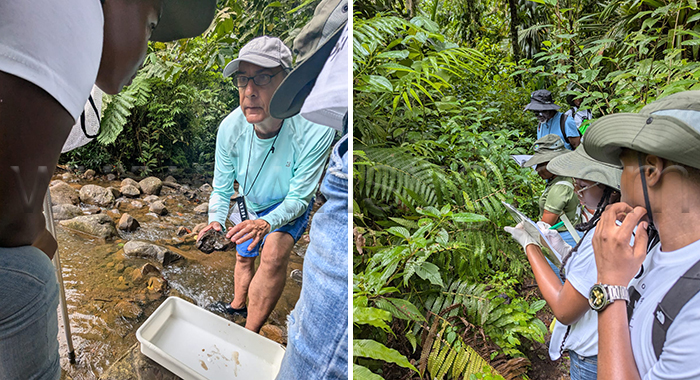
To mark Earth Day 2026, hundreds of volunteer citizen scientists across St. Vincent ventured into the Montreal Watershed to map and document the small island nation’s extraordinary native biodiversity, kicking off the inaugural BioSleuths Challenge – a nationwide conservation initiative organized by the Sustainable Development Unit (SDU) under St. Vincent and the Grenadines’ Ministry of Tourism, Civil Aviation and Sustainable Development, in collaboration with the United Nations Development Programme (UNDP).
The diverse group of participants ranged from local school students and classroom teachers to seasoned technical specialists and members of the general public, all armed with user-friendly smartphone observation tools to identify, photograph, and log a wide spectrum of native species. The survey covered all major taxonomic groups, from native plants and wild birds to terrestrial insects, reptiles, amphibians, and the aquatic life that sustains the Montreal Watershed ecosystem.
Every observation collected during the field activity will be added to St. Vincent and the Grenadines’ official national environmental database, creating a more robust, comprehensive evidence base to guide evidence-based conservation planning and long-term environmental monitoring across the country.
For small island developing states like St. Vincent and the Grenadines, where limited scientific funding and personnel often leave critical gaps in biodiversity data, citizen science programmes such as the BioSleuths Challenge fill a uniquely important role. By mobilizing everyday community members as trained environmental observers, the initiative not only generates large-scale, geographically broad ecological data that would be impossible for a small team of professional scientists to collect, but also boosts public environmental literacy and cultivates a widespread culture of environmental stewardship across the nation. This model turns passive public appreciation for nature into active, hands-on participation in conservation action.
The SDU, which functions as the country’s national focal point for work on climate change, biodiversity protection, chemical and waste management, ocean conservation, and ozone layer protection, coordinated cross-sector collaboration between government agencies and civil society organizations to deliver the event. A team of highly experienced environmental professionals led on-the-ground field guidance and training for all participants: the group included fisheries biologist John Renton, veteran forestry specialist L. Fitzgerald Providence with more than 38 years of on-the-ground conservation experience, plant health expert Sylvester Lynch, and independent environmental consultant Amos Glasgow.
According to an official press release from the organizing team, the expert squad delivered hands-on practical training covering core skills including species identification, standardized ecological observation techniques, and proper data documentation protocols to ensure all collected information meets national and international research standards. Participants also received guided training on how to use leading mobile species identification applications, including Seek by iNaturalist and Merlin Bird ID, to accurately log and verify their observations in the field.
As a signatory party to the United Nations Convention on Biological Diversity, St. Vincent and the Grenadines has binding international obligations to systematically document its native biodiversity, monitor ongoing ecosystem health, and submit regular public reports on national conservation progress. The BioSleuths Challenge directly advances these commitments by expanding the country’s formal biodiversity observation network to include a growing cohort of trained citizen scientists, dramatically extending the reach of national monitoring efforts.
The data collected through this initiative will directly inform updates to the country’s National Biodiversity Strategy and Action Plan, and will also contribute to regional biodiversity assessment efforts across the Caribbean, helping to guide cross-national conservation action in the region.
This BioSleuths Challenge forms one component of the SDU’s expanding portfolio of national environmental programming. Upcoming initiatives include the Environmental Champions Programme, a national community stewardship scheme set to launch on World Environment Day, June 5, 2026, alongside ongoing work on climate transparency, chemical and waste management, and nationwide conservation education.
A second BioSleuths Challenge field expedition is already scheduled for May 22 at the Vermont Nature Trail, to continue expanding the scope of the biodiversity survey. All data collected during the April Earth Day field activity will be fully analyzed and shared with participating citizen scientists at a dedicated follow-up event later this year. Moving forward, the SDU has announced plans to continue expanding citizen science and biodiversity initiatives across St. Vincent and the Grenadines, with the goal of strengthening the national environmental knowledge base and embedding communities as active, equal partners in ongoing conservation work.