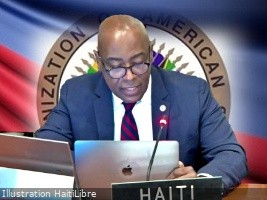
On Wednesday, May 6, 2026, Organization of American States (OAS) Secretary General Albert R. Ramdin delivered a comprehensive progress update to the bloc’s Permanent Council in Washington, D.C., detailing the hemispheric body’s ongoing work to support stability and development in crisis-stricken Haiti. The update outlined measurable advances across five core priority areas: political mediation, electoral system preparation, security sector assistance, international coordination, and expansion of the OAS’s institutional footprint within Haiti.
Ramdin emphasized that all OAS initiatives are centered on the principle of Haitian-led solutions, with a core focus on aligning national and international stakeholders and moving toward structured implementation of the widely endorsed Haiti Roadmap for Stability and Peace.
One of the most critical achievements highlighted by the Secretary General was the OAS’s intervention during the period surrounding February 7, 2026, a window marked by severe institutional uncertainty in the Caribbean nation. Leveraging its formal good offices mandate, behind-the-scenes quiet diplomacy, and coordinated outreach to Haitian authorities, regional bodies, and global partners, the OAS played a key role in preserving executive branch continuity and preventing a far-reaching collapse of state institutions.
On the electoral front, Ramdin noted that the December 2025 adoption of Haiti’s Electoral Decree marked a key turning point, shifting the process from broad planning to concrete, organized preparation. Through its Department of Electoral Cooperation and Observation, the OAS maintains an ongoing technical working group with Haiti’s Provisional Electoral Council, responding to requests for support in critical areas including electoral technology, voter information systems, and institutional capacity building.
In the security domain, the OAS has evolved its support from planning to active operational assistance, Ramdin reported. Current engagement includes backing for the civilian component of Haiti’s Gang Suppression Force (GSF), alongside targeted initiatives to upgrade national police capacities, improve security infrastructure, deliver specialized training, strengthen anti-gang financial investigations, and boost security at Haiti’s key maritime ports and coastal borders.
Ramdin also spotlighted progress on the development of the Haiti Roadmap Dashboard, a transparency and coordination tool designed to provide clearer visibility, full traceability, and greater accountability for all contributions and advances made by the international community. The first phase of the platform, which maps all ongoing OAS-led projects, is already complete, and the second phase will integrate data on bilateral support provided by individual OAS member states. Ramdin called on member state delegations to submit any outstanding contribution data to ensure the platform accurately captures the full scope of collective global support for Haiti.
Haiti’s Permanent Representative to the OAS, Jean Josué Pierre, confirmed that the Secretary General’s report aligned with on-the-ground conditions in his country. He noted that while progress remains modest, Haiti is now seeing tangible signs of hope, with the capital gradually reclaiming space for normal daily life, peace, and improved security after years of widespread gang violence and institutional collapse. Pierre stressed that the immediate priority is to consolidate current gains and scale up international and national efforts. He also announced that Haiti would submit a draft resolution titled “Support for Haitian-Led Stabilization and Strengthening Coordination of Hemispheric Assistance” for debate at the upcoming OAS General Assembly, scheduled to take place in Panama in June 2026.
In additional procedural updates, Ramdin confirmed that ahead of the June 22–24 General Assembly in Panama, the OAS will convene a new meeting of the Group of Friends of Haiti. The gathering will serve to review accumulated progress, align on next steps for implementation, and mobilize additional resources and political backing for the priorities laid out in the Haiti stabilization roadmap.
Closing his presentation, Ramdin noted that the path to long-term stability in Haiti will continue to require consistent determination, coordinated action, and a shared commitment to Haitian sovereignty. “The road ahead will continue to require determination, coordination, and a shared sense of purpose. The OAS stands ready to continue contributing to this effort as a platform for alignment, a facilitator of dialogue, and a partner in implementation,” he said.