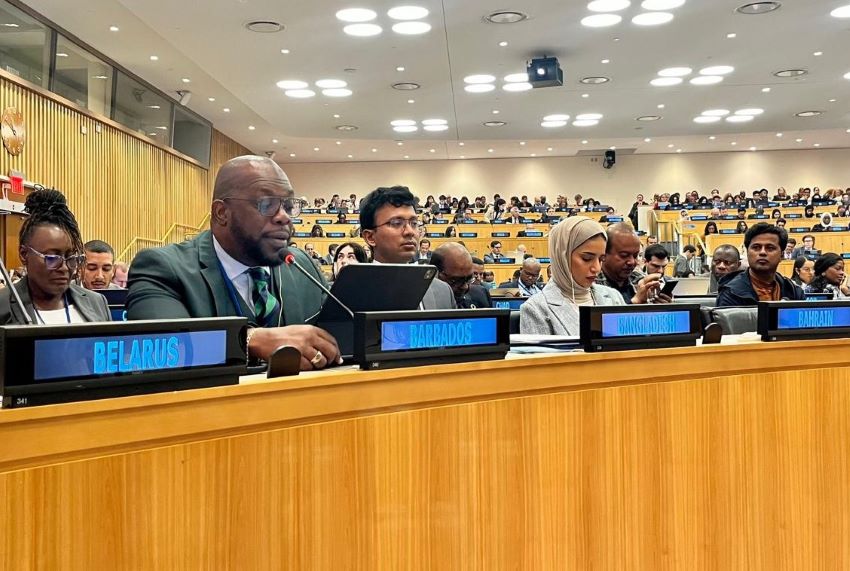
Just days after facing heated parliamentary pushback over its controversial planned immigration overhauls, Barbados’ government has carried its policy argument to the global stage, telling a key United Nations gathering that strategic migration management is non-negotiable for the small island nation’s economic survival amid cascading demographic decline, workforce contraction and accelerating climate change pressures.
Speaking at the Second International Migration Review Forum in New York, Barbados’ Minister of Home Affairs Gregory Nicholls framed migration as a core development strategy rather than a policy challenge for small island developing states (SIDS) grappling with widespread labor gaps, aging populations and climate-driven instability. The quadrennial forum serves as the UN’s flagship global convening, bringing together governments, civil society and private sector stakeholders to evaluate progress on the Global Compact for Safe, Orderly and Regular Migration, share lessons from implementation hurdles, and align on future commitments to improve global migration governance.
“Migration, managed well, is not a burden. It is an engine for creativity, innovation and growth,” Nicholls told assembled delegates in his address.
His comments came on the heels of a fiercely contested debate in Barbados’ House of Assembly over proposed updates to the country’s immigration and citizenship legislation, which the administration has positioned as a critical response to years of population shrinkage, high rates of outward migration among skilled workers, and growing strain on the domestic labor market. During the parliamentary debate, Nicholls emphasized that Barbados’ shrinking and rapidly aging population poses an existential threat to long-term economic growth, the long-term solvency of the national pension system, and the country’s ability to compete in the global tourism and digital services sectors.
Expanding on that framing for the international audience, Nicholls stressed that for SIDS, climate change and migration are inextricably linked policy priorities, not separate issues. “For small island developing states, climate change and migration are not parallel agendas – they are the same agenda,” he said.
Nicholls also used the UN platform to highlight Barbados’ recent progress advancing regional integration through a landmark free movement agreement launched last October with three other Caribbean nations: Belize, Dominica, and St Vincent and the Grenadines. The pact grants citizens of all participating states the right to live and work without time limits across member territories, while guaranteeing equal access to public healthcare and primary and secondary education for migrant workers’ children. “This is not generosity. It is obligation built on political will, regional solidarity and human rights,” Nicholls said of the agreement.
Barbados is also currently developing a comprehensive national migration policy aligned with regional frameworks from the Caribbean Community (CARICOM) and the UN Global Compact for Migration. According to Nicholls, the new policy will streamline legal migration pathways, upgrade border management infrastructure and systems, and align immigration rules with the country’s broader economic growth goals.
This policy direction mirrors key provisions of the Immigration Bill currently under parliamentary consideration, which includes expanded temporary residency categories, more flexible eligibility requirements for permanent residency, and a new points-based merit immigration system designed to attract skilled workers, foreign direct investment, and high-net-worth retirees. The government has repeatedly argued that the reforms are critical to offset decades of demographic decline and boost Barbados’ competitiveness in the global race to attract high-value human capital and business investment.
Nicholls used his address to renew international backing for climate finance reform through the Bridgetown Initiative, a global advocacy push led by Barbados Prime Minister Mia Mottley to restructure global development finance and unlock more affordable funding for climate adaptation and loss and damage in vulnerable developing nations. He warned that climate-related displacement is already placing unprecedented strain on border systems, food security and domestic political stability for small island states, stressing that proactive migration planning is a core part of climate adaptation.
“Migration should be seen as an option, and not a mere act of survival,” he said.
The minister also outlined ongoing efforts to deepen engagement with the large Barbadian diaspora communities in the United Kingdom, Canada and the United States, through initiatives to encourage diaspora investment, skills sharing with domestic workers, and return migration for Barbadians living overseas who wish to resettle in their home country.
Closing his address, Nicholls emphasized that Barbados’ participation in the UN forum was not only to share its national perspective, but to build new global and regional partnerships to advance the shared goal of “safe, orderly and dignified migration” for all.