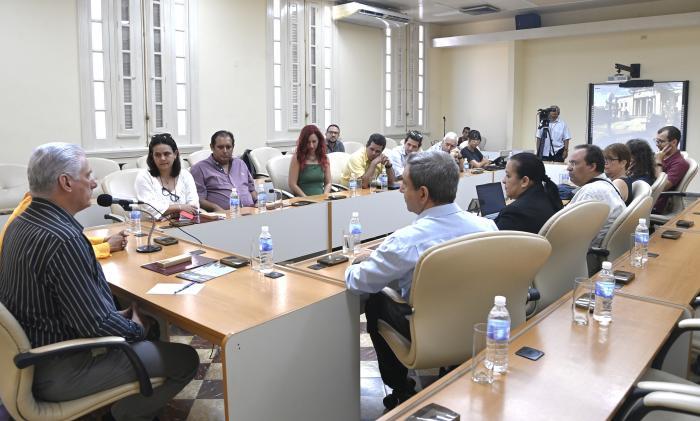
On the morning of Wednesday, May 7, 2026, Miguel Díaz-Canel Bermúdez, First Secretary of the Central Committee of the Communist Party of Cuba and President of the Republic of Cuba, undertook a working visit to the University of Havana, where he held an in-depth meeting with academic researchers leading cutting-edge artificial intelligence development initiatives across the institution. The visit, framed within Cuba’s national Science and Innovation-based Government Management System, underscores the top leadership’s sustained commitment to advancing digital transformation and leveraging AI to address pressing social and economic challenges across the island.
Díaz-Canel was joined on the visit by Walter Baluja García, Minister of Higher Education, Mayra Arevich Marín, Minister of Communications, and Miriam Nicado García, Rector of the University of Havana. During the session, researchers from two leading faculties — Physics, and Mathematics and Computer Science — presented a curated selection of their ongoing AI projects, all tailored to deliver tangible benefits for Cuba’s public and private sectors.
Leading the presentation from the Faculty of Physics was Dr. Milton García Bonato, a senior researcher at the faculty’s Center for Complex Systems. He outlined that his team’s work in AI stretches back more than 30 years, predating the global mainstream boom in artificial intelligence driven by large-scale internet-based language models. One of the team’s most high-impact innovations is an AI model built to analyze human mobility patterns. This tool proved critical during the COVID-19 pandemic, enabling policymakers to accurately assess population movement trends and measure the effectiveness of public health restriction measures. Beyond public health, the model also serves as a core planning resource for urban transportation systems, helping city officials organize transit networks based on commuter origin and destination data.
The Faculty of Physics has also expanded its AI applications into other key national sectors, including telemedicine solutions for the public health system and efficiency-focused tools for the national economy. In a post-meeting interview with reporters, García Bonato emphasized that AI aligns naturally with the faculty’s longstanding research focus on complex systems: “AI is fundamentally about leveraging existing data that captures complex interrelationships to build predictive models that support better decision-making,” he explained. “Our team is fully committed to translating academic breakthroughs into solutions that address the country’s current needs, from more efficient resource management to tangible problem-solving. The nation can count on us — our work is rigorous, peer-validated, and published in top international journals, so this is established, credible science.”
From the Faculty of Mathematics and Computer Science, Dean Dr. Suilan Estévez Velarde presented a broad overview of the faculty’s AI-driven contributions to Cuba’s digital transformation. Her presentation highlighted a diverse portfolio of tools, including platforms for AI-augmented citizen engagement, open science collaboration portals, enterprise project management systems, and logistics and operational optimization frameworks. Special attention was given to work from the faculty’s Cryptography Institute, along with advances in data analytics for decision support, medical image processing for biomedicine, and domestic language model development — headlined by CeciLIA, Cuba’s homegrown large language model.
Like their colleagues in Physics, the mathematics and computer science team made major contributions to COVID-19 response through combined AI and mathematical modeling for outbreak prediction, tools that have since been adapted for forecasting other infectious diseases. The faculty has also developed AI-powered diagnostic support tools for specific conditions including skin diseases, and industry-focused solutions ranging from predictive analytics for the domestic software sector to integration of generative AI and blockchain technology for Cuban enterprises. Estévez Velarde noted that these innovations have the potential to drive widespread modernization across the Cuban economy, boosting operational efficiency, cutting costs, and creating new export-ready products and technologies that strengthen national competitiveness.
Despite these significant advances, Estévez Velarde also highlighted a key ongoing challenge: strengthening collaboration between academic research institutions and domestic industry. She noted that misalignment around project timelines, communication styles, and priorities between academia and the private sector can leave promising research trapped as unpublished theses rather than scaled into real-world solutions, emphasizing the need for targeted training to bridge this gap and translate academic work into tangible national impact.
In her closing assessment of the meeting, University of Havana Rector Miriam Nicado García called the exchange “extremely productive.” She noted that the session gave researchers the opportunity to outline how the university is integrating AI into strategic sectors spanning health, energy, transportation, the broader economy, and public services. Attendees also reached consensus on the key priorities for future growth: continued investment in university infrastructure and faculty development, expanded AI education across all levels of the national education system, and sustained training of new PhDs, masters students, and specialists in AI and related digital fields — all critical to advancing Cuba’s long-term development goals.
Díaz-Canel reaffirmed during the visit that advancing AI and digital transformation is a core strategic priority for the Cuban government, as the nation works to build a more modern, digitally connected society that delivers greater benefits to all citizens.