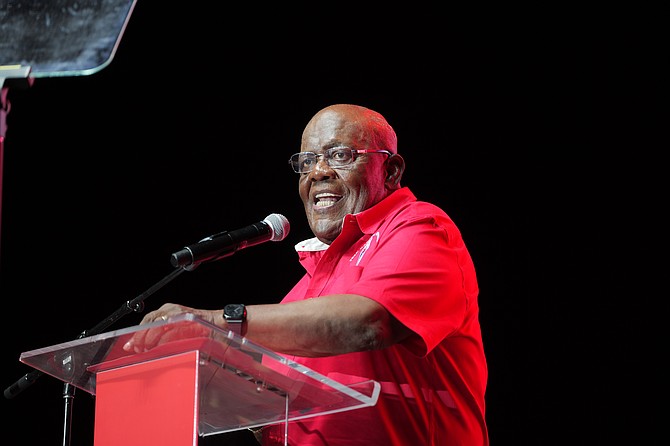
One of the Bahamas’ most iconic political figures, former Prime Minister Hubert Ingraham, has reversed a long-held personal decision to stay out of the upcoming general election’s campaign trail, emerging at a recent Free National Movement (FNM) rally to publicly oppose incumbent Prime Minister Philip Davis’ bid for a second term. His change of heart stems from deep concerns over the future trajectory of the ruling Progressive Liberal Party (PLP) and the potential ascent of PLP Fort Charlotte candidate Sebas Bastian to the nation’s highest office.
In his remarks to energized FNM supporters on Wednesday night, Ingraham acknowledged that he had no initial plans to campaign against Davis, noting a personal friendship with the incumbent that transcends partisan divides. “Brave is my friend. We are on different teams, so we never vote for each other,” Ingraham explained, emphasizing that his original plan was to remain on the sidelines during Davis’ re-election race. That neutral stance shifted entirely when he considered what a second Davis administration could mean for Bastian’s political career, he added.
Ingraham warned voters that a win for Bastian in the hotly contested Fort Charlotte constituency would put the PLP candidate on a clear path to the prime minister’s office. To block that outcome, he urged local voters to throw their support behind FNM candidate Travis Robinson in the key race. “If you want to make sure Sebas doesn’t become your prime minister, stop him in Fort Charlotte,” Ingraham argued.
The former prime minister also hit Bastian over his partisan political history, pointing out that Bastian was once a member of the FNM before defecting to the PLP. He told Fort Charlotte voters that any candidate claiming ongoing ties to the FNM should be rejected at the polls, going on to question Davis’ decision to nominate Bastian in the first place. Ingraham claimed Bastian’s political rise was due to patronage from former PLP Prime Minister Perry Christie, whom Bastian has referred to as a father figure. “Perry went against the will of the people in the Bahamas and made Sebas the man he is today,” Ingraham claimed.
Drawing on a historic electoral example from the 1997 Fort Charlotte race, Ingraham pushed back against the idea that personal wealth should translate to electoral success. He recalled that FNM candidate Zhivargo Laing entered that race with just $14,000 in net worth, facing off against a millionaire opponent who reported $14 million in assets. Despite the massive financial gap, Ingraham noted, Fort Charlotte voters elected Laing and sent the wealthy challenger home, a precedent he argued should hold in 2024.
Beyond the partisan race for Fort Charlotte, Ingraham used his speech to highlight broader flaws he sees in the Bahamas’ current electoral system. He described last week’s advanced polling as “chaotic”, repeating his longstanding call for elections to be taken out of government hands and overseen by an independent, adequately funded electoral commission — a model already adopted by many other nations across the Caribbean region.
Ingraham acknowledged that some of the blame for disorganized advanced polling stemmed from poor appointment of election officials, but he framed the issue as a systemic problem of democratic governance rather than just an isolated mistake. He noted that public trust in election outcomes depends on a neutral, transparent process that all parties can believe in, a prerequisite for losers to accept results after ballots are counted. Even with his criticism of the advanced poll, Ingraham said he was heartened to see voters waiting patiently in disorganized lines to cast their ballots, calling the turnout a powerful display of democratic commitment in the Bahamas. He urged all FNM supporters to turn out on official election day, May 12, and remain in line to vote no matter how long the wait.
Ingraham also called for sweeping modernization of the country’s voting infrastructure, saying he hoped the 2024 election would be the last time Bahamian voters are required to carry paper voter cards. He noted that even many developing countries — including fellow Caribbean nation Haiti — have already transitioned to more secure biometric voting identification, and that the Bahamas’ reliance on paper cards puts it far behind global standards. Ingraham recalled that his own administration first attempted to pass electoral reform and introduce biometric identification more than 23 years ago, with bipartisan support from the PLP at the time. The reform failed only after his government opted to put the question to a public referendum, where voters rejected the change.
The former prime minister added that he also hopes the Bahamas will eventually eliminate the outdated practice of marking voters’ fingers with ink after they cast ballots. On the topic of ballot security, he instructed FNM poll workers to closely monitor presiding officers at every polling location to ensure only one ballot is issued to each registered voter. He closed by reiterating his criticism of electoral mismanagement, pointing to alleged irregularities at an advanced polling site that included improper ballot counting and unauthorized movement of ballot boxes without notification of all participating political parties.