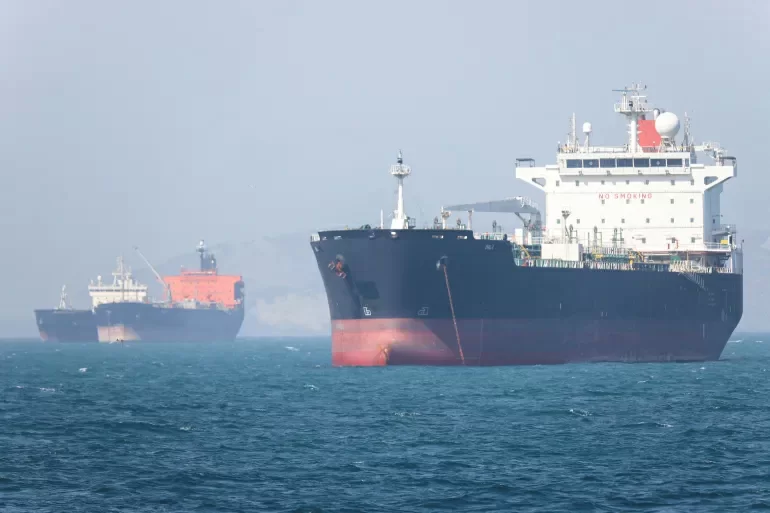
The Strait of Hormuz, the narrow waterway that carries roughly one-quarter of the world’s seaborne oil trade and massive volumes of liquefied natural gas (LNG) and fertilizer, has once again become the epicenter of a sharpening standoff between Iran and the United States, with regional security and global energy markets hanging in the balance. In the latest escalation, Iran’s Islamic Revolutionary Guard Corps (IRGC) released a new maritime map on Monday, May 4, 2026, marking out an expanded claimed control zone that extends far beyond the Strait of Hormuz and covers large sections of the United Arab Emirates (UAE) coastline.
The map draws two key boundary lines: the western line stretches from Iran’s westernmost point on Qeshm Island to the UAE emirate of Umm al Quwain, while the eastern line connects Iran’s Mount Mobarak to the UAE’s Fujairah emirate, laying formal claim to navigation authority over the entire enclosed maritime area. This provocative move comes directly on the heels of a new U.S. initiative led by President Donald Trump, dubbed “Project Freedom,” which has deployed U.S. Navy escorts to help stranded tankers transit the strait— a waterway that has remained effectively closed since the U.S.-Israel war against Iran began on February 28.
Hours after the map’s release, the UAE announced it had suffered a wave of drone and rocket attacks, with one strike igniting a major fire at a critical energy facility in Fujairah. The assault marked the first such attack on a Gulf Arab state since the fragile ceasefire between the U.S. and Iran went into effect on April 8. While the UAE swiftly blamed Iran for the strikes, Tehran initially withheld official confirmation before implicitly accepting responsibility on Tuesday, while shifting blame back to the U.S. for its aggressive military actions in the region.
In a show of defiance, Iranian Parliament Speaker Mohammad Bagher Ghalibaf wrote on social media Tuesday that “the continuation of the current situation is unbearable for the United States, and we have not even started yet.” But behind this public display of confidence, analysts warn that Iran is increasingly leaning on its control over the Strait of Hormuz as its core bargaining chip in the ongoing conflict, which remains formally paused only by the shaky ceasefire—and Iran cannot afford to give up this leverage.
Experts describe Iran’s control over the strait as a “strategic equalizer” that allows the country to offset U.S. military superiority. Iran cannot match the U.S. Navy and Air Force in a symmetric confrontation, but it leverages the strait’s unique geography: the narrow, heavily trafficked, economically critical waterway allows Iran to impose massive global costs without waging all-out war. Even without a full closure, tactics including mine-laying, drone and rocket strikes, fast patrol boat harassment, and electronic disruption are enough to make transit too risky for commercial shippers.
Since the conflict began, tanker traffic through the strait has plummeted from an average of 129 transits per day in February to a near-complete standstill, sending ripples through global energy markets, supply chains, and shipping industries. “Iran doesn’t need to defeat the U.S. Navy to reshape the economic consequences of this conflict,” explained Mohammad Reza Farzanegan, a professor of Middle Eastern economics at Marburg University. “It only needs to make clear to insurers, shipowners, and energy traders that military pressure on Iran comes with costs for the entire global market. That uncertainty alone is enough to push up oil and LNG prices, raise transportation costs, and transmit the conflict to global inflation, food security, and financial markets.”
Over the course of the conflict, Iran has demonstrated it possesses an advanced arsenal of attack drones, anti-ship missile-equipped fast attack craft, coastal rocket launchers, and precision-guided weapons, many deployable from underground coastal facilities, giving it ample capability to threaten commercial shipping through the waterway.
Yet Iran also pays a steep price for its use of this leverage. Since April 13, the U.S. has enforced a full maritime blockade of all Iranian ports and shipping, cutting off Iran’s oil exports, blocking imports of essential goods, and halting inflows of foreign currency. The blockade has sent domestic prices soaring, eliminated or put on hold millions of Iranian jobs, and been compounded by a near-total internet blackout across Tehran.
“Hormuz is probably Iran’s most important leverage point right now, even though it is a dangerous weapon,” Farzanegan noted. “It gives Iran negotiating power because full use of it would harm everyone.”
The fragile April ceasefire has already come under severe new strain following the Fujairah attack. The Fujairah refinery exports more than 1.7 million barrels of crude oil and refined fuels daily, equal to roughly 1.7% of total global daily demand. The strike came just after U.S. officials announced that two U.S. commercial vessels, escorted by U.S. guided-missile destroyers, had successfully transited the strait. Shipping giant Maersk confirmed that the U.S.-flagged Alliance Fairfax exited the Persian Gulf with U.S. military escort, but Iran has denied it allowed any vessels to pass through the waterway. The U.S. military also reported it destroyed six small Iranian patrol boats, a claim Iran denies; Tehran says U.S. strikes killed five Iranian civilians in the confrontation.
Muhanad Seloom, an instructor of international politics and security at the Doha Institute for Graduate Studies, argues that the attack on Fujairah reveals a deliberate Iranian strategy: Iran does not need to target U.S. commercial vessels directly in the Strait of Hormuz to keep economic pressure high on global markets—it can instead strike Gulf Arab states to send a warning. “Iran is trying to warn Gulf states that if they allow the U.S. to use their territory to attack Iran, Iran will destroy their infrastructure and trigger an economic collapse,” Seloom explained.
The warning is directed at the six member states of the Gulf Cooperation Council (GCC): Saudi Arabia, the UAE, Qatar, Kuwait, Oman, and Bahrain. Of these, the UAE has drawn particular Iranian ire: Abu Dhabi has deepened its strategic partnership with Israel, a U.S. ally in the war against Iran, since normalizing ties through the 2020 Abraham Accords. Just last month, the UAE also withdrew from OPEC and OPEC+, the production-cutting bloc led de facto by Saudi Arabia, shifting the regional energy and political dynamic.
Since the start of the conflict, Iran has launched at least 6,413 rockets and drone strikes targeting seven Arab states in the region, with the majority hitting the UAE. Seloom says Iran is deliberately capitalizing on this shifting regional landscape, leaving a critical open question for regional stability: “The big question now is what this means for GCC countries and how long they will maintain their strategic patience. At some point, they could begin to see this as an existential threat.”