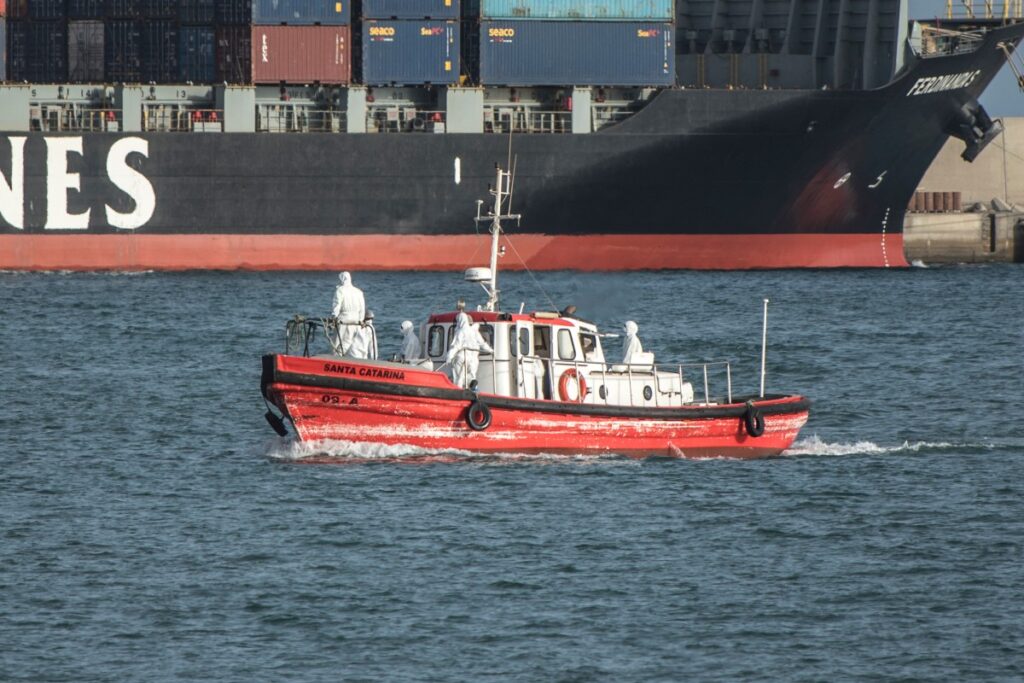
Off the coast of Cape Verde’s capital Praia, a major international public health emergency involving the expedition cruise ship MV Hondius has moved toward a partial resolution this week, after days of stalled negotiations to evacuate severely ill people onboard. Three people have already died from suspected hantavirus infection, a rare zoonotic disease most commonly transmitted to humans via exposure to infected rodents’ urine, feces, or saliva.
On Tuesday, the vessel’s Dutch operator Oceanwide Expeditions announced a coordinated plan to evacuate two gravely ill crew members and a close contact of one of the deceased passengers to the Netherlands for urgent medical treatment. Once this evacuation is complete, the ship will be allowed to continue its journey north, with plans to dock in one of Spain’s Canary Islands—either Gran Canaria or Tenerife—after a three-day voyage, according to the operator. Discussions with Spanish health authorities are still ongoing to finalize arrival arrangements, after Spanish officials previously requested full health data from the vessel before approving docking.
The World Health Organization (WHO) confirmed the evacuation plan is moving forward. Ann Lindstrand, WHO’s representative in Cape Verde, told reporters that the operation is logistically complicated: an ambulance will transport the three evacuees from Praia’s port to the local airport, where a dedicated evacuation plane will wait to carry them to Europe. She added that the ship is expected to depart Cape Verdean waters in the middle of the night once the evacuation is completed.
The outbreak first raised alarms on Saturday, when global health officials were notified of three deaths linked to suspected hantavirus among the ship’s company. MV Hondius departed Ushuaia, Argentina on April 1 on an expedition voyage bound for Cape Verde, carrying 88 passengers and 59 crew members representing 23 nationalities. Cape Verdean authorities refused the ship permission to dock after the outbreak was declared, forcing all remaining passengers and crew into isolation off the coast while global health teams scrambled to coordinate a response.
To date, WHO has confirmed two cases of hantavirus infection – one a fatality, and a second a British passenger currently in intensive care in Johannesburg, South Africa. Five additional cases are still under investigation, bringing the total suspected and confirmed cases to seven. Along with the three deaths, one patient is in critical condition in Johannesburg, three people remaining onboard have experienced mild symptoms, and one of those three has already recovered and become asymptomatic.
The timeline of the outbreak has left epidemiologists working to trace the origin of the infection. The first person to develop symptoms fell ill on April 6, just five days after the ship departed Argentina. The first two deaths were a Dutch couple: the husband died on April 11, and his wife accompanied his body off the ship at Saint Helena, a remote Atlantic island, before flying to Johannesburg, where she died on April 27 after developing gastrointestinal symptoms. A third German passenger died on Saturday.
Contact tracing is already underway for the 82 passengers and six crew members on the Airlink flight that carried the deceased Dutch woman to Johannesburg. A representative for the airline confirmed South African health authorities have requested all flight contacts reach out to public health officials for monitoring.
Maria Van Kerkhove, WHO’s director of epidemic and pandemic preparedness and prevention, told reporters Tuesday that investigators are still working to confirm the exact strain of hantavirus involved, though the working hypothesis is that it is the Andes virus – the only hantavirus strain previously documented to spread between humans. Van Kerkhove added that there are no rats onboard the MV Hondius, eliminating a potential onboard reservoir for the virus, and the WHO currently believes the original infections likely occurred off the ship. The Dutch couple had traveled through South America before boarding, and the ship’s expedition itinerary includes frequent shore stops on Atlantic islands for birdwatching and other outdoor activities, meaning infection could have occurred during a shore visit. Investigators also believe limited human-to-human transmission may have occurred between close contacts onboard.
At this stage, WHO has emphasized that the current risk of widespread transmission to the global population remains low. South African researchers are currently conducting genetic sequencing on virus samples to confirm the strain and help guide the ongoing public health response.