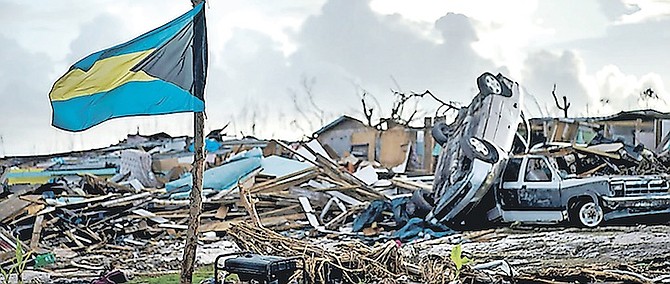
Six years after Hurricane Dorian devastated large swathes of Abaco, leaving thousands of residents homeless and economically shattered, anger is boiling over over the Davis administration’s last-minute pre-general election decision to erase all outstanding electricity bills for residents of Grand Cay and Moore’s Island – while leaving similarly devastated mainland Abaco communities without any comparable relief.
Survivors across hard-hit mainland settlements including Marsh Harbour, Dundas Town, Spring City and Murphy Town have decried the selective relief as a transparent, insulting political gambit that ignores the ongoing suffering of thousands of Dorian survivors who have yet to recover from the 2019 storm.
Neulessa Major, a lifelong Marsh Harbour resident whose home suffered catastrophic damage during Dorian, described the unequal treatment as a slap in the face to all mainland Abaco residents still picking up the pieces. Her $55,000 home roof was completely destroyed, all her personal belongings were ruined by storm surge and wind, and she was unable to move back into her repaired property until 2022. Today, she says massive outstanding utility bills burden most families and business owners across central Abaco – none of whom were offered the debt forgiveness extended to the two smaller island communities.
“When I learned that only certain groups were getting their entire balances wiped clean, I was shocked,” Major said in an interview. “All of central Abaco was hit just as hard, with these enormous bills that people can’t possibly pay. Six years on, we still have people living in tents and temporary dome shelters. A lot of homes look finished from the street, but step inside and there aren’t even floor tiles. The government acts like everything is fine for us here, but it’s not.”
The controversial debt cancellation came two weeks ahead of the national general election, after Prime Minister Philip “Brave” Davis visited Grand Cay and publicly promised the relief to voters there. Government officials defended the move, framing it as a resolution to long-running billing disruptions triggered first by Hurricane Dorian and later by the COVID-19 pandemic. Officials noted that Grand Cay and Moore’s Island residents faced unique hardships including limited banking access, extended travel and business restrictions, and that accumulated debt accrued through circumstances outside consumers’ control. The government confirmed the outstanding balances would be covered through an offsetting agreement with Bahamas Power and Light.
But that explanation has done little to ease the anger among mainland Abaco residents, who point out they weathered the same storm and the same subsequent economic crisis, with many still struggling to rebuild. Major emphasized that many Marsh Harbour residents did not wait for government aid to begin rebuilding their homes and businesses, only to be saddled with crippling utility debt that the government has refused to address.
She also called out the ruling Progressive Liberal Party (PLP) for a separate recently revealed government-funded gift card program that saw small $300 gift certificates distributed to Abaco residents just ahead of the vote – a move she dismissed as insufficient and politically motivated. The Tribune previously confirmed that more than $200,000 in public funds was used for the gift certificates, which bear the signatures of PLP officials despite being a government initiative.
“A $300 gift certificate six years after we lost everything? What is that even supposed to cover?” Major asked. “A lot of people might celebrate a small handout right before an election, but that doesn’t fix what’s broken here. I was even offered $500 in cash at my door by campaign workers – I refused it. I don’t want a personal payout. I want the government to actually do something for our community.”
Lorane Burrows, a Dundas Town resident whose home was damaged in Dorian, shared Major’s fury, noting she was forced to pay outstanding water and sewerage bills even after her storm damage left her facing major financial strain. “They need to get out,” Burrows said. “This was a slap in the face to all of us. They’ve done nothing for Abaco, nothing for people like me who are still hurting. They failed us entirely.” Burrows confirmed she and all eight voting members of her household will not support the PLP in the upcoming election.
Rochelle Lightbourn, a 55-year-old Spring City resident who lost all her belongings when her rented home was destroyed in Dorian, argued the selective relief is a clear political calculation. “I think they’re doing this because they know they’re going to lose these districts, and they’re trying to buy back support,” she said. “It’s not going to work. I still haven’t even replaced everything I lost six years ago.”
Lottie Williams, a 64-year-old Spring City resident who lost the entire back section of her home in the storm and had to be rescued by emergency crews, said relief should have been extended to every Abaco resident impacted by Dorian. “Ninety-five percent of the homes in Spring City were destroyed,” she noted. “I understand those outer cays have challenges, but we fought for our lives here, we came home and rebuilt on our own, and we got zero help from this government. High electricity bills affect all of us. It’s just not fair to only write off bills for two small communities when we’re all struggling. That money should have been spread out to everyone who needed it.”
Many residents also recalled the slow, burdensome process of restoring power after the storm, noting that even long-term local residents were forced to produce extensive documentation just to reconnect service, despite the small community where most homeowners and occupants were already well-known to utility officials. For many, the compounding stress of Dorian’s destruction followed by the economic collapse of the COVID-19 pandemic left them unable to keep up with accumulated utility costs – a hardship the government has only chosen to address for a select few, weeks before voters head to the polls.