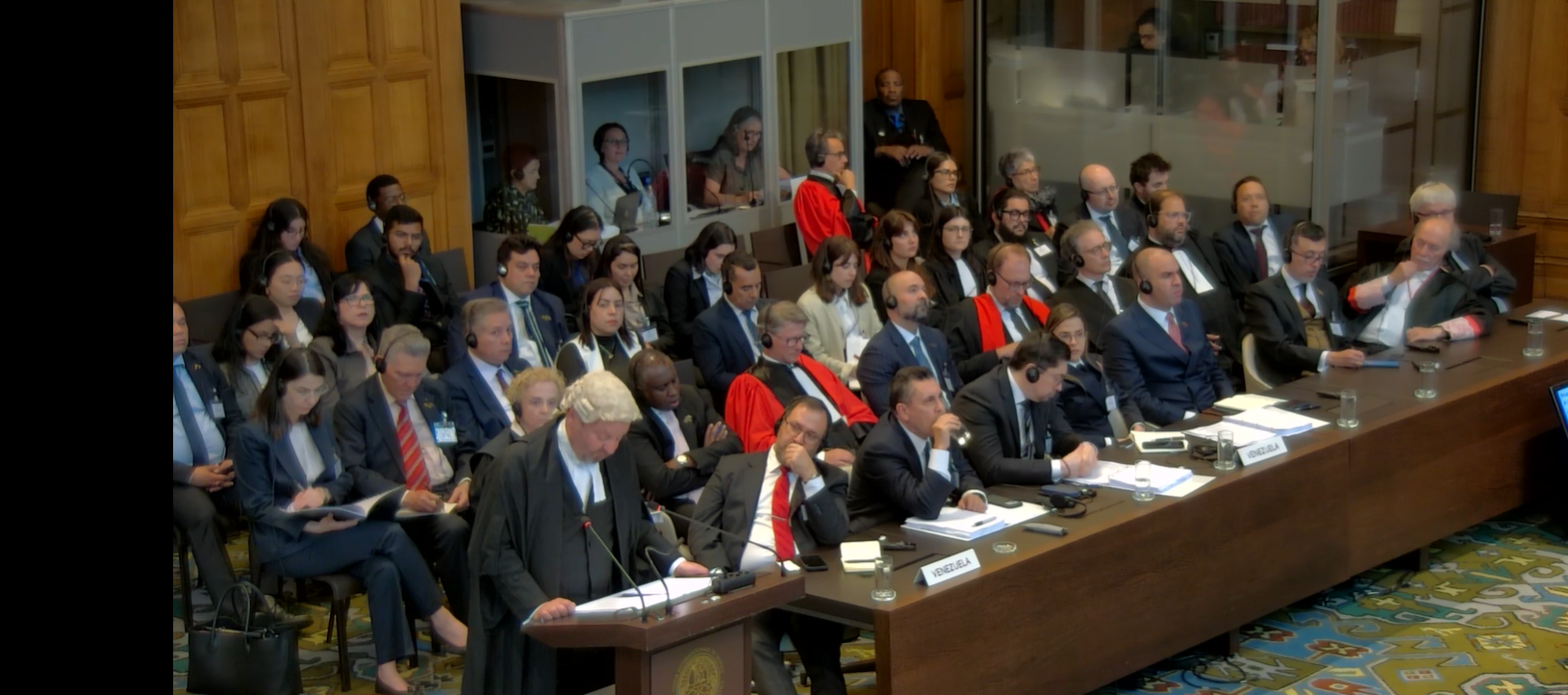
On Monday, at landmark merit hearings held at the International Court of Justice (ICJ) over the decades-long Essequibo Region territorial dispute, legal representatives for Guyana delivered a sweeping rebuttal of Venezuela’s core foundational claim, dismantling a decades-old document that has underpinned Caracas’ territorial assertion for more than half a century. The long-simmering dispute centers on the 1899 Arbitration Tribunal boundary award, which granted Guyana sovereignty over the 159,000-square-kilometer Essequibo Region rich in oil and mineral resources. Venezuela has contested the award’s validity since 1962, relying on a posthumously released memorandum written by Severo Mallet-Prevost, former secretary to the 1899 tribunal. The document alleges the final award was the product of backroom collusion between the United Kingdom and Imperial Russia, engineered through pressure from tribunal president Friedrich Martens.
Appearing before the ICJ in The Hague, prominent international law professor Philippe Sands, lead counsel for Guyana, dismissed the Mallet-Prevost memorandum as a baseless, unsubstantiated compilation of unreliable anecdotes. The memo was privately circulated after Mallet-Prevost’s death in 1948, and transferred to the Venezuelan government by American jurist Otto Schoenrich in 1949, laying the groundwork for Caracas to revive its territorial claim. Sands told the full bench of the ICJ that for more than 60 years, Venezuela has weaponized the memorandum to create unsubstantiated controversy, rather than illuminate the factual record of the 1899 award.
Sands characterized the core allegation of a secret Anglo-Russian power-sharing deal as outlandish, noting the document’s overwhelming reliance on speculation and total lack of verifiable fact. Long on fantasy and short on empirical evidence, the memorandum lay dormant for 13 years after it was first published, he added. No credible independent evidence exists to confirm the off-the-record conversations Mallet-Prevost described, and nothing in the document supports Venezuela’s claim that the 1899 award is legally void, Sands argued. Describing the memorandum as a “giant red herring,” he told the court that the document does nothing to validate Venezuela’s challenge to the 1899 award, and instead only confirms that the entire challenge is rooted in fiction rather than fact.
Sands also questioned the document’s provenance, noting it was published nearly half a century after the conversations it claims to document, and that Mallet-Prevost was a known, publicly recognized advocate for Venezuela’s territorial claims. “Venezuela has opened a world of theater and fiction, not law, not fact,” Sands told the court. “This is the stuff of a novel. It is not the stuff of a pleading before this court.” Photographs from the hearing showed Venezuela’s delegation, led by Foreign Minister Yvan Gil, listening to Sands’ rebuttal without interruption.
In addition to dismantling Venezuela’s core evidentiary claim, Guyana’s legal team has also asked the ICJ to impose formal consequences on Venezuela for violating two earlier provisional measures orders issued by the court. In December 2023, Venezuela held a national referendum that approved constitutional amendments to formally claim Essequibo as Venezuelan territory, established new administrative districts for the region, moved to register local residents to vote in Venezuelan national elections, and designated the area a national defense zone. All of these actions directly violated the ICJ’s prior orders requiring Venezuela to refrain from altering the status quo of the disputed region, Guyana argues.
Edward Craven, another member of Guyana’s legal team, told the court that Venezuela’s actions represented a clear, intentional violation of the ICJ’s binding provisional measures. Craven requested that the ICJ issue a formal declaration that Venezuela violated the court’s orders, and compel Caracas to revoke all domestic laws, executive decrees and administrative actions that purport to incorporate Essequibo into Venezuelan territory, and extend Venezuelan legislative, executive and judicial jurisdiction over the region. Guyana is also demanding that Venezuela withdraw and destroy all official maps that incorrectly depict Essequibo as part of Venezuelan territory. “These measures are requested because Venezuela is under the obligation, by way of reparation for its breaches of the provisional measures, to re-establish the situation which would in all probability have existed if those breaches had not been committed,” Craven told the court.
Venezuela is scheduled to present its oral arguments on the merits of the territorial dispute before the ICJ on Wednesday. The hearing marks a key milestone in a dispute that has raised regional tensions over the past two years, following the discovery of massive new oil reserves in the Essequibo offshore shelf that have turned Guyana into one of the world’s fastest-growing oil producers.