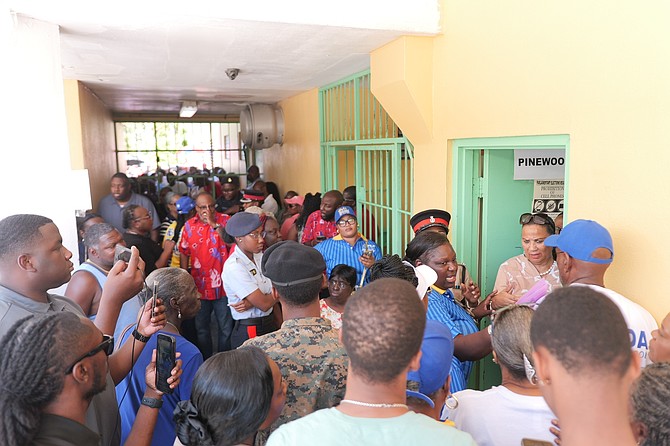
Long queues, multi-hour wait times, and widespread confusion during the Bahamas’ recent advance poll have thrown the Parliamentary Registration Department (PRD)’s preparedness into sharp question, stoking growing fears that the far larger and more complex general Election Day could face similar catastrophic dysfunction.
The final ballot of the day was not cast until 10 p.m. – a full four hours after the official scheduled closing time of 6 p.m., marking a dramatic breakdown of the electoral process that unfolded against a backdrop of weeks of criticism from the opposition Free National Movement (FNM). Prior to the advance poll, the ruling government had repeatedly dismissed opposition concerns, defending the PRD’s ability to manage the election. This week’s voting, however, laid bare severe operational strain across polling stations nationwide: some electors waited more than five hours to cast their ballots, while countless others abandoned the process in frustration, and multiple locations kept voting open far past the official close to clear massive backlogs. Even some candidates from the ruling Progressive Liberal Party (PLP) were forced to acknowledge major shortcomings in the advance poll’s organization.
Prime Minister Philip “Brave” Davis was visibly agitated during a visit to the Sadie Curtis polling location and declined to answer questions from press corps. Former PLP Cabinet minister and MP Leslie Miller, who accompanied Davis, told reporters he waited two and a half hours to vote at the Doris Johnson site, and called for a doubling of available polling space ahead of the general election. “It took me two and a half hours to vote today, okay, tremendous,” Miller said. Several other high-ranking PLP figures including Sebas Bastian, McKell Bonaby, Myles Laroda and Mario Bowleg echoed Miller’s call, noting that more space was urgently needed to reduce crowding, particularly for elderly and disabled voters. Bastian added that the problematic advance poll experience would guide necessary adjustments before Election Day.
Operational issues were apparent from the moment polls opened at many locations. At Kendal Isaacs Gym, a site serving three major constituencies, delays began immediately when the exit door remained locked at opening, creating a massive bottleneck that sent lines swelling out into surrounding areas. Voter Tavia McIntosh said the check-in process inside the station functioned smoothly, but described the outdoor crowding as totally disorganized. “You see the crowd? It is unorganised,” she said. “I hope it [the general election] doesn’t be like this.” Commissioner of Police Shanta Knowles ultimately traveled to the site to intervene and restore order.
At Thelma Gibson Primary School, voters reported widespread confusion over directional guidance, with many being sent to multiple wrong locations before finding their correct polling station. Seventy-six-year-old voter Cynthia Sealy told reporters she was redirected twice before reaching the correct spot. Other common complaints across sites focused on a lack of basic amenities for waiting voters, with many electors forced to stand for hours in direct sun without adequate shelter. At the CV Bethel polling location, FNM chairman Dr Duane Sands highlighted extreme overcrowding, noting that one advance polling room had been assigned to nearly 1,200 registered voters. “Perhaps one of the worst situations of the day is Bamboo Town has 1,200 people on the advanced poll, and one room,” Sands said. “One. One. One. So people have been waiting four, five, six hours. Okay?”
Tensions boiled over at the HO Nash polling site after multiple people were permitted to cut in line, sparking loud protests from waiting voters who decried the process as unfair. Multiple elderly voters suffered medical distress amid the heat and long waits, with at least one voter fainting. A 75-year-old elector abandoned the line after just 45 minutes, saying he could not physically tolerate the conditions, and noted he had never seen such dysfunction in decades of voting. “This ain’t the first election these people been through,” he said. “They been through many and I ain’t never seen it like this.” Another voter, Michelle Dames of Mount Moriah, also left without casting a ballot, calling for systemic changes to better accommodate vulnerable groups. “Somebody just fell out over there from standing so long,” she said. “Even though some persons are trying to provide chairs, that ain’t cutting it.”
Beyond basic operational management, FNM legal advisor Khalil Parker raised more serious procedural concerns. He pointed to reports of pre-signed ballots and completed counterfoils found before voters arrived at stations, the lack of a properly segregated voter list for advance poll participants, and a last-minute decision to allow electors with approved applications to vote even if their names did not yet appear on the official register. “So now, we have to deal with the fact that there’s going to need to be a reconciliation between those who voted, but were not on the register, and those who voted and were on the register to make sure that when we begin on election day, there is a mitigation or a correction or an updating of the official records at PRD, so that duplicating voters isn’t a substantive concern in that event,” Parker explained. He added that the FNM would demand an urgent meeting with PRD leadership to resolve all outstanding issues before the general election.
Despite widespread cross-party criticism, the PRD has maintained it remains fully prepared for the upcoming general election, noting that Election Day will feature more polling stations, additional staffing, and expanded logistical support compared to the advance poll. The department acknowledged the delays and confusion, attributing the issues to an “unprecedented” level of voter turnout that outstripped official projections. “This is the first time in Bahamian history that this number of persons has participated in the advance poll, with especially strong participation among elderly voters,” the PRD said in a statement. The department added that it has launched an internal review to identify bottlenecks and will implement targeted adjustments to improve voter flow and inter-agency coordination before Election Day.
Critics have already pushed back against the PRD’s turnout explanation, however, pointing out that all advance poll participants were required to pre-register, giving election officials an exact, advance count of how many voters were expected to cast ballots on advance polling day.