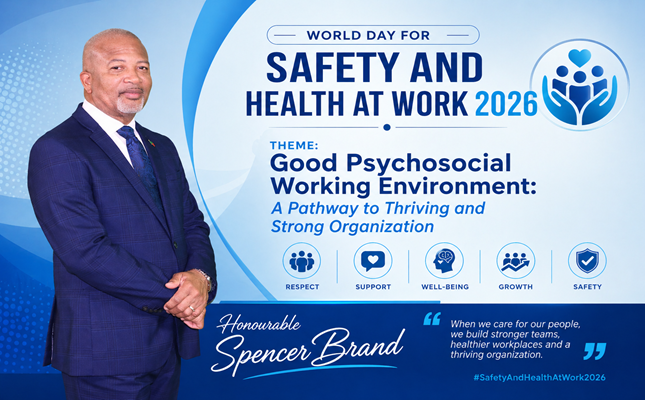
On April 28, 2026, marking the annual World Day for Safety and Health at Work, Honourable Spencer Brand, Minister of Labour within the Nevis Island Administration, delivered a keynote address centering on the urgent need to prioritize psychosocial wellbeing in workplaces across the island, framing the issue as a foundational driver of economic prosperity and social resilience.
This year’s global observance carries the official theme “Good Psychosocial Working Environment: A Pathway to Thriving and Strong Organization”, a framing that Brand leveraged to reaffirm a core governing priority: that Nevis’ workers are the territory’s most valuable asset. He emphasized that their mental and emotional wellness is not a secondary concern, but a non-negotiable requirement for a high-functioning public sector, growing private industry, and connected, resilient communities.
While the Nevis Island Administration has a long-standing track record of upholding basic workplace safety standards and expanding fair employment opportunities, Brand acknowledged that shifting global and local realities have created new demands that go far beyond minimum regulatory compliance. Rapid digital transformation, steadily growing workloads for many workers, and persistent global economic uncertainty have elevated psychosocial risks, requiring a proactive, people-centered approach to build workspaces where every employee feels valued, heard, and emotionally and physically secure.
Research and on-the-ground experience confirm that workplaces defined by respectful culture, manageable workloads, accessible peer and managerial support, and inclusive leadership deliver measurable benefits: better overall worker health, higher sustained productivity, more cohesive cross-team collaboration, and greater workforce confidence, Brand noted.
To advance this goal across Nevis’ public and private sectors, Brand laid out three interconnected guiding pillars that will shape the administration’s policy and outreach efforts moving forward.
The first pillar is people-first leadership. Brand stressed that organizational leaders set the cultural tone for entire workplaces: when leaders prioritize empathy and open communication, workers feel safe to raise concerns about burnout, workload imbalance, or other stressors without fear of retaliation. To embed this approach, he announced the administration’s commitment to expanding targeted training for leaders at all levels, equipping them to identify early signs of worker burnout, distribute workloads more sustainably, and support staff through compassionate, confidential care.
The second pillar is expanded, stigma-free access to robust mental health support. Brand noted that universal access to professional counseling, employee assistance programs, and specialized workplace health services is critical to addressing psychosocial risks. The administration will prioritize ongoing efforts to reduce cultural stigma around seeking mental health support in workplaces, expand access to evidence-based wellbeing initiatives including stress management training and peer support networks, and ensure no worker is left without resources to care for their mental health.
The third pillar is cultivating an inclusive, collaborative workplace culture. Sustainable psychosocial health relies on foundational trust, mutual respect, and open lines of communication between leadership and staff, Brand explained. The administration will encourage all employers across Nevis to facilitate ongoing structured dialogue between teams and management, implement fair workload distribution, expand flexible work arrangements where feasible, and embed inclusive decision-making processes that center the diverse perspectives of all workers.
As the governing body, Brand reaffirmed the Nevis Island Administration’s ongoing commitment to strengthening regulatory policies that protect worker psychosocial health, expanding access to resources for small and large businesses alike, and raising public awareness of overlooked psychosocial workplace risks. He noted that the government will continue to partner with businesses of all sizes to embed a culture that prioritizes mental health and empathetic, people-centered leadership.
Yet Brand emphasized that building healthy workplaces is not a responsibility that falls to government alone. Employers, workers, industry organizations, and local communities all have a critical role to play in creating safer, more supportive work environments across the island. The collective benefits of this work are impossible to ignore: when workers feel consistently supported in their wellbeing, they deliver stronger performance, collaborate more effectively, and help build more resilient organizations and communities across Nevis.
Brand added that the public sector will lead by example, demonstrating that investing in worker wellbeing and boosting productivity are not competing goals, but mutually reinforcing priorities. By walking this path publicly, the government can set a benchmark for private sector employers and strengthen public services, local business performance, and the overall long-term resilience of Nevis as a territory.
In closing, Brand called on all residents, employers, and workers across Nevis to join the collective effort to improve workplace psychosocial health. He stressed that a positive, supportive work environment is not a one-time policy achievement, but an ongoing commitment that requires consistent attention and collaboration. As the world marks this annual observance, Brand urged all stakeholders to pledge to protect the wellbeing of Nevis’ workforce and build workplaces where every person can grow and thrive. He closed by wishing all observers a meaningful World Day for Safety and Health at Work 2026, and extended a blessing for the continued prosperity of Nevis.