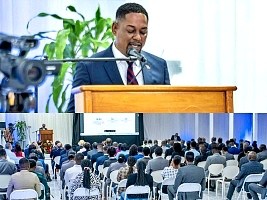
Against a backdrop of sustained global discourse around human mobility and displacement, Haitian policymakers and stakeholders gathered Wednesday, April 29, Push for coordinated, forward-thinking solutions to the country’s ongoing migration challenges. Hosted at Port-au-Prince’s Montana Hotel and organized by the Jean Price-Mars Diplomatic Academy with official backing from Haiti’s Ministry of Foreign Affairs, the one-day symposium centered on the theme “Haitian Migration and its Contemporary Dynamics: Between Crises, Mobility, and Public Responses”, bringing together leading voices from diplomacy, academia, and national government institutions to examine the current state of Haitian migration and map out actionable policy responses.
Marc-Elie Nelson, Haiti’s Minister of Social Affairs and Labor (MAST), delivered the symposium’s keynote address, placing the protection of Haitian migrants at the top of the government’s policy agenda. “Migration has grown into one of the most pressing issues shaping international relations and public debate across the globe, and it is a defining challenge for our nation,” Nelson told attendees. He outlined a four-pillar approach to addressing the crisis: strengthening protections for Haitian citizens living abroad, deepening collaborative partnerships with the international community, expanding economic and social opportunities for young Haitians to reduce the pressure to emigrate, and more effectively integrating the Haitian diaspora into national development planning.
Nelson used his remarks to reaffirm the Haitian government’s commitment to addressing the root drivers of forced migration. He emphasized that the administration would work across all relevant state institutions to advance inclusive social policies designed to reduce the systemic vulnerabilities that push thousands of Haitians to seek opportunities abroad each year.
Pushing back against narratives that frame Haiti as permanently trapped in a cycle of human capital flight, Nelson struck a hopeful tone about the country’s potential. “Haiti is not condemned to perpetually export its youth and its most dynamic citizens,” he said. “Our country possesses extraordinary human resources, and our people have a well-documented resilience that is recognized across the entire world.” The minister outlined an ambitious vision to reframe migration as a coordinated national project, with the goal of building domestic capacity to retain young Haitian talent, encourage the return of skilled Haitians living abroad, and rebuild a sense of hope across the country.
Beyond high-level government addresses, the symposium served as a critical collaborative platform for cross-sector experts to share new research and on-the-ground findings related to Haitian migration, laying the groundwork for future multi-stakeholder action on the issue.