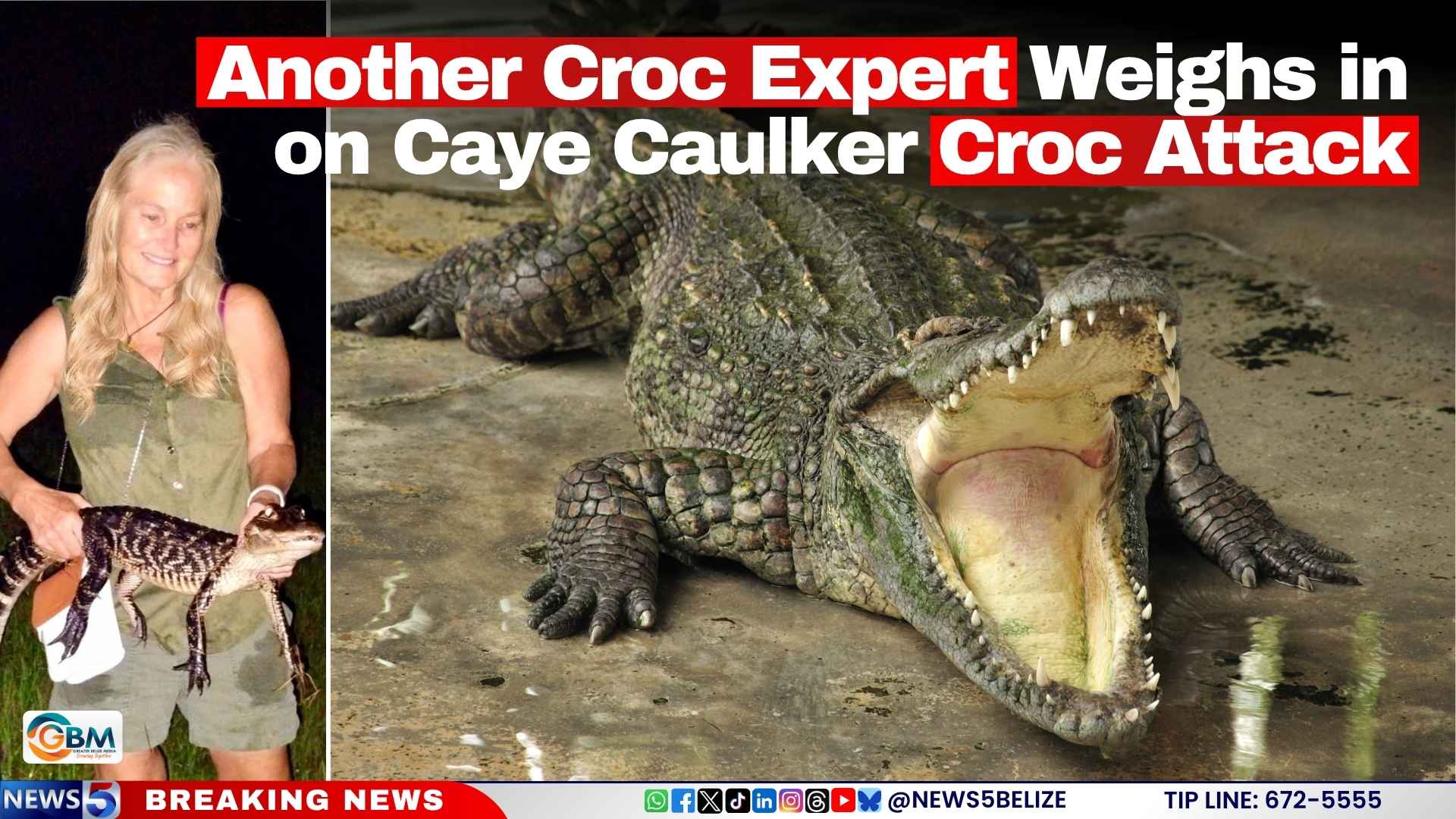
A recent crocodile attack on a tourist in the popular Belizean coastal destination of Caye Caulker has ignited divergent expert analysis over what factors led to the harmful encounter, reigniting conversations about human-wildlife coexistence in high-traffic tourism zones.
The incident, which unfolded shortly after 3:30 a.m. on a Monday, left Nicole Robinson, a United States national, with injuries after she entered the water to swim. In the immediate aftermath of the attack, Marisa Tellez, executive director of the Crocodile Research Coalition, offered an initial assessment framing the encounter not as unprompted aggressive behavior from the reptile, but as a natural instinctive response shaped by timing and local environmental conditions.
Tellez highlighted two key contextual factors that could explain the interaction: the species’ peak feeding window falls during early morning hours, and the attack occurred amid the annual nesting season, when crocodiles often act defensively to protect their nests. She also noted that long-term patterns of human food access in the area could be a contributing driver of altered crocodile behavior.
However, Cherie Chenot-Rose — a leading crocologist, co-founder of crocodile conservation groups GiveaCroc and ACES Belize — pushes back on the initial conclusion, arguing that key missing information makes Tellez’s nesting-based assessment premature. At the time of analysis, experts have not confirmed whether the crocodile involved in the attack is female, a detail critical to the nesting protection hypothesis. Chenot-Rose instead argues that repeated human interaction is the far more impactful factor driving risky crocodile behavior in the area.
For years, Chenot-Rose explains, crocodiles in Caye Caulker’s tourist-facing coastal zones have become conditioned to associate humans with food, through both direct and indirect feeding. Unregulated tourist attractions that intentionally feed crocodiles, fishing crews discarding scraps into nearshore waters, and local residents dumping food waste into island canals all have contributed to this long-term process. Over time, this repeated exposure erodes the reptiles’ innate fear of humans, rewiring their natural foraging and movement patterns.
This conditioning makes crocodiles far more likely to approach humans in the water, Chenot-Rose warns, particularly during low-visibility nighttime and early morning hours when crocodile activity is naturally elevated. This shifted behavior is the primary factor that elevates encounter risk in developed coastal destinations like Caye Caulker, she argues.
To address the ongoing risk, Chenot-Rose is calling for immediate action: the crocodile responsible for the attack should be captured, properly sexed and identified, and cross-referenced with existing tagging data to check for a prior history of nuisance behavior near human activity. Without swift intervention to remove a crocodile that has already displayed aggressive behavior toward humans, she warns, another harmful encounter is nearly guaranteed.