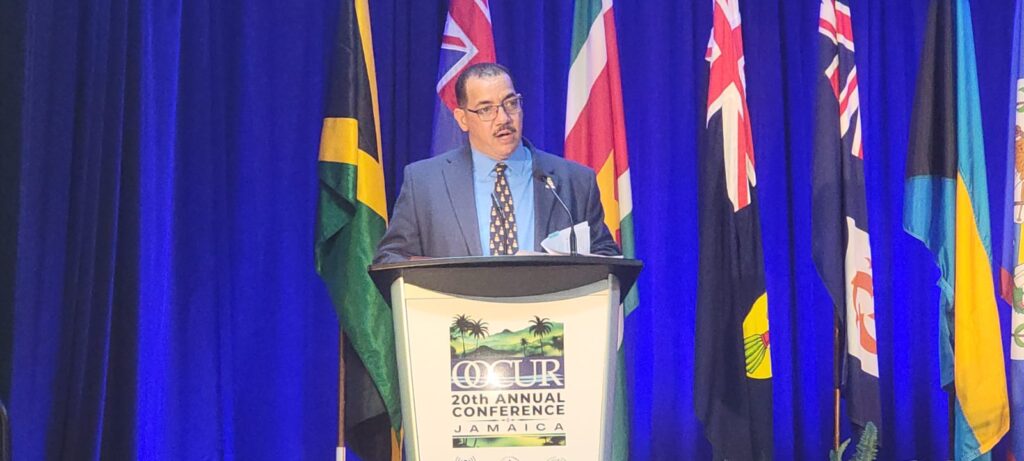
Against a backdrop of skyrocketing global oil prices fueled by ongoing conflict in the Middle East, a top Cayman Islands official has issued a urgent call for Caribbean countries to abandon their long-standing reliance on expensive imported fossil fuels and pivot toward the region’s abundant untapped renewable energy resources.
Cayman Islands Finance and Economic Development Minister Rolston Anglin, who also holds the education and training portfolio, delivered the call Tuesday during the opening ceremony of the Organization of Caribbean Utility Regulators (OOCUR) 2026 Conference, which is being hosted this year at Jamaica’s Ocean Coral Spring Resort in Trelawny. The conference, running through May 1 under the theme “Navigating Caribbean Regulatory Challenges: Opportunities, Innovations and Collaborations,” brings together regional policymakers and energy regulators to address pressing sectoral challenges.
Anglin pointed out that Caribbean nations have depended on imported fossil fuels for generations, leaving household budgets and national economies extremely vulnerable to every swing in global commodity prices. “This dependence is a vulnerability we have accepted as permanent. It is not,” he told attendees, highlighting that the region is naturally endowed with high-potential renewable resources—from abundant sunlight and steady winds to geothermal energy—that have yet to be developed at a large scale.
Beyond environmental benefits, Anglin framed the shift to renewables as a critical economic and national security priority for the region. “The raw materials for transformation are here. What is required now is the regulatory architecture to unlock investment, protect consumers, ensure grid stability, and attract the partnerships needed to move from ambition to reality,” he said, adding that regional energy regulators hold consequential leverage to drive this transition.
Speaking on behalf of Jamaican Prime Minister Dr Andrew Holness, Minister without Portfolio Andrew Wheatley, who oversees science, technology and special projects, outlined Jamaica’s ongoing progress in building out alternative energy capacity. To accelerate the shift away from fossil fuels, Jamaica has cut import taxes on electric vehicles to boost adoption of clean mobility, and is scaling up solar photovoltaic systems paired with battery storage as a core renewable energy strategy.
Wheatley noted that private investment in residential and commercial solar systems has grown in Jamaica, driven by both cost-saving incentives and rising public awareness of climate change risks. He echoed Anglin’s assessment that persistent heavy dependence on imported fossil fuels has left Caribbean nations with some of the world’s highest electricity prices, squeezing both household finances and business competitiveness. He also reiterated a longstanding regional point: while Caribbean countries contribute a tiny fraction of global greenhouse gas emissions, they bear the brunt of climate change impacts, most notably through increasingly powerful and destructive hurricane seasons.
Anglin emphasized that cross-border and cross-stakeholder collaboration is the foundation of successful regional energy transition. He called on fellow regional government leaders across all jurisdictions represented at the conference to strengthen partnerships with independent energy regulatory bodies, incorporate their on-the-ground expertise into policy design, and provide these institutions with the funding, clear mandates, and political backing they need to operate effectively.
Organizations such as OOCUR, he added, offer an invaluable platform for cross-border knowledge sharing that regional policymakers should actively leverage to accelerate progress. Anglin also highlighted a critical gap holding back the transition: many regional governments, including his own in the Cayman Islands, have not yet recognized the full economic value of well-resourced, technically skilled independent energy regulators. Underfunding or sidelining these institutions, he warned, slows broad national development and prevents the region from unlocking the full economic and environmental potential of its renewable energy endowments.