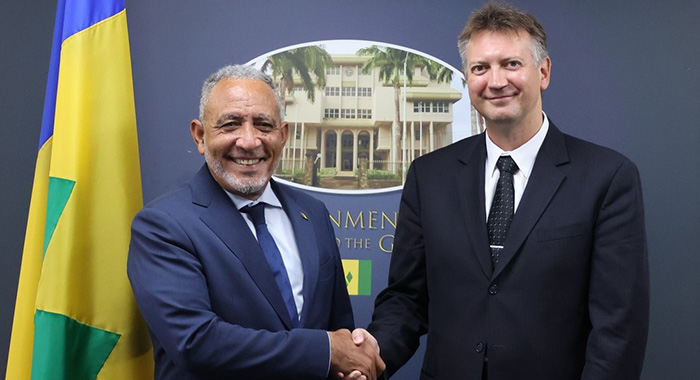
Eight years after St. Vincent and the Grenadines (SVG) first slid into a state of high risk of debt distress, the island nation’s newly elected government has laid out a balanced fiscal strategy that prioritizes strengthened tax enforcement over new tax hikes, paired with private sector-led growth and targeted debt restructuring to reverse the country’s strained fiscal position.
Prime Minister and Finance Minister Godwin Friday outlined the administration’s approach during a joint press briefing with the International Monetary Fund (IMF) in Kingstown on Tuesday, held alongside the release of the IMF’s latest economic outlook for SVG. Friday, whose New Democratic Party (NDP) secured a landslide 14-1 victory over the long-ruling Unity Labour Party in the November 2025 general election, ended 25 years of opposition rule and inherited a daunting fiscal landscape: as of December 31, 2025, the country carries a total national debt of 3.5 billion Eastern Caribbean dollars, with a debt-to-GDP ratio hovering between 113% and 120% per World Bank data.
Framing the government’s core revenue strategy, Friday emphasized systemic tax reform and modernization, with a near-term focus on closing compliance gaps rather than raising existing tax rates. “We’ve identified property tax enforcement as one of our key priority areas,” he explained, noting that current compliance rates for property taxes sit at just 20% — a figure he called shockingly low. “Simply making the existing system work, without changing rates or adding new financial burdens for taxpayers, will deliver significant revenue gains. That’s the approach we are adopting to strengthen our revenue position,” the prime minister said, adding that broader tax system modernization efforts are underway but declined to share further details.
On the expenditure side, the administration plans to pursue targeted rationalization of large recurring spending items, including public sector wage bills, pension obligations, and government subsidies, while directing limited public resources toward high-impact productive investments to drive economic expansion. Friday highlighted agriculture, tourism, and the blue economy as key growth sectors, noting that tourism has already posted solid gains over the past two to three years, while the blue economy holds untapped transformative potential for the island nation.
Against a backdrop of limited fiscal space that rules out large-scale public-led investment, Friday made clear that the government’s growth strategy centers on private sector leadership, attracting both domestic private capital and foreign direct investment to drive expansion. “The scope for government to lead the large-scale investments we’ve seen in the past is very limited right now, because we simply don’t have the fiscal room for that,” he noted.
To address the country’s heavy debt burden directly, Friday laid out a three-pronged strategy combining active debt management operations, fiscal adjustment, and a new citizenship by investment (CBI) programme — a key campaign promise from the NDP that the party has said will not add to existing national debt. The plan includes debt swapping and refinancing to replace higher-interest debt obligations with lower-cost alternatives, and Friday stressed that while the government is negotiating with bilateral and multilateral partners to ease its debt load, it remains fully committed to meeting all its existing financial obligations. The end goal, he said, is to free up critical fiscal space to maintain core government functions and fund new strategic investments.
Under the proposed CBI programme, which would grant citizenship in exchange for qualified investments, Friday confirmed that all generated revenue will be prioritized for debt reduction and capital projects, rather than covering routine day-to-day government spending, a model aligned with how other Caribbean nations have structured similar programmes. IMF Mission Chief for SVG Sergei Antoshin noted during the briefing that a well-designed CBI programme could deliver a modest boost to fiscal revenue, but also carries inherent risks that require careful structural planning to maximize benefits. Friday responded that he broadly accepts the IMF’s guidance, noting that the government’s revenue allocation strategy aligns with that risk-mitigation approach.
Currently, SVG’s baseline annual growth projection sits at around 2.7% — a rate Friday says is too slow to address the full scale of the country’s fiscal and social challenges. “We need faster growth than that, and we have a clear roadmap to deliver it. We are working to put all these measures in place as quickly as possible,” he said. The prime minister framed growth, debt sustainability, and social protection as mutually dependent objectives, noting that long-term stability depends on getting the balance right: “Sustainability only comes when we can meet our debt obligations, invest in our productive sectors, and build the infrastructure that generates further growth. These are significant challenges, and we are fully aware of the work ahead of us.”