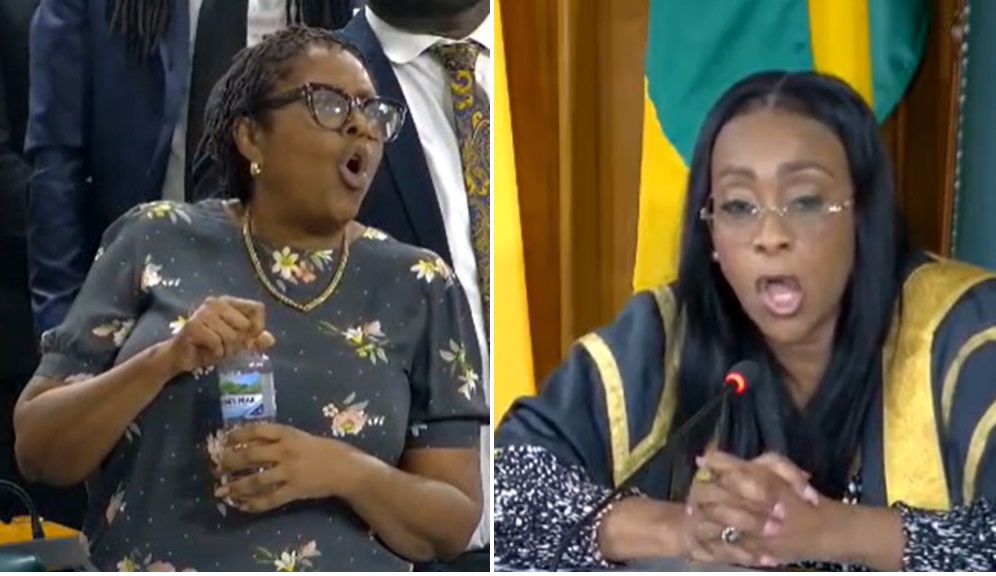
Late on Tuesday, a chaotic confrontation over a critical piece of government legislation disrupted proceedings in Jamaica’s House of Representatives, resulting in the suspension of opposition Member of Parliament Angela Brown Burke, who represents St Andrew South Western. The incident unfolded during a Committee of the Whole House sitting, where lawmakers were conducting a line-by-line review of the National Reconstruction and Resilience Authority (NaRRA) Bill, a flagship policy proposal from the current administration.
Tensions that had been simmering during debate on the divisive bill boiled over into open disorder, with the confrontation centering on the parliamentary mace — the centuries-old ceremonial object that embodies the constitutional authority of Jamaica’s legislature. After Brown Burke engaged in an incident involving the mace, Speaker of the House Juliet Holness initiated formal disciplinary proceedings by “naming” the MP, a procedural step reserved for cases of gross disorderly conduct under parliamentary rules.
Citing Standing Order 43, Subsection 2, which requires lawmakers found guilty of grossly disorderly behavior to leave the chamber for the rest of the sitting, Holness ordered parliamentary marshals to escort Brown Burke out of the building. The opposition MP repeatedly refused to comply with the Speaker’s instructions, attempting to argue her case before being cut off, and proceedings were brought to an abrupt standstill as marshals moved to enforce the order.
Leader of Government Business Floyd Green quickly introduced a formal motion to confirm Brown Burke’s suspension for the remainder of the day’s sitting, which passed along party lines with the government’s majority approving the measure. In remarks after order was temporarily paused, Speaker Holness emphasized that any attempt to touch or grab the mace — regardless of whether it was done in jest or protest — crosses an unacceptable line in parliamentary procedure.
“Member, at no time can you grab the mace in Parliament. Not even in jest, member. And not in protest either,” Holness told the MP, stressing the symbolic weight of the object to the institution’s integrity. She later reminded all assembled lawmakers that parliamentary rules are not trivial, and disciplinary procedures are in place to protect the dignity of the body.
After the confrontation, the sitting was paused for five minutes to allow tempers to cool, and Brown Burke ultimately left the chamber before lawmakers resumed their deliberations on the bill. Prime Minister Andrew Holness called for calm once proceedings restarted, noting that the disruptive scene would not be remembered as one of parliament’s finest moments, and stressing that the order and dignity of the institution must be protected at all times.
The NaRRA Bill at the center of the tension is a key policy priority for the Jamaican government. If passed, it will establish the National Reconstruction and Resilience Authority, a centralized body tasked with coordinating post-disaster reconstruction and long-term national resilience-building efforts to respond to major emergencies ranging from hurricanes to public health crises. The legislation has already sparked sharp division among both lawmakers and the Jamaican public, with disagreements over its scope and implementation driving tense debate throughout the legislative process.