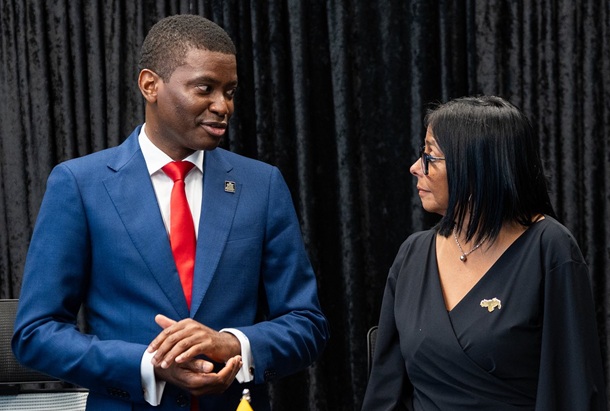
On Tuesday, April 28, 2026, the Caribbean Community (CARICOM) headquarters issued a formal statement cautioning its member states against allowing regional platforms to be leveraged to advance territorial claims currently under adjudication by the International Court of Justice (ICJ). The rebuke comes in response to widespread outcry from Guyanese President Irfaan Ali over a controversial incident during recent visits by Venezuelan President Delcy Rodriguez to two CARICOM member nations: Grenada and Barbados.
During separate official meetings with Grenada Prime Minister Dickon Mitchell and Barbados Prime Minister Mia Mottley, Rodriguez wore a map-shaped brooch that explicitly included Guyana’s 159,000-square-kilometer Essequibo Region as part of Venezuelan territory. The long-running territorial dispute over the resource-rich Essequibo has been pending before the ICJ for years, with the court scheduled to open oral arguments on the merits of Guyana’s case next month. Guyana brought the original suit to challenge the validity of the 1899 Arbitral Tribunal Award that first established the land boundary between the two South American nations.
In its official statement, the CARICOM Secretariat stressed that all regional community forums and diplomatic engagements must not be used, either directly or indirectly, to promote or seemingly legitimize claims that are already the subject of active international judicial proceedings. The bloc anchored its position in the Revised Treaty of Chaguaramas, the binding legal framework that governs CARICOM, outlines its core mission, and sets standards of conduct for all member states. The agreement requires all members to protect the bloc’s institutional integrity and cohesion in their external relations.
“In the exercise of their sovereign rights, Member States remain mindful of their collective responsibilities to the Treaty and to uphold the principles of international law, respect for judicial processes and good neighbourly relations,” the statement read.
The regional body confirmed it had received an official letter dated April 28, 2026, from Ali conveying Guyana’s deep concern over the brooch incident. Following Ali’s formal objection, Venezuela’s Foreign Minister Yvan Gil hit back at the Guyanese leader, dismissing the complaint as overreach. “It is really unusual that President Irfaan Ali now intends to establish himself as the arbiter and couturier of even the way other heads of state dress,” Gil said. “Is he also going to ban maps, history books or any symbol that bothers him?”
Notably, CARICOM’s position balances respect for national sovereignty with adherence to collective obligations: the bloc reaffirmed that every member state retains full sovereign authority to conduct independent bilateral relations with external partners, a longstanding principle that remains fully respected across the community. At the same time, the bloc emphasized that all such engagements must align with member states’ shared commitments under the CARICOM agreement.
The secretariat also reiterated its unwavering longstanding stance: it continues to fully support the sovereignty and territorial integrity of Guyana, and remains firm in its backing for a peaceful resolution of the dispute through the ICJ’s judicial process. CARICOM closed its statement by reaffirming its commitment to regional unity, the rule of international law, and the peaceful settlement of all cross-border disputes in line with established global legal norms. It is worth noting that the ICJ is also currently adjudicating a separate boundary dispute between Guatemala and Belize, another CARICOM member state.