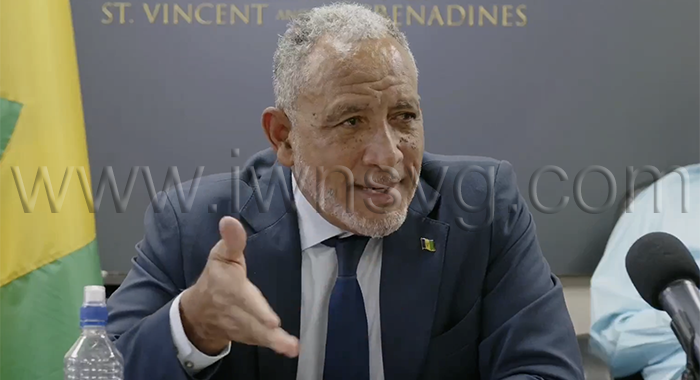
Five months after taking office as St. Vincent and the Grenadines’ (SVG) fifth prime minister, Godwin Friday — who also serves as minister of finance — has announced a deliberate, rules-based strategy to address the Caribbean nation’s worsening debt crisis and fragile fiscal position. The plan was unveiled Tuesday during a joint press conference in Kingstown held at the conclusion of an Article IV consultation with the International Monetary Fund (IMF), the Washington-based global financial institution.
Friday emphasized that SVG cannot rely on passive waiting for economic challenges to resolve on their own, a sharp break from the fiscal trajectory of the previous Unity Labour Party administration, which held power from 2001 until November 2024. Current projections paint a stark picture of the nation’s finances: SVG’s debt-to-GDP ratio already sits at 113% for 2025, and if no policy changes are made, that figure is expected to climb to 145% by 2031. The country has been classified at high risk of debt distress since 2016, and ongoing external shocks including soaring global oil prices and persistent inflation, paired with lingering recovery costs from recent natural disasters, have pushed the already precarious fiscal situation to a breaking point.
While Friday confirmed the IMF is providing critical technical support to the reform effort, he stressed that the stabilisation programme will be fully homegrown, with national ownership at its core. “We will implement, we will develop, devise, of course with your technical assistance, our homegrown economic stabilisation programme that will ensure that we have national ownership of the recovery journey on which we are embarking,” the prime minister said. “We are on that journey.”
A core principle guiding the government’s approach is social fairness, Friday added, noting that any fiscal adjustment must prioritize protecting SVG’s most vulnerable communities, who bear the brunt of rising prices and economic instability first. “It is not just a balance sheet matter… it involves people’s lives,” Friday said of the government’s framework. “The costs of these higher oil prices and higher costs of inflation and so forth… will not be borne disproportionately by those persons who are most vulnerable, because they’re the ones who feel it first. Protection of the most vulnerable are central to any reform efforts.”
To deliver accountability and transparency, the government will establish a legally backed rules-based fiscal framework with clear, measurable targets. Key milestones include reaching a 3% primary surplus as a share of GDP by 2029, and aligning the nation’s fiscal practices with the Eastern Caribbean Currency Union (ECCU)’s 60% debt-to-GDP benchmark. Friday acknowledged the 3% surplus target is ambitious, requiring an 11 percentage point turnaround in the coming years, but noted similar shifts have been achieved in other nations, and the ambitious timeline is necessary to put SVG on a sustainable path.
The prime minister welcomed the IMF’s balanced, collaborative approach to the partnership, saying it aligned with the government’s focus on balancing fiscal responsibility with inclusive economic growth. “We’re prepared to do what is necessary here in a way that is going to set our country on a path towards fiscal responsibility, but also one that generates growth… and that we do so in a way that is both responsible and sustainable,” Friday said.