Decades before modern phrases like “fake news” and “cognitive warfare” entered everyday public discourse, Fidel Castro Ruz, the iconic founding leader of the Cuban Revolution, had already mapped out the hidden mechanisms of power that major world powers would unleash through digital information and communication technologies.
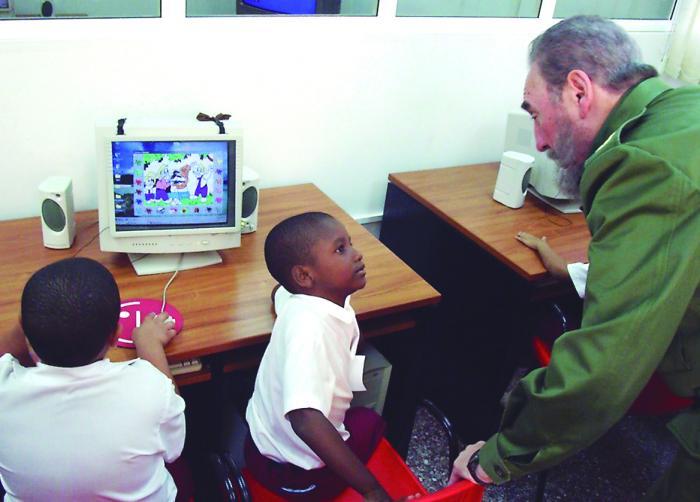
Crucially, Castro’s perspective was never rooted in opposition to technological progress itself. A close look at his legacy reveals a consistent commitment to expanding digital access and technical expertise across Cuba: he championed the development of the island’s first domestic computer, established the country’s preeminent University of Information Sciences, and launched the nationwide Joven Club de Computación (Youth Computer Club) initiative to bring digital literacy to generations of young Cubans.
Instead, his words represented a prescient, far-sighted warning: he accurately foresaw that cyberspace would evolve into the central battlefield of a quiet, unconventional war designed to colonize the minds of people across the Global South. Castro framed the internet as inherently contested terrain. He never rejected its transformative potential for marginalized nations, noting in a 2012 address at the launch of the book *Guerrillero del Tiempo*: “The internet is a revolutionary tool that allows us to receive and transmit ideas in both directions—something we must know how to use.”
Yet as early as 2006, when the U.S. government formally announced the creation of its Air Force Cyberspace Special Command, Castro sounded an urgent alarm that rings even louder in today’s hyper-connected world. “The internet can be used with the worst intentions in the world, as envisioned by the CIA and the Pentagon,” he warned at the time. This core duality defined his entire framework on digital power: the network itself is not the enemy; the danger lies in how U.S. imperialism and its allied powers would weaponize it for geopolitical gain.
At the heart of Castro’s analysis was a sharp critique of mass psychological manipulation. In a landmark November 2005 address delivered at the University of Havana’s Aula Magna, he laid out a critical distinction that explains the effectiveness of 21st century unconventional conflict. “When they first emerged, the mass media took hold of people’s minds and ruled not only on the basis of lies, but also of conditioned reflexes,” he explained. “A lie is not the same as a conditioned reflex. A lie affects knowledge; a conditioned reflex affects the ability to think.”
This core thesis exposes that the goal of this digital warfare is not merely to spread false information—it is to erase a population’s capacity for critical thought. Through endless repetition of ideological slogans that seep into the collective subconscious, adversaries can reshape public opinion without overt military intervention. Castro illustrated this dynamic with a stark, direct example: “Because they have already created reflexes in you: ‘This is bad, this is bad; socialism is bad, socialism is bad,’ and all the ignorant, all the poor, and all the exploited saying: ‘Socialism is bad.’ ‘Communism is bad,’ and all the poor, all the exploited, and all the illiterate repeating: ‘Communism is bad.’”
Today, that dynamic has been amplified exponentially by algorithmic curation and viral social media platforms, turning this repetitive messaging into a constant, pervasive assault on independent consciousness.
Castro’s analysis expanded further to connect digital psychological warfare to the global military-industrial complex. In an August 2009 reflection titled *The Empire and the Robots*, he denounced the stark global inequality that drives weapons development: while more than one billion people across the planet faced chronic hunger, the United States accounted for 42% of total global military spending, pouring vast resources into developing “technologies for killing.”
The question he posed nearly 20 years ago remains as urgent as ever: “If robots in the hands of transnational corporations can replace imperial soldiers in wars of conquest, who will stop the transnational corporations in their search for markets for their devices?” This shift toward the dehumanization of war—replacing on-the-ground soldiers with drones, algorithms, and autonomous weapons—works hand in hand with psychological warfare: it turns mass destruction into a distant, abstract spectacle, making it far easier to manipulate public perception to justify military aggression. Recent examples, such as Project Maven, the partnership between the Pentagon, tech firms Palantir, Anthropic and its AI Claude, in strikes targeting Venezuela and Iran, confirm Castro’s early insight.
All of Castro’s interconnected warnings about unconventional warfare coalesce into a overarching diagnosis he labeled “knowledge imperialism.” Repeatedly across his speeches, he framed this as the “main battlefront of the imperialist war,” with an ultimate goal of breaking the sovereign will of independent nations without firing a single shot. Instead of overt military invasion, imperial powers rely on cultural subversion and systematic information manipulation to achieve their geopolitical aims.
In 2017, Cuban President Raúl Castro Ruz formally reaffirmed this framework before the country’s National Assembly, emphasizing that massive U.S. investments in digital and cultural tools were designed to “refine the tools of the so-called ‘unconventional war’” to provoke political destabilization and restore capitalist rule on the island.
In the decades since Fidel Castro first issued these warnings, his early analysis has become a core part of Cuban state doctrine, and an essential lens for interpreting 21st century geopolitical conflict. In an era where social media amplifies manufactured conditioned reflexes, algorithms target and segment users to spread tailored misinformation, and autonomous weapons replace frontline soldiers, Castro’s words carry the weight of a fulfilled prophecy—one that is ultimately a call to defend popular sovereignty through critical knowledge and commitment to truth.