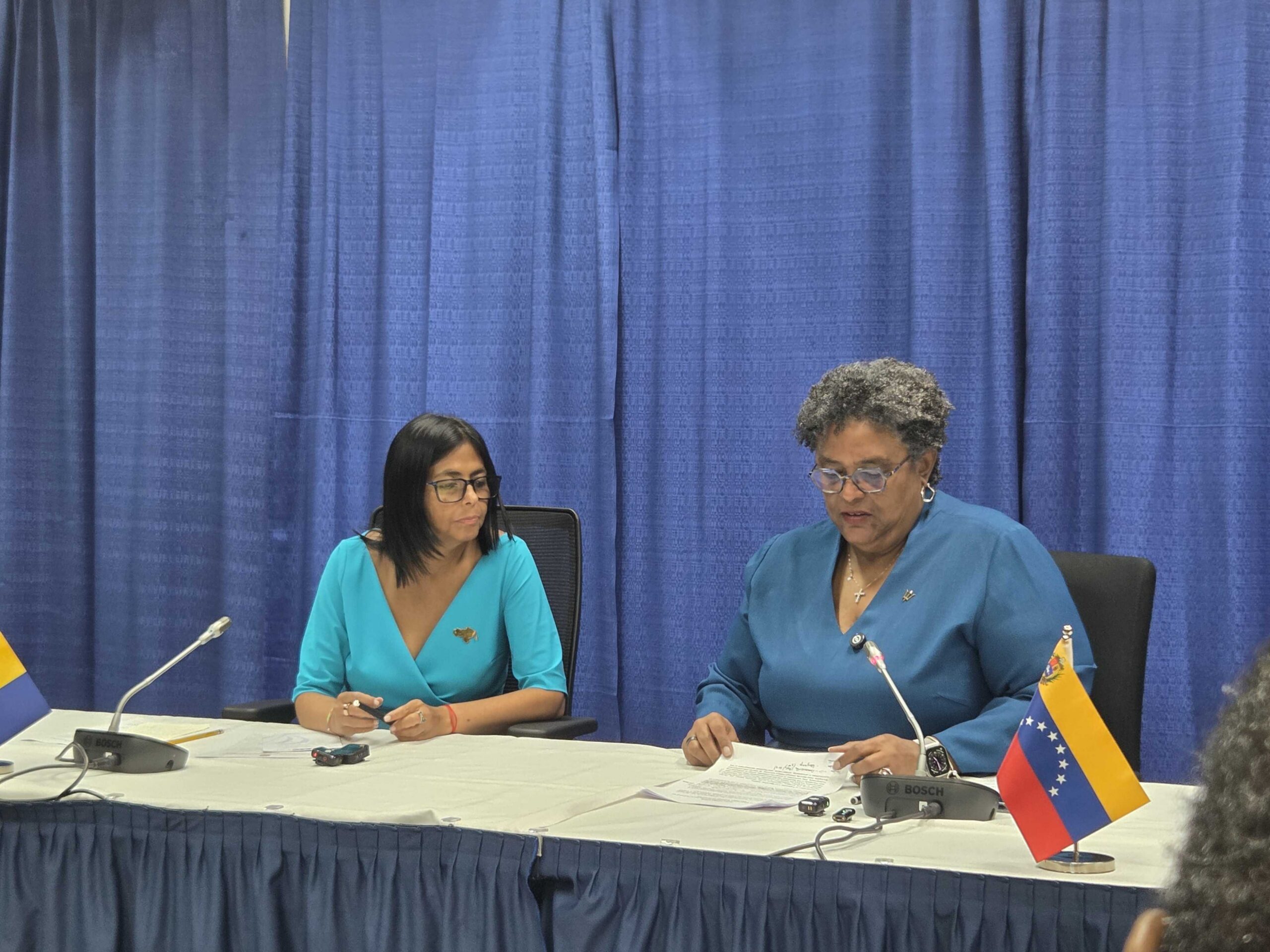
In a landmark diplomatic gathering hosted in Bridgetown on Monday, Barbados and Venezuela unveiled a wide-ranging strategic alliance covering food production, energy investment, and language education, marking the first high-level visit from Venezuela’s new interim government following the US removal of former president Nicolás Maduro. The meeting, held at the Lloyd Erskine Sandiford Centre, brought together Barbadian Prime Minister Mia Mottley and Venezuelan Acting President Delcy Rodríguez, who jointly announced the start of a new, transformative era of bilateral collaboration after a full day of closed-door negotiations.
Both leaders emphasized that the close geographical proximity of the two nations — a mere one-hour flight apart — has long been underutilized, and the new partnership will finally build the deep economic and social connections that match this geographic advantage. Mottley framed the cooperation as a critical collective defense mechanism against the ongoing global economic strains of soaring inflation and disrupted supply chains, noting that the two countries already have a foundational history of dialogue from prior diplomatic engagements.
“Venezuela has made impressive progress in securing food sovereignty, and it is well positioned to help many nations across our region access affordable, nutritious food,” Mottley stated. A core initiative of the new partnership will allow Barbadian government representatives and private farmers to cultivate food directly on Venezuelan territory. This arrangement is designed to stabilize volatile food prices on Barbados’ import-dependent island economy, while leveraging the nation’s established Caribbean logistics networks to turn the island into a regional export hub for Venezuelan-grown produce. Mottley added that the plan will eliminate wasted cargo capacity on trade routes between the two countries, ensuring that planes and ships returning from Barbados to Venezuela are not carrying empty holds, boosting economic efficiency for both sides.
In a surprising policy announcement, Mottley reaffirmed a decades-old pledge to make Spanish Barbados’ second official language, a policy first outlined almost 50 years ago that was never fully implemented. Under the new target, all Barbadians under the age of 18 will receive formal Spanish language education by 2030, a move designed to eliminate language barriers and streamline cross-hemisphere trade and travel. Mottley noted that this linguistic integration will also lay the groundwork for future cooperation in tourism and transport connectivity, which the two nations plan to advance in subsequent negotiations.
Turning to energy cooperation, Mottley recognized Venezuela’s long history as an energy security stabilizer for the Caribbean, referencing landmark prior agreements including the San Jose Agreement and PetroCaribe. She confirmed that the Barbados National Energy Company will now begin exploring joint investment opportunities in Venezuela’s existing oil and gas fields, to strengthen Barbados’ long-term energy security amid the current global energy crisis. Mottley added that the partnership will also extend beyond fossil fuels to collaborative development of renewable energy technologies.
Acting President Rodríguez, who assumed leadership of Venezuela after US special operations forces invaded Caracas in early January and removed Maduro to face US criminal charges, described the new agreement as a “new birth” of bilateral relations, officially marking April 27 as the starting date of the revitalized economic and trade alliance. Rodríguez echoed Mottley’s praise for the food production initiative, confirming that the arrangement will not only improve food access for Barbadians but also position Barbados as a global export hub for Venezuelan agricultural products.
Rodríguez also outlined plans to expand air and maritime connectivity between Caracas and Bridgetown, noting that increased flight frequencies will unlock new tourism markets for both countries. She extended an invitation for Barbadian tourism professionals to lead training programs for Venezuelan hospitality workers, while offering Venezuelan energy expertise to help Barbados expand its domestic energy output. The two sides also agreed to explore joint manufacturing of solar panels as part of their renewable energy collaboration.
On the education and language front, Rodríguez announced that Venezuela will expand the operations of its Venezuelan Institute for Cultural Cooperation in Barbados, integrating digital education technology to connect Venezuelan language teachers with Barbadian students to support the push for Spanish proficiency across the island.
The visit comes amid a deeply unstable political transition in Venezuela, with widespread international debate over the legitimacy of US intervention and the nation’s future democratic governance. The US military operation that removed Maduro has been widely condemned by global policymakers as a violation of Venezuelan sovereignty and international law. Currently, Maduro is being held at the Metropolitan Detention Center in Brooklyn, New York, alongside his wife Cilia Flores. He has pleaded not guilty to all charges of drug trafficking and corruption, telling a Manhattan federal court that he is a “prison of war” who was illegally kidnapped by US forces.
The high-level talks concluded with a ceremonial exchange of cultural gifts, including an indigenous handcrafted beach bag from Venezuela and a original work of Barbadian art, symbolizing the deep cultural ties the two leaders aim to solidify through the new partnership. “We invite you and your delegation to always treat Barbados as your home,” Mottley told Rodríguez at the closing of the summit. “Our core goal is to build a relationship that delivers tangible benefits to ordinary citizens of both nations, so that everyone can access the best that both our countries have to offer.”