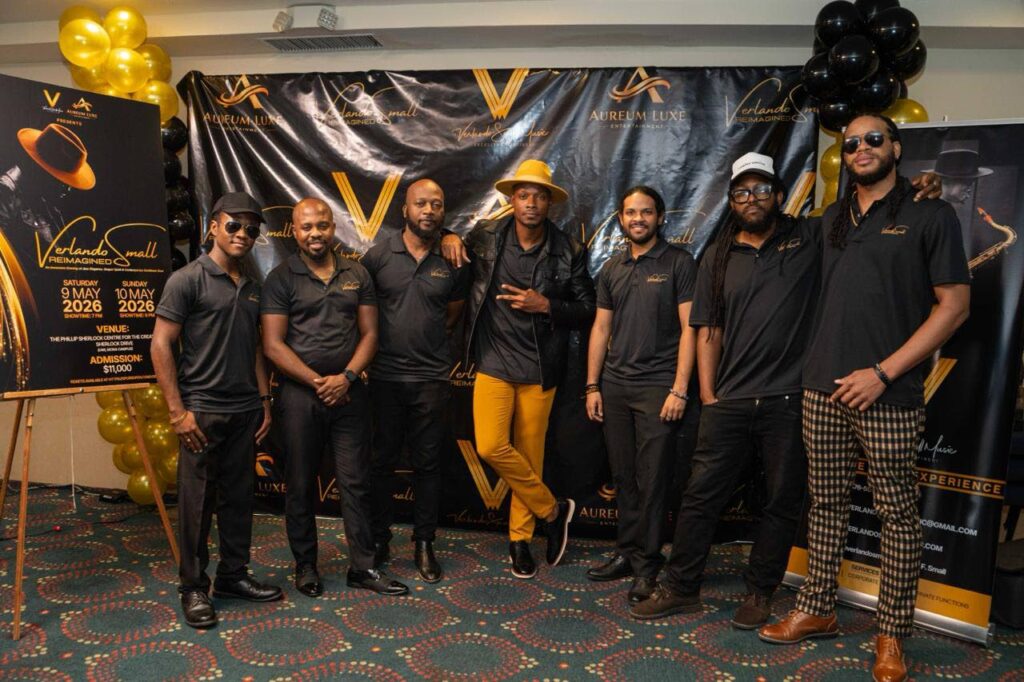
Jamaica’s live music industry is undergoing a long-overdue reckoning, as a collective of instrumental musicians led by saxophonist Verlando Small is calling for a fundamental shift in how session and backing musicians are valued, positioned, and compensated within the country’s entertainment ecosystem. At the official launch of the Verlando Small Reimagined performance series, held at the University of the West Indies Mona Campus’ Philip Sherlock Centre for the Creative Arts, artists opened up about the systemic challenges that have long sidelined instrumentalists, pushing them to the background of live productions even as their work forms the backbone of every successful show.
Slated for May 9 and 10, the two-night event is co-produced by the Verlando Small Reimagined Production Team and Aureum Luxe Entertainment, with a talented core lineup featuring musical director Evan Mason, guitarists Nicholas Groskopf and Brandon Benjamin, percussionists Colin Phillips and Robert Malcolm, multi-instrumentalist Joe Davis, and producer-engineer-musician Keneil Delisser. The launch drew a host of respected Jamaican music industry figures, including veteran industry leader Tommy Cowan and iconic tenor saxophonist Dean Fraser, all gathered to discuss the future of the craft in Jamaica.
Opening the conversation, Tommy Cowan framed the push for musician leadership as a full-circle moment for Jamaican music, recalling the legacy of standout instrumentalists from decades past. “From the days of Ernie Ranglin, Tommy McCook, and Dan Drummond, through to icons like Dean Fraser today, excellence has always come when musicians step into their own power,” Cowan noted. “Ultimately, it comes down to each musician’s personal responsibility, ambition, and understanding of their purpose in this industry.”
For Verlando Small, who made history in 2013 as the only non-vocalist to win Jamaica’s popular Digicel Rising Stars talent competition, the conversation is long overdue. Small, who has built a cross-genre reputation playing saxophone in contemporary worship, reggae, jazz, and soul, challenged fellow instrumentalists to take an active role in elevating their standing in the industry. “If we want more recognition and better treatment as musicians, we have to be willing to grow into more,” Small asserted. “Earning a seat at the planning table doesn’t just happen — it requires vision, original ideas, and a solid understanding of how the business side of music works.” He also emphasized that musicians consistently go above and beyond to deliver a seamless, successful show, and that greater inclusion in production planning and fair compensation must match that commitment. “We never let a show fail — we always give more than what’s asked of us. Inclusion and fair pay have to follow that effort,” he said.
Grammy Award-winning guitarist Nicholas Groskopf echoed Small’s perspective, pointing out that while the work of musicians is irreplaceable, they are often sidelined until showtime. “Live music simply cannot happen without us, and every musician is a star in their own right — but it’s still a team effort,” Groskopf explained. “A lot of the time, we feel pushed to the back seat and forgotten, until the day of the show when everyone is scrambling to pull everything together.” He added that while Jamaica’s music industry is globally celebrated for its innovation and talent, systemic improvements are needed to better integrate musicians into early planning and production processes, rather than treating them as afterthoughts.
Percussionist Robert Malcolm highlighted another persistent challenge: the industry’s overreliance on informal verbal agreements, with little to no formal documentation. “We operate mostly in a verbal community here, but there’s almost never any follow-up in writing,” Malcolm said. “Without a paper trail, you get constant confusion around expectations, rehearsal schedules, and compensation, which leaves musicians in vulnerable positions.”
For musical director Evan Mason, the path forward starts with greater visibility and more intentional opportunities for instrumentalists to step into the spotlight. “We need more platforms, more events where musicians can perform in the light, not just as backup, but as the main attraction,” Mason said. While he acknowledged that Jamaica has produced legendary standouts like Dean Fraser, Monty Alexander, and Dennis Rushton, he noted these iconic figures are exceptions, not the norm for most working instrumentalists in the country. “We just need more opportunities to showcase the incredible depth of talent that exists here,” he added.
Mason also pushed for musicians to proactively engage with the business side of the industry, even when it means having uncomfortable conversations. “Learn how the business works. Have those difficult discussions, because that’s where fair compensation comes from,” he said. “Most of the time, being clear from the start with paperwork and formal contractual agreements makes everything easier for everyone involved. We’re not here to bash anyone in the industry — we’re saying that as musicians, we have work to do to lift ourselves up and claim the space we deserve.”
The upcoming Verlando Small Reimagined shows are designed to turn this conversation into action, putting instrumentalists front and center to showcase their talent and redefine their role in Jamaica’s live entertainment landscape.