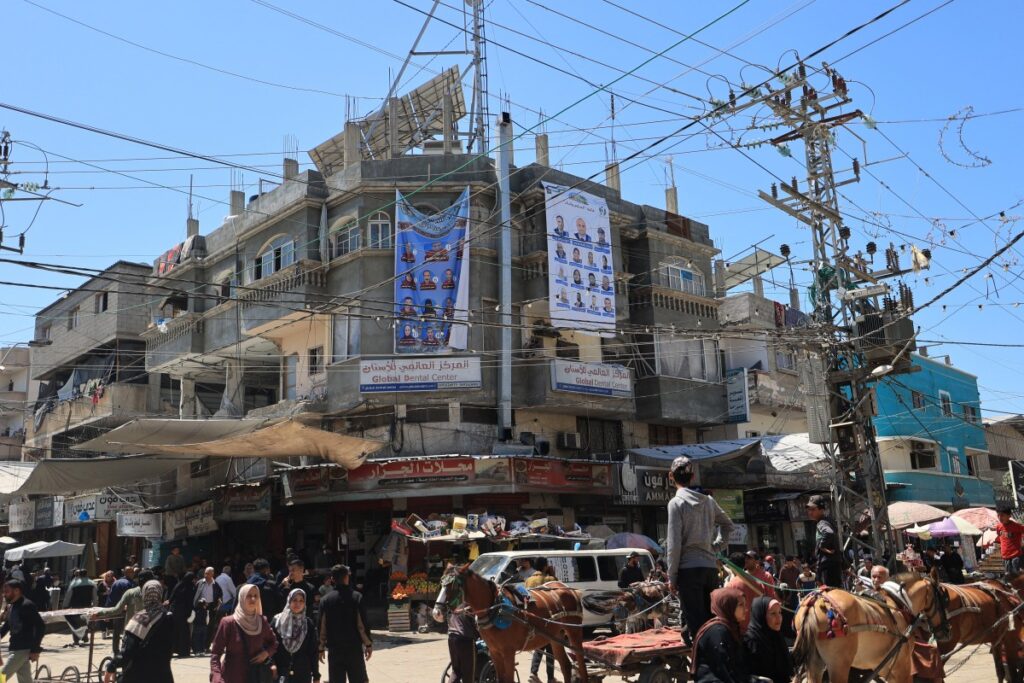
For the first time since the outbreak of the latest Gaza war, Palestinian voters across the Israeli-occupied West Bank and the central Gaza district of Deir el-Balah are casting ballots Saturday in long-awaited municipal elections, a vote shaped by a limited political landscape and broad public apathy toward the ability of the process to deliver meaningful change.
Figures from the Ramallah-headquartered Central Elections Commission (CEC) show roughly 1.5 million registered voters will participate across the West Bank, joined by an additional 70,000 registered voters in Deir el-Balah. Unlike broader national elections, the vast majority of competing candidate lists are either aligned with Palestinian President Mahmoud Abbas’s secular nationalist Fatah party or running as independent candidates. Notably, no lists are fielded by Hamas, Fatah’s long-standing political rival that controls roughly half of the Gaza Strip.
Across most West Bank municipalities, Fatah-backed tickets face off against independent slates led by candidates from smaller opposition factions, including the Marxist-Leninist Popular Front for the Liberation of Palestine. In dozens of districts, however, the lack of competition has already preordained results: in major population centers including Nablus and Ramallah, the seat of the Palestinian Authority (PA), only one candidate list was submitted, allowing that ticket to claim victory automatically without any voter turnout.
Many voters echo deep skepticism about the election’s ability to improve daily life under Israeli occupation. Mahmud Bader, a private business owner from the northern West Bank city of Tulkarem, where two adjacent refugee camps have been under full Israeli military control for more than a year, said he planned to cast a ballot despite expecting no tangible improvements. “Whether candidates are independent or partisan, it has no effect and will have no benefit for the city,” Bader told AFP. “The Israeli occupation is the one that rules Tulkarem. This vote is just an image shown to international media — to pretend we have functioning elections, a state, or independence.”
Logistical challenges also shape the vote in war-ravaged Gaza. The CEC confirmed polling stations in the West Bank will operate from 7:00 a.m. local time (0400 GMT) through 7:00 p.m., but stations in Deir al-Balah will close two hours earlier at 5:00 p.m. The adjustment is designed to allow vote counting to finish before sundown, a necessary workaround given chronic widespread power outages across the war-damaged strip.
International observers have framed the vote as a rare step forward for democratic engagement amid ongoing conflict. UN Middle East coordinator Ramiz Alakbarov praised the CEC for pulling off a “credible process” under extreme constraints. “Saturday’s elections represent an important opportunity for Palestinians to exercise their democratic rights during an exceptionally challenging period,” Alakbarov said in an official statement.
This vote marks the first electoral contest held in Gaza since the 2006 legislative elections, which were won by Hamas. The Islamist group has controlled most of Gaza since 2007, splitting Palestinian governance between the Hamas-led strip and the Fatah-governed West Bank. Jamal al-Fadi, a political scientist based at Cairo’s Al-Azhar University, told AFP the PA’s decision to limit Gaza balloting exclusively to Deir el-Balah is a deliberate pilot test to assess public opinion in the post-war context, when no comprehensive public opinion polling has been conducted.
The selection of Deir el-Balah was also rooted in practicality: the district is one of the few areas of Gaza where a large majority of the original population has not been displaced by the more than two-year-long conflict between Hamas and Israel, al-Fadi explained. The 90-year-old Abbas, who has held the Palestinian presidency for more than two decades without holding a new presidential election, has repeatedly promised to hold national legislative and presidential votes that have yet to be organized.
For some first-time voters, the election carries symbolic weight even amid its limitations. Farah Shaath, 25, said she was eager to cast her first ever ballot Saturday. “Although it is unlike any election in the world, it is a confirmation of our continued existence in the Gaza Strip despite everything,” Shaath said.
Organizing the Gaza vote has also required navigating competing security claims. CEC spokesman Fareed Taamallah told AFP that the commission has recruited polling staff from local Palestinian civil society groups and contracted a private security firm to guard the 12 polling centers in Deir el-Balah. But an anonymous CEC source based in Gaza told AFP that Hamas police have insisted on taking responsibility for securing the electoral process, planning to deploy unarmed plainclothes security personnel around all polling sites.