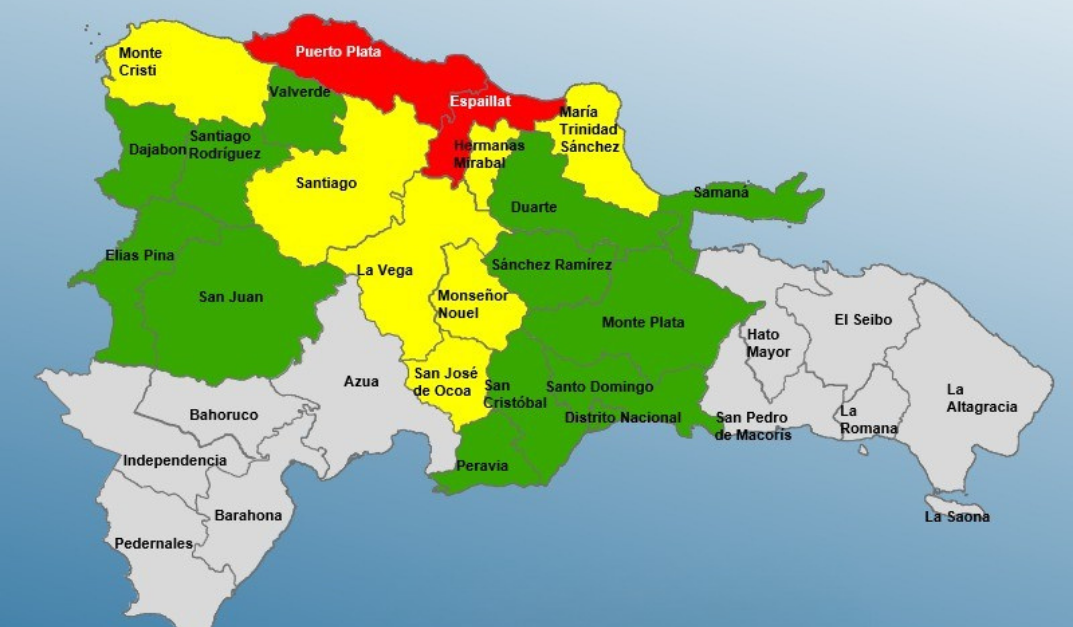
SANTO DOMINGO — Unfavorable atmospheric conditions driven by a prefrontal trough and warm east-southeast winds have prompted the Dominican Republic’s Emergency Operations Center (COE) to implement a graded national alert system across multiple regions of the country, with two northern provinces remaining on the highest warning level as forecasters predict prolonged heavy precipitation and extreme weather.
As of the latest update from COE, Puerto Plata and Espaillat, both located along the country’s northern Atlantic coast, continue to be under red alert — the most severe tier of warning for ongoing high-risk weather. The agency expanded its yellow alert, a secondary warning designation for elevated but less immediate risk, to 10 jurisdictions, including Monte Cristi, María Trinidad Sánchez, Hermanas Mirabal, Monseñor Nouel, Santiago, La Vega, San José de Ocoa, San Cristóbal, the province of Santo Domingo, and the National District, the country’s capital administrative region. An additional 10 provinces, namely San Juan, Elías Piña, Duarte (with specific focus on the flood-prone Lower Yuna region), Samaná, Valverde, Santiago Rodríguez, Dajabón, Monte Plata, Peravia, and Sánchez Ramírez, remain under green alert, which signals potential risk that has not yet reached higher warning thresholds.
National weather forecasting officials confirm that the combination of the prefrontal trough and warm moisture-laden winds will create conditions ripe for significant cloud buildup, periods of moderate to intense rainfall, sudden thunderstorm activity, and powerful wind gusts across large swathes of the country through the alert period. In response to the projected hazards, public safety officials have issued urgent guidance to residents living in all alert-designated areas. Local authorities are urging communities to avoid attempting to cross swollen rivers, creeks, and ravines, where fast-rising floodwaters can create life-threatening hazards, and to steer clear of all recreational water bodies while unstable conditions persist.
Maritime safety warnings also remain in effect along a large stretch of the Dominican Republic’s Atlantic coastline, extending from Manzanillo Bay in Monte Cristi province all the way to Cabo Francés Viejo in María Trinidad Sánchez. Along this route, operators of small and medium-sized watercraft have been advised to stay secured in port, as rough ocean swells, sustained strong winds, and poor visibility from heavy rain and lightning create major navigation risks for vessels not equipped to handle extreme sea conditions.