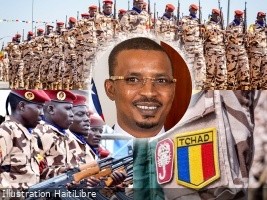
In a major development for the international effort to stabilize Haiti, the first group of 400 Chadian soldiers has already arrived and begun low-profile operations in the violence-plagued Caribbean nation, senior Chadian officials confirmed Monday. The deployment forms part of the United Nations-endorsed Gang Suppression Force (GSF), a multinational mission launched to dismantle powerful armed gangs that have paralyzed Haitian governance and displaced hundreds of thousands of civilians.
Chadian President Mahamat Idriss Déby announced the country’s full deployment plans in an official address delivered to the nation’s parliament and senate by National Assembly President Ali Kolotou Tchaïmi. Per the announcement, Chad will contribute a total force of 1,500 personnel split across two battalions of 750 troops each, with the entire contingent set to serve an initial 12-month tour of duty starting in April 2026. The first 400 troops have already completed their deployment to Haiti, joining the anti-gang campaign targeting armed criminal groups and urban terrorist networks.
Multiple coordinated cargo plane rotations have already delivered a full suite of heavy military equipment to support the mission, including armored vehicles, advanced surveillance systems, engineering machinery and weaponry. Most of this hardware has been transported to the purpose-built GSF headquarters base in Port-au-Prince, where construction to accommodate the incoming Chadian troops was accelerated by early equipment deliveries earlier this month. As of the latest updates, the infantry fighting vehicles included in the shipment have not yet been moved to frontline operational positions, sources familiar with the deployment confirmed.
The deployed hardware package is tailored specifically to counter the unique tactical challenges posed by Haiti’s gang-controlled territories. It includes wheeled armored infantry fighting vehicles of the BTR class or comparable models, fitted with defensive armor to protect troops from small arms and sniper fire while offering mounted fire support for ground operations. Military engineering assets include armored bulldozers and wheeled loaders, which are critical for clearing the concrete barriers and repurposed shipping containers gangs use to block access to their strongholds in neighborhoods like Cité Soleil and Village de Dieu.
The contingent also brings a fleet of tactical surveillance and attack drones that provide real-time aerial intelligence, allowing command teams to pinpoint the location of gang leaders ahead of coordinated ground raids. For counter-sniper operations targeting armed gang members positioned on Port-au-Prince’s rooftops, the force is equipped with heavy machine guns and long-range precision sniper rifles.
In a break from standard international deployment protocols, no official public ceremony was held to mark the arrival of the Chadian troops. Haitian government officials have also not released any public statements confirming the deployment, a choice driven by strategic operational security considerations. That deliberate lack of public fanfare has allowed Chadian forces to establish their presence in Haiti discreetly, avoiding early targeted retaliation from gang groups.