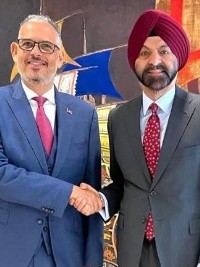
Top-level diplomatic discussions between Haiti’s leadership and the World Bank have opened a new chapter in international engagement over Haiti’s ongoing crisis, with the Caribbean nation’s prime minister laying out a clear three-pillar strategy for stabilizing the country and kickstarting economic revival. The high-stakes meeting took place on April 20, 2026, in Washington D.C., bringing together Haitian Prime Minister Alix Didier Fils-Aimé and World Bank Group President Ajay Banga to align on shared priorities for security and long-term recovery. Fils-Aimé was joined by a senior delegation comprising Haitian Foreign Minister Raina Forbin, Special Advisor Guerly Leriche, Haitian Ambassador to the United States Lionel Délatour, and leading economist Ludmilla Buteau Allien.
During the closed-door talks, attendees centered the conversation on Haiti’s fragile national context: while the Haitian National Police has made incremental security gains by retaking control of key strategic locations from armed groups, widespread gang violence continues to destabilize communities and derail economic progress, leaving the overall situation deeply concerning. Fils-Aimé argued that addressing the multifaceted crisis requires an integrated, holistic framework rather than piecemeal interventions, anchored in three core priorities: restoring consistent national security, strengthening institutional rule of law, and expanding inclusive economic opportunities for all Haitians.
In remarks following the discussion, the prime minister emphasized that security alone cannot resolve Haiti’s challenges. While foundational to any recovery, progress on public safety must be paired with tangible, on-the-ground actions that deliver tangible hope and improved prospects for the general population, he said. As Haiti prepares for upcoming national elections, Fils-Aimé stressed that creating immediate, high-impact employment – particularly for the country’s large youth population – is an urgent priority that cannot wait for long-term institutional reforms. He pushed for fast, results-driven intervention through large-scale labor-intensive public employment programs, which are designed to deliver visible, immediate benefits to struggling communities. “Every job created is a direct response to violence and exclusion,” Fils-Aimé emphasized.
Talks also touched on the need to move beyond outdated, conventional development models that have failed to deliver sustained progress in Haiti. Attendees agreed that future international interventions should prioritize measurable community impact, full financial transparency, and inclusive wealth creation that lifts marginalized populations rather than concentrating gains. The meeting marks a key step in advancing dialogue between Haiti’s transitional government and major international financial institutions, as the country works to chart a path out of years of political instability and gang-fueled violence.