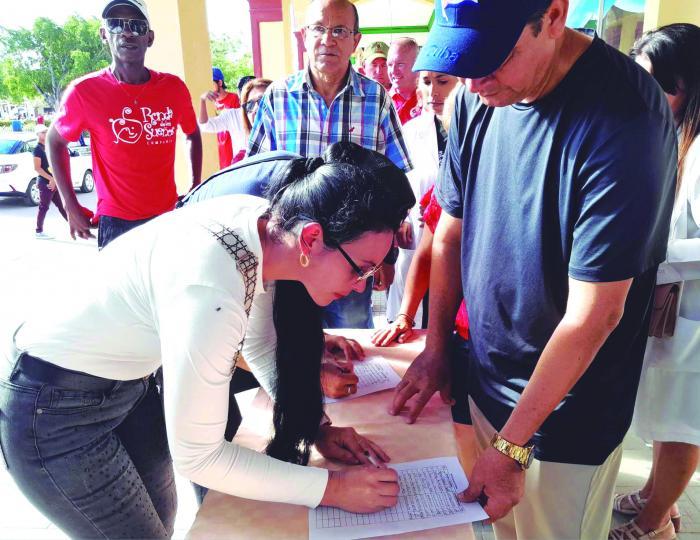
Sixty-five years after Cuban forces secured the first major military defeat of U.S. imperialism in the Americas at the Bay of Pigs, tens of thousands of Cubans across every province of the island have come together to participate in the nationwide “My Signature for the Homeland” movement, throwing unified public support behind the Revolutionary Government’s latest declaration of sovereignty.
Across the country, the movement brought together Cubans of all generations, professions and backgrounds, each adding their name to the statement to reaffirm national unity, reject long-standing foreign intervention, and defend the Cuban Revolution against ongoing external pressure.
In the southern coastal province of Cienfuegos, crowds gathered at José Martí Park to kick off local activities. Damián Cosme, an educator and recipient of Cuba’s Hero of Labor honor, emphasized his unwavering commitment to the revolutionary cause, stating he was prepared to fulfill every demand the Revolution placed before him, even giving his life if called upon. Anay Morera Guillen, secretary of the Central Workers’ Union of Cuba in Cienfuegos, added a clear message for the global community: “We are here to tell the world that Cuba will not surrender. Now, when the Homeland needs us most, we are more united than ever to overcome every adversity.”
Across central Cuba in Sancti Spíritus, the movement extended beyond collective public action to become a intergenerational family commitment for many participants. Transportation worker Andrés Concepción traveled to the signing event with his wife Yudiana, his adult son Dairon, and his young daughter Dina, describing the act as a personal and family duty driven by pure conviction. “These are moments to give a resounding yes to our country,” Concepción explained. “It’s the legacy from colonial times, but it’s also about continuity, which is of utmost importance. For us, it’s not over. There will be Cuba and the Revolution forever.” He framed his participation as a passing of legacy from his parents’ generation to his own, and on to his children and future descendants, noting no one had pressured him to attend: “It is a way of demonstrating to imperialism and the entire world the unity we have as a people, our rejection of the United States blockade, our repudiation of war, violence, and terrorism, and the commitment to peace that we have always had as a nation.”
In Bayamo, the historic hub of Granma province, generations of residents gathered in Revolution Square to echo the resolve that carried Cuba to victory at the Bay of Pigs, reaffirming that national freedom is non-negotiable. Representing the country’s veteran revolutionary combatants, Reynaldo Fernández Moreno denounced the ongoing harassment from the U.S. government: “The United States has not relented in its efforts to crush the Cuban Revolution through various plans of aggression to divide and destabilize us.” He also called out what he described as Washington’s hypocrisy, noting U.S. officials falsely accuse Cuba of supporting terrorism while carrying out thousands of subversive campaigns intended to break the Cuban people’s capacity for resistance.
At the Valle del Yabú Agricultural Enterprise in Santa Clara, veteran tourism worker Manuel Soliño Guevara, another Hero of Labor of the Republic of Cuba, added his signature after completing a day of volunteer farm work. He reaffirmed his commitment to the homeland, echoing the iconic revolutionary slogan first introduced by Fidel Castro 66 years prior: “Homeland or Death.” Soliño emphasized that unity of purpose is critical to protecting peace and preventing foreign military aggression, noting that Cuba has never posed a threat to any other nation.
In Santiago de Cuba, widely known as the cradle of the Cuban Revolution, commemorations for the 65th anniversary opened with flag-raising ceremonies at the province’s most iconic historic sites. Young activist Yesenia Acuña Borrero spoke at the Revolution Plaza named for fallen independence hero Antonio Maceo, in front of his equestrian monument, reaffirming: “Although we are a people who love peace, our flag will be defended at any cost.” Nearby, at the Guillermón Moncada Stadium, hundreds of residents of all ages gathered to celebrate the anniversary, which stands as a permanent demonstration of the Cuban people’s refusal to tolerate foreign interference or invasion. Local resident Yaney León added: “Without a doubt, I also take this opportunity to pledge my support for the Homeland, for our dignity, and for peace.”
In eastern Cuba’s Holguín province, thousands of signatories used their participation to reaffirm Cuba’s long-held core commitment to peace, paired with the unshakable conviction that defending national sovereignty is a supreme duty for all Cubans. At a patriotic gathering in Calixto García Park in the provincial capital, young public health professional Elaine Cruz Bobas spoke before the signature drive began, stating: “The truth of these people will not be silenced. The suffering of millions of Cubans as a result of the blockade and the brutal economic war is an act of genocide.”
At José Martí Park in Ciego de Ávila, provincial economy and planning worker Edilia Gutiérrez Cordero arrived early on the Sunday of the event. While her daily work centers on balancing budgets and calculating achievable development targets, on this day her task was to add her name to the statement of national commitment. “My signature for the Homeland is a way of saying: We are here,” she said, her voice cutting through the park’s bustle. She repeated the line firmly, standing against what she described as escalating imperialist threat. Gutiérrez explained that her signature carried both a yes and a no: it was a yes to Cuban sovereignty and national presence, and a resounding no to the war foreign powers seek to impose on the island. Even amid widespread economic hardship caused by the decades-long U.S. blockade, she described herself as happy: “Every day I make Cuba the way I want, because I feel free in the country where I was born. That freedom is not an empty phrase. It is the freedom to choose to stay, to build alongside my compatriots, and to stand in solidarity.”
In Las Tunas, hundreds of residents gathered in José Martí Square in front of a monument to the national hero to condemn the U.S. blockade and repeated threats from the U.S. government. University professor Carlos Alberto Suárez Arcos noted that the gathering was marked by hope and energy, pointing out that global solidarity actions for Cuba continue to grow because the island remains a powerful global symbol. “It is not a weapon of mass destruction, it is a soul of mass construction,” Suárez Arcos said.
In Camagüey’s Victoria de Girón neighborhood, the neighborhood named for the 1961 Bay of Pigs victory, hundreds of local residents gathered to add their signatures. Two young participants shared powerful reflections on the meaning of their participation. University of Camagüey student Yolanda Molina Castillo emphasized that her signature was no empty gesture, noting: “History confirms our tradition of struggle, and the examples are written in the blood of thousands of men and women who fell for this freedom and peace we enjoy.” Juan Carlos Blanco, another young Camagüey resident, told reporters his signature was a binding oath: “I signed for Cuba and for Fidel, for the Homeland, the Revolution, and Socialism. My signature is my commitment to defend our future, our principles, and our sovereignty.”
In the eastern border province of Guantánamo, at the historic Arroyo Hondo agricultural complex where Cuban independence leaders José Martí and Máximo Gómez relaunched their revolution in 1895, agricultural worker Taylienis Acosta Jiménez put forward a clear message to U.S. political leaders threatening Cuba. “Here are my hands, if needed to save the Revolution,” she said. “I am like my people: peaceful. Gringo, think before you attack us. If you do, there will be deaths and grieving families on both sides; something very painful. It is your responsibility to prevent it.”