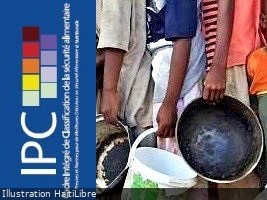
In an official presentation hosted at Port-au-Prince’s Montana Hotel on April 16, 2026, Haiti’s National Food Security Coordination (CNSA) released updated Integrated Food Security Phase Classification (IPC) data that paints a deeply concerning picture of the country’s ongoing food crisis, even as it notes limited, localized progress. The new analysis projects that between March and June 2026, Haiti’s annual lean season, more than 5.83 million people – equal to 52% of the population evaluated in the study – will experience acute food insecurity severe enough to qualify as IPC Phase 3 (Crisis) or higher. Compared to the CNSA’s September 2025 projection, which estimated 5.91 million people would fall into these high-risk phases, this marks a small improvement. Similarly, the number of people projected to face the most severe Phase 4 (Emergency) conditions has fallen slightly from 2 million to 1.9 million, or 16% of the analyzed population. However, CNSA analysts warn that these marginal gains are far too small to reverse the overall downward trajectory of food security across the Caribbean nation. The limited improvements can be traced to three key factors: a slowdown in Haiti’s rampant annual inflation, generally favorable growing conditions during the winter agricultural cycle, and improved access to movement along a small number of key roadways. Inflation has cooled from 31.9% in September 2025 to 22.1% as of February 2026, but global market shocks have erased much of this progress. The recent outbreak of conflict in the Middle East and subsequent blockade of the Strait of Hormuz have sent major disruptions rippling through the global food supply chain, with immediate, negative consequences for Haiti, which relies heavily on imported food staples. When compared to the most recent six-month period from September 2025 to February 2026 – when 5.7 million people faced Phase 3 or higher food insecurity – the upcoming lean season will bring a clear net deterioration in conditions for Haitian households. Two primary drivers are fueling this deepening crisis: escalating armed violence across the country and lingering damage from last year’s major hurricane. Today, armed non-state gangs control approximately 90% of the Port-au-Prince metropolitan area. Chronic violence has crippled Haiti’s already fragile economy, blocked the movement of critical food supplies and civilians, and pushed thousands of vulnerable Haitians into desperation, with many forced to join armed groups just to secure enough food to feed their families. In October 2025, Hurricane Melissa made landfall in southern Haiti, bringing catastrophic torrential rain, widespread flooding, and deadly landslides that destroyed homes, infrastructure, and cropland across the Grand Sud region, portions of the west coast near Petit-Goâve and Port-au-Prince, and the southeastern department. The ongoing economic collapse has compounded hardship for communities still recovering from the storm’s damage. Of the 30 administrative areas evaluated in the latest IPC analysis, 10 remain classified as Phase 4 Emergency. These high-risk zones include two districts in the Northwest Department, three zones in the Artibonite Department outside Gonaïves, the Lower Plateau, all internally displaced person camps, the island of La Gonâve, the Belle-Anse district in the Southeast Department, and the low-income neighborhoods of Port-au-Prince including Cité Soleil. Every other region of the country is projected to remain in Phase 3 Crisis for the March-June 2026 period. In response to these findings, the CNSA has outlined three core priority actions for national and international stakeholders. First, emergency life-saving interventions are immediately required for all Phase 4 areas. These responses must prioritize supporting the poorest and hardest-hit households to meet their basic food needs, close critical consumption gaps, and prevent the total, permanent loss of household livelihoods. Second, targeted support to rebuild livelihoods is critical to strengthen long-term resilience. Successive climate and economic shocks have eroded household ability to recover from crises, so rapid support to restore productive assets – including the distribution of agricultural inputs, livestock support, rural credit, direct material aid, and cash transfers – is essential to support the 2026 spring planting season and help families restore their independent income streams. Finally, the CNSA emphasizes the urgent need to connect emergency food response to long-term development and peacebuilding efforts. Chronic limited access to basic services and long-standing governance gaps continue to worsen food insecurity for Haitian households. Tying together emergency relief, development programming, and peacebuilding work is the only way to create sustainable, transformative improvements in food and nutrition security and build lasting stability in the country’s most affected regions.