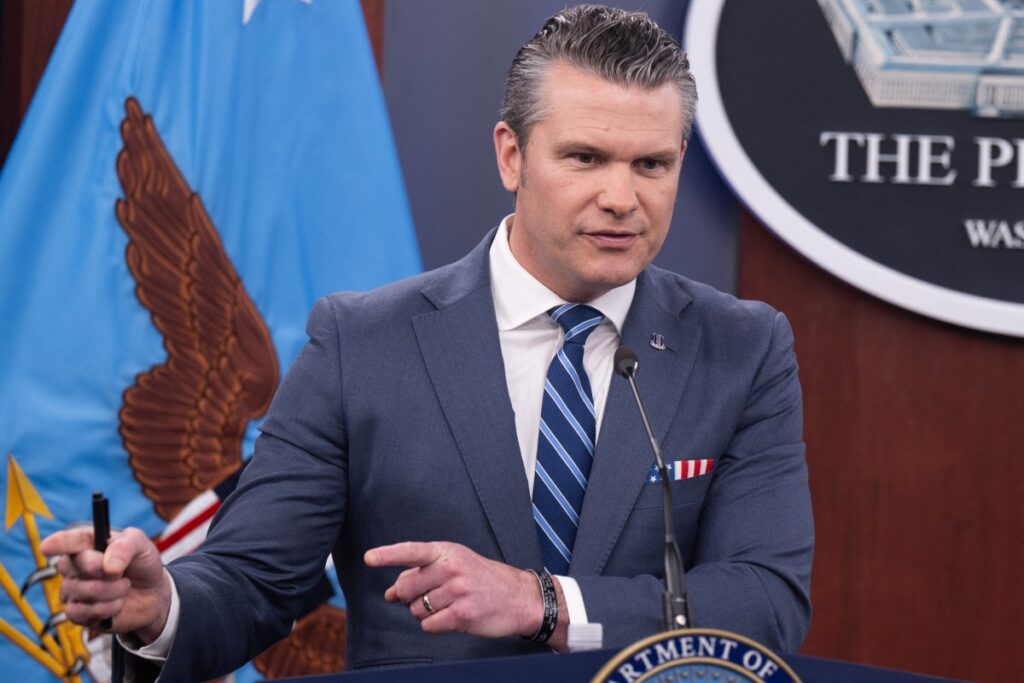
In a blunt press briefing held at the Pentagon on Thursday, United States Defense Secretary Pete Hegseth issued a stark warning to Iran: Washington will maintain a full blockade of the country’s ports for however long is required to force a negotiated settlement, and will launch new military strikes if Tehran rejects a diplomatic outcome.
Hegseth made clear the consequences of Iran walking away from talks, stating, “If Iran chooses poorly, then they will have a blockade and bombs dropping on infrastructure, power and energy.”
The blockade officially went into effect at 14:00 GMT this Monday, launching just one day after a new round of peace negotiations in Pakistan concluded without any breakthrough agreement between the involved parties. Dan Caine, the highest-ranking active U.S. military officer, clarified that the restrictions are universal, applying to all commercial and military vessels sailing to or from Iranian territorial ports, no matter what flag they sail under.
Standing alongside Hegseth during the briefing, Caine added that non-compliance will be met with immediate force, but noted that so far, 13 vessels bound for Iranian ports have chosen to alter course and avoid confrontation.
Hegseth also used the briefing to accuse Iranian leadership of attempting to recover and reactivate military equipment that survived five weeks of joint U.S.-Israeli airstrikes across the country. Speaking directly to Iranian officials, he asserted that U.S. intelligence is fully tracking all movements of remaining military assets, arguing that Tehran’s efforts to rebuild its capabilities are futile while U.S. military position continues to strengthen.
“You are digging out your remaining launchers and missiles with no ability to replace them — you have no defense industry, no ability to replenish your offensive or defensive capabilities,” Hegseth said.
Admiral Brad Cooper, commander of U.S. Central Command which oversees all American military operations across the Middle East, confirmed that U.S. forces are using the current lull in active large-scale strikes to bolster their own position. He emphasized that the U.S. military is rearming, refitting, and refining its operational tactics to prepare for any future escalation, noting that no other global military can adapt to changing battlefield conditions as quickly as the United States.