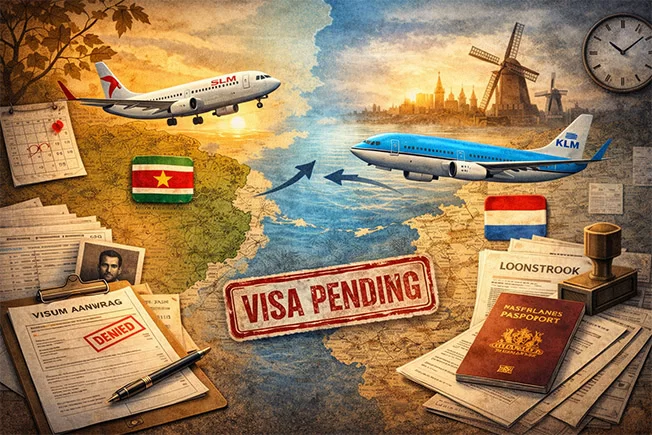
Seated in her favorite rocking chair, an 85-year-old Surinamese woman waits, her gaze fixed on a door that will not open this month. She celebrates her milestone birthday this week, and her son, who lives across the Atlantic in Suriname, has longed to hold her, speak to her without a crackling phone line between them, and see her one last time before it is too late. He will not make it — not for lack of desire, not for lack of money to pay for the trip, but because the rigid Dutch Schengen visa system has shut him out.
For Surinamese citizens hoping to travel to the Netherlands, entering the country is not a simple matter of planning a trip. It is an exhaustive, dehumanizing gauntlet of bureaucratic requirements that reduces a deeply personal family reunion to a mountain of paperwork and invasive checks. Applicants must surrender full access to their private financial lives, turning over three months of bank statements, employment verification letters, pre-booked flight tickets and travel insurance. Every document is meant to prove one thing: that they are not a “risk” that will overstay their visa, and that they will definitely return to Suriname after their visit — even when their only goal is to spend time with an aging parent.
Even having a sibling already residing in the Netherlands who agrees to sponsor the trip is not enough to cut through the red tape. The sponsor must also disclose all of their personal financial details, submit pay stubs, share private identifying information and take on full financial guarantee for the traveler’s entire trip, covering all food and travel costs. What should be a heartfelt family gathering is reduced to nothing more than spreadsheets, numbers and constant government scrutiny.
After applicants complete the extensive online paperwork, the real waiting begins. Securing an in-person appointment through the visa processing system is already an ordeal, with waiting times stretching more than a month for an available slot. Once a traveler finally makes it to a VFS Global processing center, they walk out €90 poorer and no less uncertain about the outcome of their application. The response is coldly corporate: applicants can expect to wait a minimum of one month just to get a decision. As of mid-April 2026, applications submitted all the way back in January are still being processed, making travel in the same month impossible, and forcing applicants to reschedule their appointments from scratch.
The crushing nature of the system becomes even clearer when checking for new appointment slots. On April 13, 2026, the earliest available appointment date was May 29, 2026. Even after that appointment, the processor requires a minimum of another month to review the application — despite all documents already being submitted electronically more than a month prior. By that time, the financial guarantee submitted by the family and the purchased travel insurance will both expire. What this all means is simple: the son will not get his chance to celebrate his mother’s birthday with her in person.
A comparison to U.S. visa processing highlights how deeply dysfunctional the Dutch system is. Even under the often unpredictable U.S. immigration system, the process is clear and fast. Applicants know what to expect, receive an immediate decision after their in-person interview, and get their passports back within a week — often with a multi-year five-year visa that allows future travel. The rules may be strict, but the process is organized, efficient, and treats applicants with basic dignity.
That human element has been completely erased from the Dutch visa system. Dutch officials routinely deflect blame, pointing to Brussels, Schengen Area rules, and shared European policy as justification for the strict process. But for applicants, who bears responsibility does not change their lived experience: the system is slow, cold, demeaning, and inhumane.
This disconnect is all the more striking given the centuries-long deep historical and social ties between the Netherlands and Suriname. Lofty diplomatic rhetoric and official state visits do nothing to change the reality on the ground for ordinary Surinamese families. The contrast becomes even more glaring when the situation is reversed: Dutch citizens traveling to Suriname can apply for an e-visa online and receive their approval via email within a matter of days, with no stacks of paperwork, no months-long waiting, no constant uncertainty. They get straightforward, simple access.
For Surinamese people, a visa to the Netherlands is never just a travel document — it is an almost insurmountable barrier. It is a weeks-long journey marked by constant stress, crippling uncertainty, and total dependence on a bureaucratic system that does not care about individual circumstances. The system makes no exceptions for advanced age, for running out of time, for the need to say goodbye to a dying loved one.
Today, families are trapped on opposite sides of the Atlantic, a distance that modern air travel could easily bridge in a single day on KLM or Surinam Airways flights. Surinamese people who hold Dutch passports often note that a purple EU passport is just a travel document, but the reality is that it grants them the freedom to travel between the two countries whenever they want, to enjoy life in both nations, and pack a suitcase at a moment’s notice. This painful family separation exposes that the fight is about far more than just a piece of paper: it is about equal access, basic human dignity, and freedom of movement. One group can travel whenever they choose; the other must jump through endless hoops just to prove they deserve the right to see their own family.
As the 85-year-old mother waits for a son who will not come, the system’s failure is laid bare. It has forgotten the human core of what it is meant to facilitate: people who want to see each other one last time, before it is too late. There will be no visa for a birthday visit. If the worst comes to pass, the family may only qualify for an emergency visa for a funeral.