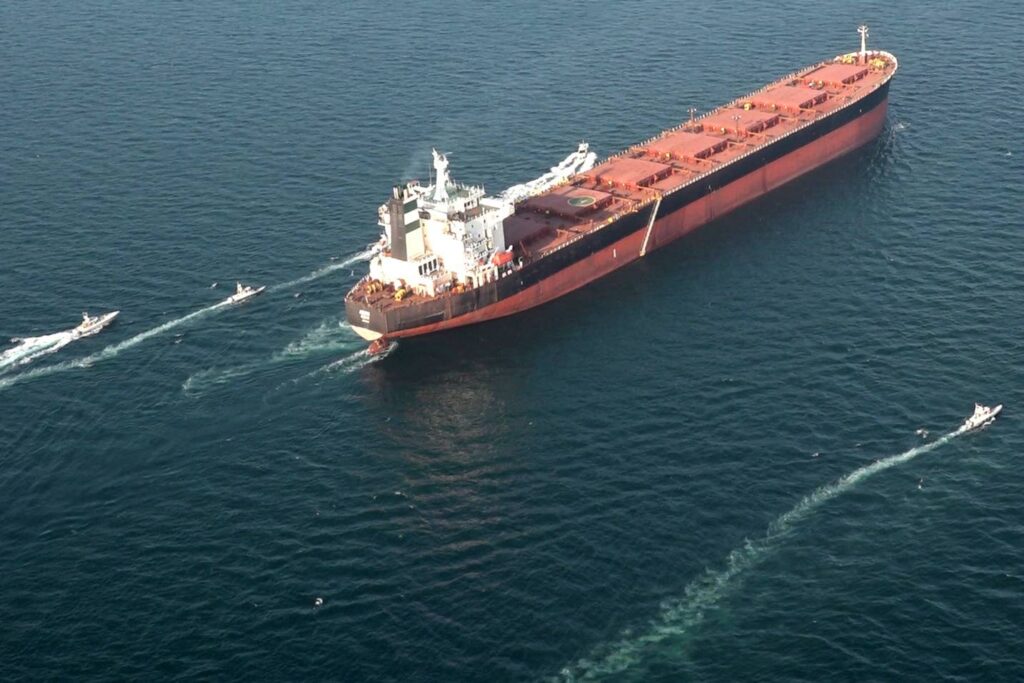
After days of high-stakes closed-door negotiations in Islamabad, hopes for a breakthrough deal to de-escalate months of escalating conflict between the United States and Iran have completely collapsed, leaving U.S. President Donald Trump trapped between a set of unappealing policy choices that carry major domestic and international risks ahead of upcoming midterm elections. U.S. Vice President JD Vance, who led the American negotiating team in marathon talks with senior Iranian officials, left Pakistan without any framework for an agreement, shattering earlier expectations that a deal could ease the tensions that have rippled across the entire Middle East since conflict erupted in late February.
The core challenge now centers on Trump’s earlier order to implement a full naval blockade of the Strait of Hormuz, the strategic chokepoint that carries roughly one-fifth of the world’s daily oil shipments, set to take effect this Monday. Independent regional and security analysts across the globe have warned that moving forward with the blockade would only complicate an already intractable crisis, while walking back the threat would undermine the Trump administration’s repeated public claims that Iran had been cornered and had “no cards” left to play.
Domestically, ramping up military action carries significant political risk for Trump’s party ahead of the midterms. American voters are already grappling with surging gasoline prices driven by market uncertainty over Middle Eastern oil supplies, and a new round of escalation could further alienate an already skeptical electorate. The broader global economic impact also looms large: the proposed blockade would do little to ease the market volatility that has pushed energy prices higher in recent months, deepening the economic jitters already facing major economies worldwide.
Many foreign policy experts have criticized the Trump administration’s approach to the crisis as unplanned and reactive. Brian Katulis, a senior fellow at the Washington-based Middle East Institute, argued that Trump’s off-the-cuff rhetorical style and frequent aggressive threats—what he describes as the president’s “carnival barker” approach—have left senior White House and Pentagon officials constantly scrambling to adjust policy with no clear long-term strategy. “He may be simply buying more time to move in more military assets or because he doesn’t know what else to do. I wouldn’t call it a strategy; it is a military-centric approach without strategy,” Katulis told AFP in an interview.
Shibley Telhami, a leading scholar of Middle Eastern affairs at the University of Maryland and a nonresident fellow at the Brookings Institution, called the threat of a Hormuz blockade “bewildering and seems self-defeating.” He noted that Iran already has deep-seated distrust of Trump, and the unilateral threat has done lasting damage to America’s global diplomatic credibility. “Hard to understate what this makes of what’s left of America’s global credibility,” Telhami said.
Tehran has already issued a sharp warning in response to the blockade threat. Iran’s powerful Revolutionary Guards, the country’s elite military force, pledged over the weekend that any hostile move against the strait would trap Tehran’s enemies in a “deadly vortex” of prolonged conflict.
Israeli security analyst Danny Citrinowicz, a fellow at the Institute for National Security Studies in Tel Aviv, echoed the widespread skepticism that a blockade would force Iran to back down. “There is little reason to believe that a blockade would force Iranian capitulation. If anything, Iran’s demonstrated resilience thus far suggests the opposite,” Citrinowicz posted on the social platform X. He added that Iran’s size and mature military capabilities mean any sustained blockade would require massive, long-term commitments of American military and financial resources, a burden that the U.S. is poorly positioned to take on at this moment.
Public opinion polling suggests that a prolonged military engagement would face significant pushback from the American public. A CBS News poll released Sunday found that negative emotions—worry, stress, and anger—far outweigh feelings of safety and confidence among U.S. adults when asked about the ongoing conflict. More than 80 percent of respondents said the U.S. should prioritize reopening the Strait of Hormuz to improve global oil access, lower domestic gas prices, and support greater freedom for the Iranian people, but fewer than 10 percent believe the Trump administration has made progress on any of those goals.
“ I don’t see how, 40 plus days into this war, that we are safer, that our allies are safer. I’m not even sure Israel is safer,” Democratic Senator Mark Warner said Sunday on CNN’s *State of the Union*. “I don’t understand how blockading the strait is going to somehow push the Iranians into opening it. I don’t get the connection there.”
Returning to sustained, meaningful negotiations also faces major hurdles, after Trump pulled the U.S. out of the 2015 multinational nuclear accord with Iran, which had restricted Tehran’s nuclear program in exchange for relief from crippling international sanctions. Democratic Senator Tim Kaine noted that the U.S. withdrawal from that previous agreement destroyed any remaining trust Iranian leaders might have had in Washington’s commitments. “This is not going to be an easy negotiation because the last negotiation that led to a control of Iran’s nuclear programme, the US made the decision to tear it up and walk away from the deal,” Kaine told CNN.
Katulis echoed that assessment, arguing that mutual distrust runs deep on both sides. “Iranian officials are also untrustworthy and duplicitous, but the Trump Administration is providing the mirror image of that,” he said. “If I were an Iranian official leaving Islamabad, I would wonder if I am back on the Israeli kill list.”