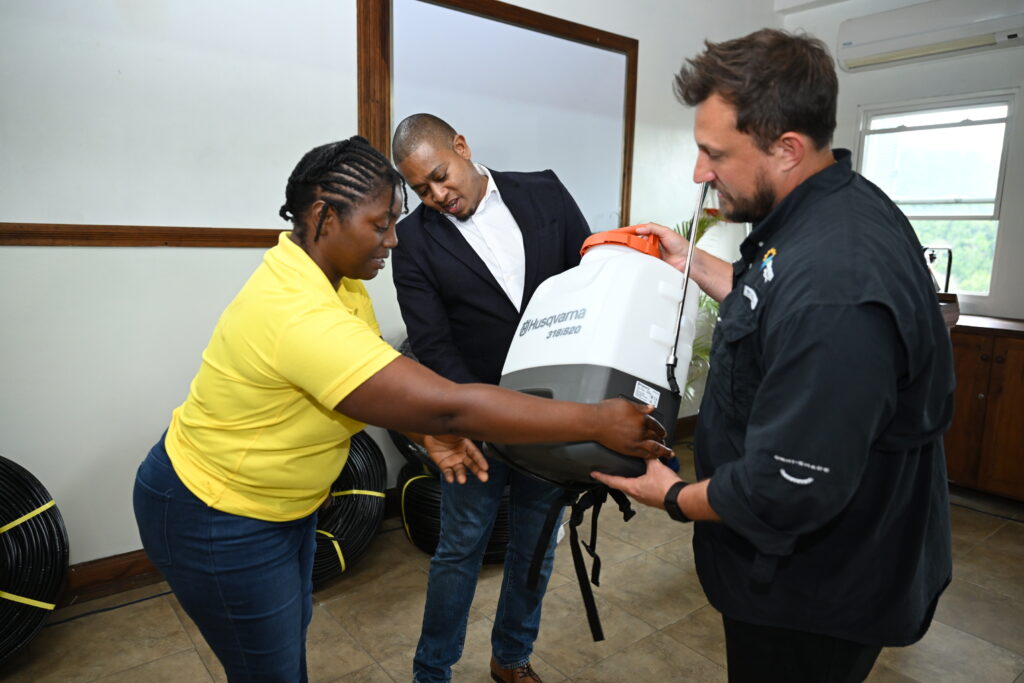
Five months after Hurricane Melissa swept across Jamaica, leaving widespread destruction in its wake, hundreds of agricultural producers across the island are set to receive targeted, long-term support through the newly launched Isratech Resilience Farm Tour, a private-sector led initiative focused on rebuilding livelihoods and strengthening climate preparedness.
Organized by local firm Isratech Jamaica Limited, the program delivers hands-on support to farmers in targeted parishes, with no-cost access to critical resources ranging from technical farm assessments and irrigation infrastructure to seedling trays, enriched soil, and other core production inputs. Beyond immediate disaster relief, the initiative is rooted in advancing climate-smart agricultural practices that build long-term adaptive capacity for producers navigating increasingly frequent extreme weather events.
Speaking at the program’s official launch held at Isratech’s Kendal offices in Manchester on April 8, company Chief Executive Officer Benjamin Hodara explained that the effort was developed in direct response to unmet needs of producers who have continued to struggle long after the hurricane’s immediate aftermath passed. Agricultural recovery is not a quick process, Hodara emphasized: the damage inflicted by major storms extends far beyond destroyed standing crops, unraveling entire production cycles and shattering household livelihoods that depend on consistent harvest income.
“Farmers across the country took a serious hit, and while the hurricane happened over five months ago, recovery takes time,” Hodara said. “When disaster strikes, income stops, cycles are broken, and the road back is harder than many realise. What farmers need is not just relief, but confidence that they will be supported when they reinvest.”
The Resilience Farm Tour builds that confidence by bringing support directly to farming communities across the island, Hodara noted. Each participating farm will also operate as a local demonstration site, allowing neighboring producers to observe modern, climate-adapted agricultural solutions perform under real Jamaican growing conditions, creating a ripple effect of knowledge sharing across the sector. A key priority of the initiative is lifting up women in agriculture, aligned with the national observation of 2026 as the Year of the Female Farmer.
Georgette Henry-Morgan, a young farmer based in Manchester, where much of the hurricane’s damage was concentrated, praised the program, noting that local producers still grapple with severe long-term impacts including destroyed greenhouses and damaged critical infrastructure that has cut production capacity for many operations. The comprehensive package of resources and guidance provided through the tour, she said, will meaningfully boost producers’ ability to rebuild and boost output.
“We don’t just want to recover; we want to recover stronger. With the right support, we can build a more resilient agricultural community better equipped to face future challenges,” Henry-Morgan said.
Garnet Edmondson, Chief Executive Officer of the public sector Rural Agricultural Development Authority (RADA), has formally endorsed the initiative, highlighting the critical role of public-private partnerships in advancing a more sustainable, climate-resilient agricultural sector across Jamaica. He noted that the Isratech-led program aligns perfectly with RADA’s long-term strategic goals to improve on-farm water management, empower underrepresented groups including young and women producers, and advance the country’s broader targets for agricultural innovation and national food security.