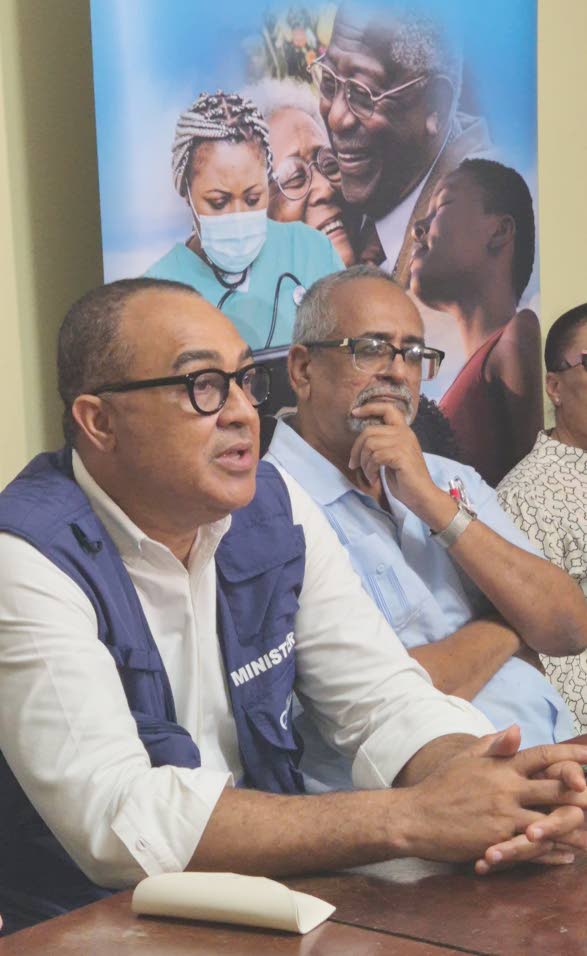
MONTEGO BAY, St James — In a Thursday press briefing held at Cornwall Regional Hospital (CRH), Jamaica’s Minister of Health and Wellness Dr. Christopher Tufton has issued a direct challenge to the Jamaica Medical Doctors’ Association (JMDA), calling on the organization to share specific information it claims to hold about qualified local medical professionals ready to fill positions left vacant by the recent departure of over 200 Cuban medical personnel.
Tufton clarified that the departing Cuban workers had been brought in to fill longstanding gaps that Jamaica’s domestic medical workforce had been unable to cover for years. “There has been a call recently by the JMDA suggesting that we hire locals to fill the gap, now that the Cubans have returned to their country,” the minister noted. “I just want to make it clear that the Cubans were here to fill positions that we had difficulties finding locals for. To the extent that those locals are available, and the JMDA has information on that, then send that information in to us. We’ll be more than happy to hire them once they’re qualified.”
Addressing the complexity of the ongoing staffing crisis, Tufton explained that most of the vacant roles are specialized positions that have consistently struggled to attract qualified local candidates. “The positions of these nurses and doctors, in most cases, are that they were the specialist nurses. Their role was to fill gaps that we have that we could not fill with locals, because locals were not available, and the challenge continues to be how to fill those slots,” he said.
To address the shortage, the Jamaican health ministry has launched two major recruitment drives: one targeting Jamaican medical professionals working abroad, and another sourcing qualified specialists from other countries. Tufton confirmed that around 70 interviews with diaspora-based applicants are already underway in Kingston, following targeted advertising for open roles to the global Jamaican medical community.
Discussions to bring in foreign specialists are also at an advanced stage, with new employment agreements set to be signed in the coming months with medical professionals from Nigeria and Ghana. The ministry has also opened talks with Apollo, a major hospital and health system based in India, to source additional talent. “The recruitment — to the extent that we don’t have the talent here — of those talents is continuing. We do anticipate over the next few months to be able to fill out those positions,” Tufton predicted.
CRH, one of the island’s major public health facilities, has been hit particularly hard by the Cuban medical exit. Of the 27 Cuban medical workers who left the hospital, 22 were specialized nurses, with the remaining posts held by doctors and radiotherapists supporting the facility’s oncology cancer treatment unit. While CRH has already expanded its local workforce by adding 25 registered nurses, 18 patient care assistants, six additional doctors, one junior resident, five senior house officers, two dental interns, and one medical technologist, these new hires have not replaced the specialized expertise lost when the Cuban team departed.
Four critical radiotherapy posts in the oncology department remain unfilled, and hospital administrators have been forced to adjust work scheduling to maintain core services, doubling up existing staff on shifts to keep care running. “I just toured the facility, and the leaders there have said that they have doubled up the staff that they have to continue the regular scheduling, but it’s very difficult. Work continues, but we do have a gap in terms of four radiotherapists,” Tufton confirmed. The ministry is currently making emergency arrangements to bring in temporary and permanent replacements for these critical roles.
The departure of the Cuban medical team came after the Jamaican and Cuban governments failed to reach a new agreement last month to extend the decades-long staffing arrangement. The Jamaican government has stated that Havana would not agree to revised contract terms aligned with Jamaican national law and international labor conventions. However, critics, including the Cuban government, have argued that the decision stems from Jamaica bending to diplomatic pressure from the United States. The end of the arrangement brings a close to over 50 years of partnership that gave millions of Jamaicans access to low-cost, high-quality medical care across the island.