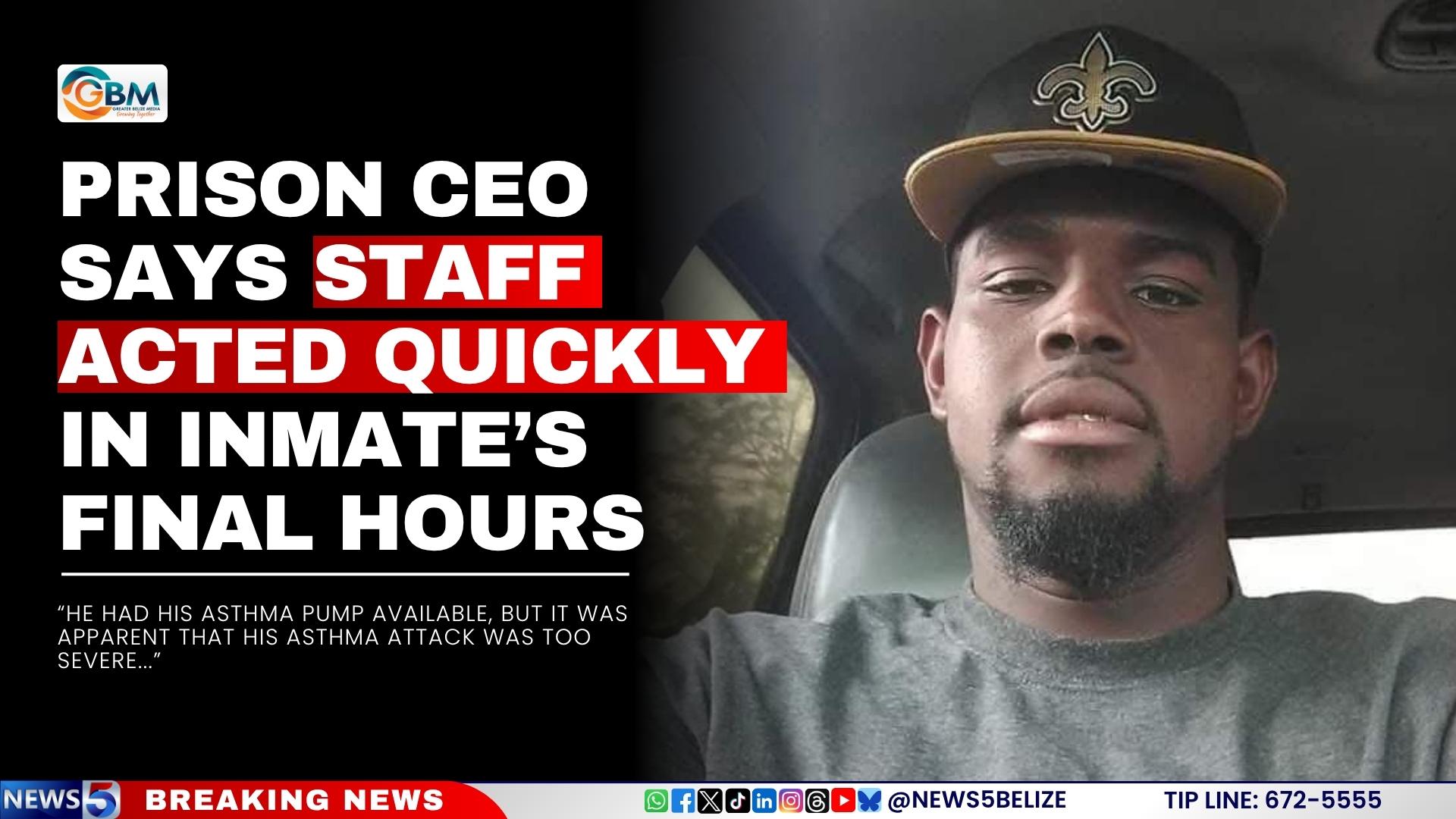
Public debate over the standard of medical care provided to incarcerated people in Belize has been reignited following the recent death of an awaiting-trial inmate at Belize Central Prison.
Phillip Bowen, a 40-something man with a chronic asthma diagnosis who was awaiting trial on 2020 double murder charges linked to an incident in Hopkins Village, suffered a life-threatening asthma attack in the prison early on the morning of April 8, 2026, and died before he could reach a public hospital for emergency care.
Belize Central Prison is operated under contract by the Kolbe Foundation, whose chief executive officer Virgilio Murillo has publicly pushed back against growing concerns from Bowen’s family and the general public, defending the speed and competency of on-site prison staff’s response to the incident.
According to Murillo’s official account of the event, staff first received word that Bowen was experiencing respiratory distress at approximately 7:20 a.m. immediately after Bowen himself requested medical assistance. He was quickly escorted to the prison’s on-site medical center, where he accessed his own asthma inhaler — but the attack proved far more severe than the device could manage. “His asthma attack was too severe that even with the pump it was not adequate to help him,” Murillo explained in a press briefing.
Following the failure of on-site intervention, prison staff moved immediately to transfer Bowen to the Karl Heusner Memorial Hospital (KHMH), Belize’s main public tertiary care facility. Murillo emphasized that the entire transfer process proceeded without any avoidable holdup: the prison maintains a dedicated standby ambulance for emergencies, and Bowen was loaded into the vehicle for transport just seven minutes after staff first became aware of his condition. Unfortunately, he died while the ambulance was still en route to the hospital, just moments from the facility’s entrance, Murillo confirmed.
“Based on what I have been told so far, it was very timely and there was no delay,” Murillo told reporters, reaffirming that every correctional and medical staff member on site followed emergency protocol to the letter.
Bowen’s death has not only left his family grieving but also brought long-simmering questions about correctional health care back to the forefront of public discourse in Belize. Critics and loved ones of incarcerated people with pre-existing chronic conditions have repeatedly called for more rigorous inspections, expanded on-site care resources, and clearer accountability frameworks to prevent preventable deaths behind bars. For now, Murillo’s statements confirm that an internal review of the incident is ongoing, but the prison leadership stands by the actions of its staff in Bowen’s final hours.