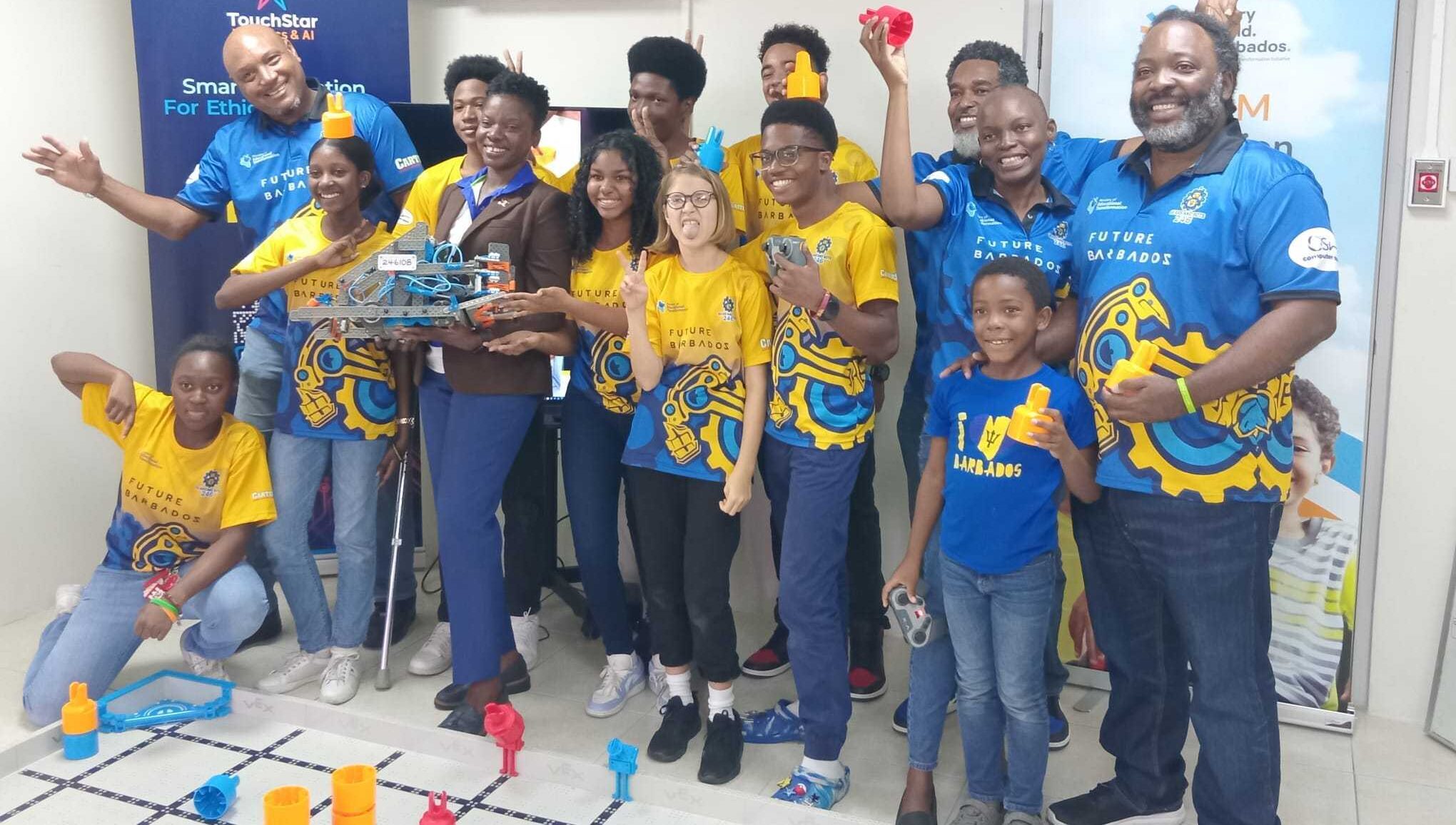
A cohort of talented secondary school students from across Barbados is set to make history this month, representing the small Caribbean island at the 2026 VEX World Robotics Championship in St. Louis, Missouri, following five months of nonstop work to design and build two fully custom competition robots from the ground up.
Organized under the banner of the Gears Unboxed 246 Robotics Club, the team draws members from five of Barbados’ top secondary institutions: The St Michael School, Harrison College, Queen’s College, The Lodge School, and the Foundation School. Last week, the young innovators gathered at the Special Education Unit to showcase their months of work to educators, government officials, and program sponsors, demonstrating the core capabilities of their two creations, codenamed *Flying Fish* and *Broken Trident*.
For the team’s volunteer mentors, this milestone is far more than a simple competition trip—it represents a decades-long push to shift Barbados’ relationship with technology from a net importer of foreign ideas and devices to a global exporter of homegrown innovation. “This is about representing the blue, yellow, and black of our nation,” said Shawn Hoyte, a lead coding and robotics mentor and teacher. “I told these young people from day one: this is not beyond us. We can’t keep relying on other countries to build our technology and create our ideas. These are indigenous innovations, built right here by Barbadian youth. They aren’t just leading the way for our country—they are the tip of the spear.”
To reach this point, the team has followed a grueling schedule that far outpaces the average school extracurricular. For five months, members have worked from 9 a.m. to 8 p.m. most days, including weekends, to troubleshoot designs, refine code, and test their robots. What makes the achievement even more notable is that most elite international competitors spend a full year preparing for the championship, while the Barbadian team condensed that entire process into half the time.
Twelve-year-old Paula Bridgeman, a robot builder and driver from Queen’s College, walked audiences through the design of *Flying Fish*, the team’s entry in the championship’s pin-stacking competition, where teams earn points for strategically grouping colored pins. “The autonomous section is where the robot operates entirely on its own, completing all tasks without any human control,” Bridgeman explained. “A single connected pin earns one point, but mixed-color connected clusters give a five-point bonus, so the robot’s positioning and decision-making have to be perfectly calibrated.”
Fifteen-year-old Tykiari Sergeant, a team member from Harrison College, detailed the steep learning curve the group faced to master advanced engineering concepts they had never studied before, including pneumatics and gear ratio tuning. “Every gear on this robot serves a specific purpose—it’s not just for aesthetics,” Sergeant said. “Adjusting the number of teeth on a gear changes the robot’s speed and torque, so we had to test dozens of combinations to get it right. We went through so many iterations because of stability issues, but after hours of research and trial and error, we finally landed on a design that worked.”
Joshua Jupiter, 15, from The St Michael School, explained the team’s advanced technical work on autonomous navigation, noting that they implemented a custom Proportional Integral Derivative (PID) control algorithm to let the robot automatically correct its course during the fully autonomous phase of competition. The team’s second robot, *Broken Trident*, built for the VEX V5 division, features a one-of-a-kind S-shaped intake system engineered to collect and score game balls with far greater efficiency than most standard designs.
The milestone drew praise from top leaders in Barbados’ education sector, with Chief Education Officer Dr. Ramona Archer-Bradshaw in attendance at the demonstration to celebrate the team. Dr. Archer-Bradshaw’s presence was particularly meaningful, as she has been one of the core driving forces behind bringing robotics education to Barbados’ schools for more than a decade. The entire initiative has been made possible by private sponsor support and the volunteer work of teachers who have stepped outside their regular job duties to serve as mentors for the students.
Looking back, Dr. Archer-Bradshaw recalled the origins of the movement back in 2013, when she was a science tutor at Erdiston Teachers’ Training College with a simple but ambitious dream: to embed coding and robotics into Barbados’ national K-12 curriculum to build critical thinking skills among young people. “This journey didn’t start yesterday, and it didn’t start last year—it started back in 2013, when I believed that coding and robotics could change how our children learn to problem-solve,” she shared.
The initiative grew out of an early partnership with the Caribbean Science Foundation and prominent Barbadian scientist Cardinal Ward. After completing personal training in robotics drivetrain design and block coding, Dr. Archer-Bradshaw led a nationwide effort to train teachers across Barbados, an effort that has now resulted in more than 300 local educators earning certification in various VEX robotics platforms.
While qualifying for the world championship represents the highest milestone for the program to date, Dr. Archer-Bradshaw emphasized that the initiative’s true value extends far beyond competition results. “Some people will look at this and say it’s just coding and robotics, but it’s so much more than that,” she explained. “This is a vehicle to teach young people how to think critically, how to solve problems, how to bounce back when you make a mistake, and how to collaborate and communicate with your teammates. Those are skills that will serve them for life, no matter what career they choose.”
The program expanded dramatically in 2022, when the Ministry of Education Transformation supported the integration of coding into nursery, primary, and secondary school curricula, with education reform leaders spearheading sustainable institutional change. The expansion led to the appointment of a dedicated full-time education officer to oversee the program and ensure its long-term growth. When program coordinator Kenneth Harewood first approached Dr. Archer-Bradshaw last year to request support for sending a team to the world championship, she issued a clear challenge: this could not be a one-off event. The team had to build a pathway for future Barbadian teams to compete in years to come. The team met that challenge, clearing the way for this month’s 2026 trip and establishing a sustainable pipeline for future participation.
The Gears Unboxed 246 team enters the championship focused on their ultimate goal of bringing home the world title, a win they frame as a history-making moment for Barbados’ education and technology sectors. “These students deserve to be celebrated, because nothing like this has ever been done for Barbados,” Hoyte said. “I love taking on challenges, and even with all the hard work, nothing compares to the pride of watching these young people represent our country on the world stage.”
Closing out the demonstration, Dr. Archer-Bradshaw credited the initiative’s success to the hundreds of dedicated teachers across the island who have poured extra time into making the program a life-changing opportunity for Barbadian youth. “I’m so happy that the vision and the dream of coding and robotics in our schools has finally come to pass,” she said, as the audience erupted in applause for the departing team.
The 15-member team includes competitors across two divisions: the VEX IQ team features Virineia Lakuboo (1st form, Harrison College), Joshua Jupiter (3rd form, St Michael School), Paula Bridgeman (2nd form, Queen’s College), and Tykairi Sargeant (4th form, Harrison College). The VEX V5 team includes J’nai Thomas (5th form, Christ Church Foundation), Nathan Whittaker (4th form, Alleyne School), Ashley Chase (5th form, St Michael School), and Tyler Marshall Branker (5th form, Christ Church Foundation).