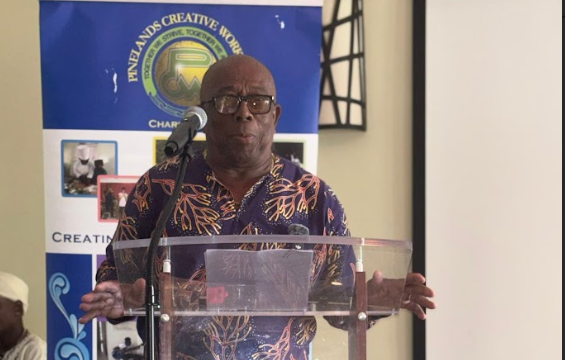
One of Barbados’ most cherished, centuries-old community cultural institutions is facing an identity crisis as growing commercialization for tourism pulls it away from the working-class grassroots roots that gave it life, the island’s Minister for Pan-African Affairs and Heritage Trevor Prescod has warned.
Prescod shared his concerns Wednesday during a cultural heritage workshop hosted by the Pinelands Creative Workshop (PCW), arguing that the core spiritual essence of the Barbados Landship can only survive when anchored in the rural village communities that spawned the movement more than 160 years ago.
Originating in 1863 in Licorish Village, My Lord’s Hill, the Landship is a one-of-a-kind cultural tradition modeled after a seafaring vessel, featuring naval-style hierarchical ranks, community parades, and choreographed movement sequences designed to simulate a ship sailing across dry land. Beyond its performative elements, the movement was originally founded as a mutual aid society for working-class Barbadians: it provided members with collective fellowship, cooperative savings programs, and funeral support, while using immersive music, dance, and ceremonial practice to strengthen and preserve Afro-Barbadian cultural identity and local community bonds. The tuk band music that accompanies Landship performances even carries layered historical roots, adapted from the drum-and-fife marching traditions of the 19th century British military.
Prescod, who represents Licorish Village as part of his St Michael East constituency, notes this small community remains one of the only places where the Landship still operates according to its original community-focused model. Today, by contrast, the tradition has shifted dramatically: from being woven seamlessly into the fabric of daily village life, it now exists primarily as a curated spectacle for national civic events and international tourists.
“I still believe that the landship should go back to the village occasionally. That’s where the spirit and the dynamics of the life that formed the landship itself emerge,” Prescod said, reflecting on the rich, informal grassroots cultural life that once sustained local community bonds. He recalled a bygone era when neighborhoods were filled with spontaneous street performances, including the familiar sound of a penny whistle player busking early in the morning beneath residential windows — casual, community-rooted expression that shaped the Landship from its earliest days.
In a subsequent interview with Barbados TODAY, Prescod expanded on his concerns, explaining that the Landship’s historic role as a self-sustaining community support network has eroded significantly amid the shift to commercial tourism-focused performance. The movement once operated as a formal economic and social safety net for working-class members: it ran collective savings schemes known locally as “susu” or “meeting turn” that helped members fund home construction, and offered practical and financial support to families grieving the loss of a loved one.
“It has been commercialised and because it has been commercialised, it is losing its indigenous value,” he told the outlet.
Despite these growing challenges, efforts to safeguard the tradition are already underway. The Barbados Landship Association is currently working to expand public engagement with the movement through school education programs and social development community projects. Just recently, the tradition earned international recognition when UNESCO added it to the 2003 Convention List of Intangible Cultural Heritage in Need of Urgent Safeguarding, a designation that draws global attention to at-risk cultural practices.
Still, Prescod emphasized that international recognition alone is not enough to preserve the Landship’s core identity. He warned that modern commercial adaptation must not erase the tradition’s original purpose and cultural meaning, and called on the Pinelands Creative Workshop to support efforts to revive its grassroots roots. For the minister, the work ahead goes far beyond simple preservation of the status quo.
“It’s not even a case of retaining it now,” he said. “We have to give it a rebirth.”