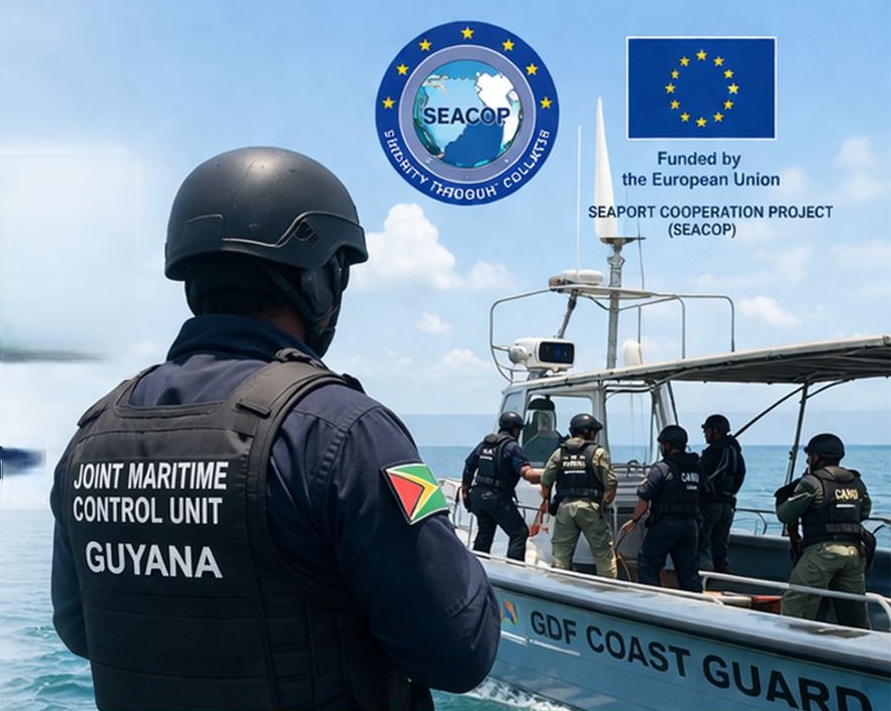
On Monday, Guyana’s Customs Anti-Narcotics Unit (CANU) announced that the country has earned third place in the 2026 Joint Maritime Control Unit (JMCU) Caribbean Competition, held under the European Union-funded Seaport Cooperation Project (SEACOP), a regional initiative focused on countering maritime illicit trafficking.
The annual competition is designed to benchmark and elevate the capabilities of Caribbean law enforcement teams to carry out high-risk vessel inspections for contraband, most notably illegal narcotics, while adhering to global safety and procedural standards. It brings together maritime enforcement agencies from across the Caribbean region to test practical skills, share best practices, and strengthen cross-border cooperation against transnational organized crime.
Guyana’s delegation was made up of personnel from three leading national security agencies: CANU, the Guyana Police Force (GPF), and the Guyana Defence Force (GDF) Coast Guard. The team scored 72 out of a total 80 possible points, equal to a 90% overall rating. This result tied Guyana with Saint Kitts and Nevis for third place, trailing only regional leaders Barbados and Trinidad and Tobago, which scored 75 points (94%) to claim the top two positions.
Assessments for the competition were conducted against a strict 80-point evaluation framework that graded teams across multiple core competency areas. Judges evaluated operational safety protocols, tactical search methodologies, internal communication, inter-agency teamwork, decision-making during high-pressure scenarios, adherence to legal and procedural rules, professional conduct, and command effectiveness.
In its official statement, CANU emphasized that Guyana’s strong performance reflects the nation’s growing and robust maritime interdiction capacity, built through sustained investments in targeted training, improved inter-agency coordination, and intelligence-led enforcement operations. The result also cements Guyana’s commitment to collaborative regional security, as participating nations work collectively to shut down illicit trafficking routes that span Caribbean waters.
Alongside Guyana, Barbados, Trinidad and Tobago, and Saint Kitts and Nevis, the competition drew participants from a range of Caribbean nations including Suriname, Jamaica, and Antigua and Barbuda, demonstrating the widespread buy-in for coordinated regional security action across the bloc.
CANU noted that the SEACOP JMCU Competition serves as a critical developmental platform for Caribbean maritime law enforcement, helping agencies align operational standards, improve interoperability during joint operations, and adopt proven best practices from peer nations. For Guyana, the third-place finish confirms the country’s position among the top tier of regional maritime interdiction units, with clear room to advance to the top of the rankings through continued refining of operational protocols and training.