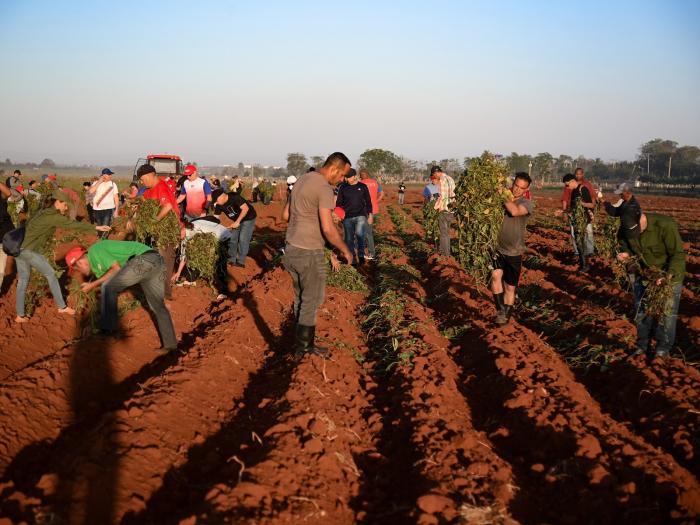
On a misty Sunday early this April, Cuba launched an island-wide day of voluntary labor to mark two landmark milestones for the country’s youth organizations: the 64th anniversary of the Union of Young Communists (UJC) and the 65th anniversary of the José Martí Pioneer Organization (OPJM). The national volunteer push centered on two core national priorities: expanding agricultural output and building new photovoltaic solar energy infrastructure, addressing two of the country’s most pressing ongoing challenges.
Leading the effort on the ground in Bauta, a municipality in western Cuba’s Artemisa Province, was Miguel Díaz-Canel Bermúdez, who serves as both First Secretary of the Central Committee of the Cuban Communist Party and President of the Republic. Joined by generations of local Cuban volunteers, Díaz-Canel took part in hands-on planting work to highlight the central role of domestic food production in the country’s current national strategy.
The president had already laid out the guiding ethos of the voluntary work days during a recent gathering with high-achieving young Cubans from across all sectors of society: “To produce is to resist, and to create is to conquer.”
Díaz-Canel was not alone in the Artemisa planting activity. He was accompanied by senior party and youth organization leaders, including Roberto Morales Ojeda, a member of the Political Bureau and Secretary of Organization of the Central Committee, and Meyvis Estévez Echevarría, First Secretary of the UJC National Committee.
After the day’s agricultural work concluded, Mirthia Julia Brossard Oris, a member of the UJC National Bureau in charge of Ideological Affairs, spoke to reporters about the significance of the celebrations amid the country’s prolonged challenges. She emphasized that despite the complex economic and social conditions facing the Caribbean nation—conditions made far more severe by the decades-long intensified U.S. imperial blockade—April 4’s anniversary events have not been sidelined or canceled.
Across the country, Brossard detailed, a wide range of activities were organized to mark the anniversaries. These included mass mobilizations for food production, public forums denouncing the ongoing blockade, mountain hiking excursions, “I Accuse Imperialism” Pioneer Tribunals for youth, kite-flying events organized to advocate for peace and oppose the imperial siege, cultural festivals and open-air concerts in city parks and main public squares, and award ceremonies recognizing the contributions of outstanding young Cuban leaders.
One of the most meaningful moments of the anniversary celebrations, Brossard highlighted, was the recent meeting between Díaz-Canel and the group of recognized outstanding young Cubans. During that gathering, the president spoke to the critical role that new generations can play in strengthening their local communities, a contribution that has become increasingly essential amid the current period of economic readjustment driven by widespread resource limitations, most notably widespread energy shortages.
“In Cuba, there is no such thing as a defeated youth,” Brossard affirmed, speaking on behalf of Cuban young people. She added: “Our commitment, in these challenging and creative times, is to propose, mobilize, convene, and involve all young people in key national tasks, especially within our local communities.”
The Bauta planting event itself featured cultural entertainment from young improvisational poets associated with the Punto Cubano project of the Casa de la Décima in neighboring Mayabeque Province. As a capstone to the day’s activities, 18 Cubans from diverse professional and social sectors were formally inducted into the Union of Young Communists, receiving their official membership cards during a public ceremony.