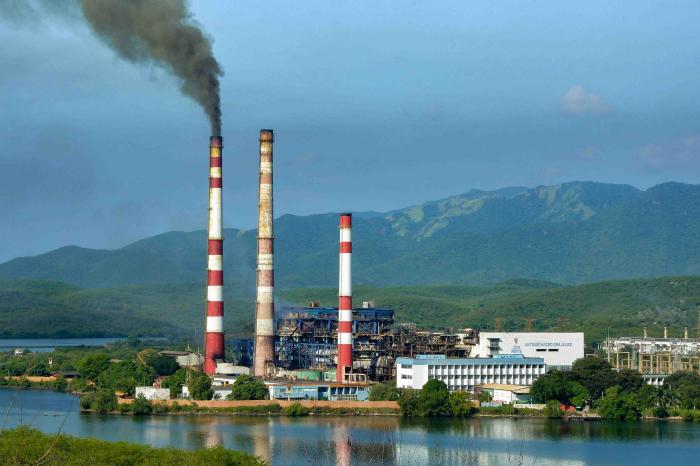
Sixty years have passed since the Antonio Maceo Grajales Thermoelectric Power Plant (CTE), commonly known locally as “Renté”, first synchronized its generating unit to Cuba’s national power grid, and the facility still stands as an irreplaceable energy backbone for the entire eastern region of the island nation.
Located in Santiago de Cuba, the plant has adapted its operations to run on domestically produced crude oil since the 1990s, a transition rooted in a directive from Cuba’s historic Commander-in-Chief that launched a modernization project for the facility’s 100-megawatt units. That project combined French technical support with homegrown Cuban engineering expertise, laying the foundation for the plant’s decades of continued operation, recalled Mayra McCalle Irsula, an industrial maintenance engineer who has spent more than 35 years working at Renté.
Today, the plant faces unprecedented challenges: decades-long U.S. sanctions have frozen most imports, left warehouses with critically low spare parts inventories, and created persistent fuel shortages that limit the facility’s maximum output. But for the plant’s more than 1,000-person workforce, external pressures are nothing new, and they have responded with a commitment to local innovation rather than waiting for outside solutions, according to CTE General Director Jesús Aguilar Hernández.
“Power generation cannot stop” is the guiding principle for the team, which has restructured its operations to guarantee uninterrupted output. Cross-functional teams combine operators, maintenance technicians, support staff and security personnel to streamline response, while maintenance crews stay on call 24/7 to address any emergency. Remote work is implemented for non-essential administrative roles where possible to keep core generation services running without interruption.
While the plant’s total installed capacity stands at 500 megawatts, current constraints mean it can deliver a steady 285 megawatts to the National Electric System (SEN) via three fully operational units (3, 5, and 6) running at maximum capacity. Recent targeted overhauls in early 2026 brought units 5 and 6 back online after extensive repairs to circulation pumps, turbines and boilers, and the local workforce has turned to local manufacturing to replace critical imported components that are no longer available.
In the plant’s machining workshop, that innovation becomes tangible. Eduardo Morales García, a veteran technician set to receive a 40-year service medal, explained that his team now manufactures parts that once were imported exclusively from Russia, including key shafts for Unit 5’s seawater pumps. Working with limited raw materials, the team has even redesigned critical systems to improve performance: Morales modified the boiler water supply system across multiple units, cutting unplanned downtime from failures and improving control of core operational parameters, while also developing a custom demineralized water system for the plant’s 100 MW units. For Morales and his co-workers, Renté is more than a job — it is a lifelong commitment, with the entire team ready to respond at any time of day or night, even when resources are scarce.
Complex maintenance work on the plant’s massive generation units demands extreme precision, and transportation disruptions tied to fuel shortages have created additional staffing constraints that slow progress. Ángel Fabars Borlot, electromechanical supervisor for the Power Plant Maintenance Company, explained that even the smallest components on the 60-year-old machinery weigh tons, with clearances measured in millimeters, making every step of repair work high-stakes. Despite understaffing, the small team of highly skilled, dedicated technicians on site delivers exceptional work to keep the units running.
Maximiliano Guisande Agüero, head of dynamic equipment at Renté who boasts 56 years of experience at the plant, led the final work to bring Unit 5 back online earlier this year. He emphasized that every day of delayed repair costs the national grid critical generation capacity, so the team dedicates every possible hour to returning units to service as quickly as possible, well aware of the country’s ongoing energy challenges.
To secure the plant’s future for decades to come, the leadership has prioritized cultivating the next generation of skilled workers. The facility has formal partnerships with the Pre-University Vocational Institute of Exact Sciences, local polytechnic schools, and the University of Oriente, offering hands-on work placements and professional training to students to recruit and retain new talent.
For Aguilar Hernández, reaching the 60-year milestone is both an honor and a responsibility. “It represents a challenge left to us by previous generations that we must pass on to future ones,” he said. “It requires constant work and deep commitment. More than the equipment itself, what keeps this plant running is the skill and dedication of its workforce.”