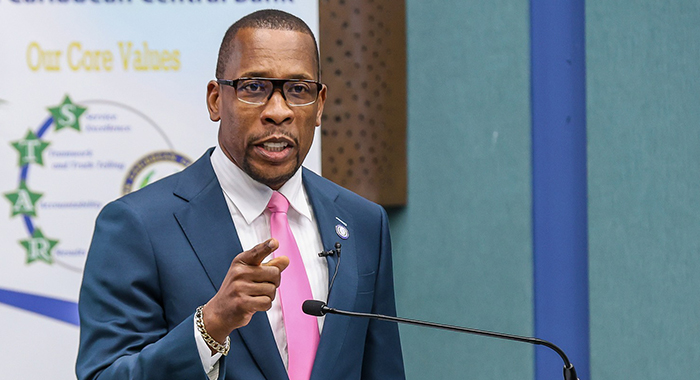
At a high-profile launch event this Thursday, Eastern Caribbean Central Bank (ECCB) Governor Timothy Antoine has laid out a bold, decade-long strategic plan aimed at doubling the Eastern Caribbean Currency Union (ECCU)’s total GDP and lifting collective citizen prosperity, centered on an initiative branded “The Big Push: Collective Action for Shared Prosperity in the ECCU”.
Three years in the making, the plan began as a provocative question Antoine posed to regional stakeholders: what would it take to double the size of the ECCU’s economies over 10 years? Today, that hypothetical vision has transitioned into a concrete, actionable roadmap for transformative change. To deliver meaningful, inclusive growth that residents can actually feel — not just measure on spreadsheets — Antoine argues the region must completely reimagine its long-standing development model, and confront a series of unvarnished, unavoidable structural challenges holding back progress.
Contrary to framing the region’s stagnation as a temporary, cyclical downturn, Antoine emphasizes that the ECCU’s growth obstacles are deeply structural. He outlined several critical constraints that demand urgent attention: over 80 percent of the food consumed across the bloc is imported, driving exorbitant food import costs and contributing to elevated rates of diet-related disease and mortality. Nearly 90 percent of the region’s energy comes from polluting fossil fuels, pushing up electricity prices for households and businesses and eroding the international competitiveness of local industries. Intra-regional connectivity is another persistent pain point: transport links are so costly and inefficient that it is often cheaper for ECCU residents to travel to major North American hubs like New York or Miami than to neighboring Caribbean nations such as Barbados or Trinidad.
Additional systemic challenges include stagnant or falling labor productivity across the bloc, paired with ongoing population decline that creates a major headwind for economic expansion. Antoine also highlighted that access to credit for private sector businesses remains far too limited, a gap that stifles entrepreneurship and job creation. “How do you grow and double the size of an economy with a falling population? We have to arrest this issue, folks. We have to wrestle with these issues and we have to solve them,” he stressed.
Antoine was clear that “The Big Push” is no empty political slogan. Instead, it is a coordinated transformation strategy that relies on cross-regional collaboration and consistent execution, with core priorities of economic diversification, enhanced climate and economic resilience, improved competitiveness, and above all, shared prosperity that puts people first. The plan’s ultimate goals are deeply tied to everyday livelihoods: it aims to create meaningful professional opportunities for young graduates at home, so they do not have to leave their communities to build careers; support local farmers to produce competitively and cut reliance on food imports; and create the conditions for small businesses to expand and generate new local jobs.
“Taken together, these hard truths are not mere inconveniences. They are structural constraints on our growth, our resilience, and our sovereignty,” Antoine said. He warned that continued inaction on these long-standing issues carries steep costs, noting that “inaction is not neutral; it compounds and accelerates decline” — making delay no viable option for regional leaders and stakeholders.
The ECCB governor emphasized that the 10-year plan is designed to address these gaps head-on, but stressed that the central bank cannot deliver the initiative alone. “The big push is not a panacea and it is not the responsibility of the ECCB alone,” he explained. “We can choose to either curse darkness or light a candle. This strategic plan lights candles on many of these issues, but we cannot do it alone.”
Antoine added that while the plan is undeniably ambitious, it is a necessary step forward for the region. The ECCB’s core role is not to generate growth directly, but to create the stable, enabling conditions that make growth possible: maintaining a strong Eastern Caribbean Dollar, safeguarding the regional financial system, and building sustained confidence among investors and residents alike. Collective action across public, private, and civil society stakeholders, he said, will be the key to turning the vision of doubled, shared prosperity into a reality for all people of the ECCU.