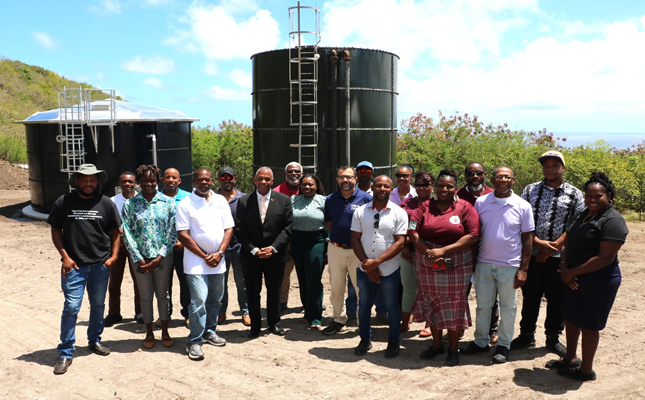
CHARLESTOWN, NEVIS – March 31, 2026 – Nevis’ ongoing efforts to strengthen domestic food security and build climate-resilient agriculture have received a transformative boost, following the official handover of three key pieces of agricultural infrastructure to local farming stakeholders. The donation package, which includes a 30,000-gallon water storage tank for the New River Farmers Cooperative, a 100-by-80-foot shade house, and a dry produce storage facility at the island’s Prospect Agricultural Station, forms part of a regional sustainability initiative led by three major global environmental bodies: the International Union for Conservation of Nature (IUCN), the Global Environment Facility (GEF), and the United Nations Environment Programme (UNEP).
The core mission of this cross-partner project is to strengthen environmental governance across St. Kitts and Nevis through widespread adoption of sustainable land management practices that align conservation, food production, and climate adaptation. At the handover ceremony hosted at the New River site, Merla Isles, President of the New River Farmers Association, emphasized that reliable water access has long been a critical unmet need for local producers grappling with a shifting climate.
“With climate change making rainfall patterns increasingly unpredictable, it has never been more important to capture and store available water to sustain farming operations across our community,” Isles said. “This new tank will directly help us boost crop production and secure sustainable livelihoods for hundreds of farming households. We are deeply grateful for this investment, and we are committed to working alongside Nevis’ Ministry of Agriculture to properly maintain this infrastructure so it can serve our community for generations to come.”
Beyond the water storage infrastructure that directly supports day-to-day farming, the two additional facilities at the Prospect Agricultural Station advance the project’s broader goals of integrating biodiversity conservation, sustainable land management, and climate-smart agriculture into the federation’s core development planning. The large shade house, constructed adjacent to the Larinson Parris Agricultural Depot, will serve as a dedicated propagation space for native fruit tree saplings. These saplings will later be used to restore forest cover in regions of Nevis that have been degraded by years of soil erosion, hurricane damage, and widespread pest and disease outbreaks.
Steve Reid, Project Coordinator with Nevis’ Ministry of Agriculture, outlined the long-term ecological and agricultural benefits of the shade house facility, noting that targeted reforestation will in turn support more stable soil and water retention for surrounding farmland.
Honourable Eric Evelyn, Nevis’ Deputy Premier and Minister of Agriculture, welcomed the timely intervention, highlighting how the new infrastructure addresses pressing gaps in the island’s agricultural capacity. In particular, the new dry storage facility will solve a longstanding challenge for local producers, who have previously lacked adequate space to preserve and store harvested crops before they reach local markets.
“These three new assets are part of the critical work being delivered through this partnership with GEF, UNEP and IUCN, and we are eternally grateful for their continued investment in our agricultural sector,” Evelyn said. “Thanks to this collaboration, we now have the infrastructure we need to store water for farming, propagate trees for landscape restoration, and properly store the fresh produce grown right here on Nevis. This is a game-changing step forward for our food security goals.”
The infrastructure was formally handed over to Nevis’ government and local farming groups by a team of key initiative leaders, including IUCN Technical Officer Melvin James, IUCN Project Coordinator Nikita Brown, and GEF Programme Officer and Task Manager Dr. Christopher Cox, all of whom oversaw the design and implementation of the project on Nevis.