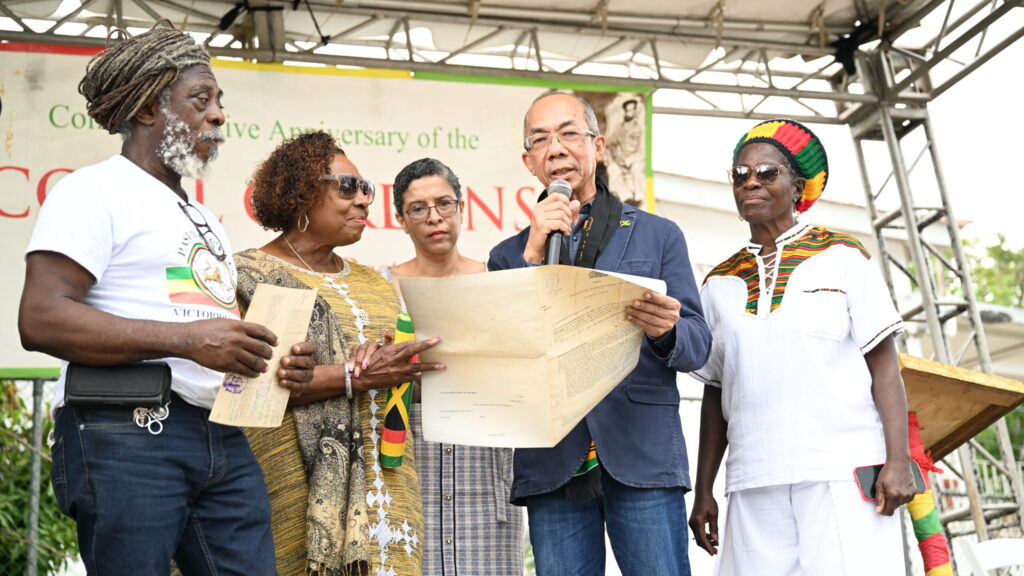
ST JAMES, Jamaica — On Good Friday, April 3, a landmark moment of reckoning and repair unfolded in St James, as Jamaican senior officials formally transferred full legal ownership of two parcels of land to the Rastafari Coral Gardens Benevolent Society (RCGBS), delivering long-awaited state restitution for the 1963 Coral Gardens incident that targeted the local Rastafari community.
Deputy Prime Minister and Minister of National Security and Peace Dr. Horace Chang led the handover ceremony, joined by Olivia Grange, Minister of Culture, Gender, Entertainment and Sport. The event was held on the newly transferred plots in Albion, St James, to mark the annual commemoration of the 1963 Coral Gardens Atrocity Against Rastafari.
In his remarks to attendees, Dr. Chang — who also serves as Member of Parliament for St James North Western — clarified that the official titles for Lots 84A and 84B grant full legal ownership rights exclusively to the RCGBS. This transfer secures the community’s unconditional right to occupy, manage, and develop the property in line with its own priorities and cultural needs. The land is designated to function as a purpose-built, secure community space for Rastafari elders, designed to support the group’s unique cultural and social requirements.
“This is a critical step forward. We are not erasing our history, nor are we rewriting it,” Dr. Chang emphasized. “We must carry our history with us, but we also have the responsibility to move forward and build a better, more just future from that history. That is exactly what this handover represents.” He also praised the sustained advocacy of RCGBS leadership over decades, specifically highlighting Ras Lewis Brown for his organizing and advocacy work, and Sistha Pamela Rowe-Williams for her consistent communication and unwavering commitment to the group’s core goals.
Dr. Chang also acknowledged the critical work of the National Land Agency (NLA), led by CEO and Commissioner of Lands Cheriese Walcott, which oversaw the completion of all required legal processes to ensure the transfer was legally sound and permanent. He added that the Jamaican government looks forward to continued collaboration with the RCGBS in future initiatives.
For her part, Minister Grange framed the handover as evidence of the government’s deepening commitment to addressing the longstanding harms inflicted on the Rastafari community. She reported that to date, more than $130 million has been distributed to the RCGBS Trust Fund to support survivors of the 1963 atrocity, with an additional $12 million deposited into the fund in recent weeks. Grange also noted that the government has provided ongoing financial support for the temporary Rastafari elders’ home in Norwood, while a permanent facility that meets the community’s specific cultural and dietary requirements is being developed.
Grange emphasized that the land transfer marks a major milestone in a national reparations process that launched in 2017, when Prime Minister Andrew Holness issued a formal public apology on behalf of the Jamaican state and committed to a comprehensive program of reparations and restoration for the Rastafari community. Led by Grange’s ministry, the initiative has focused on redressing the intergenerational harms of the Coral Gardens incident through three core pillars: direct financial support, formal state recognition of the Rastafari community, and tangible reparative action such as this land transfer.
Speaking on behalf of the Rastafari community, Brown reflected on the 60-plus year journey that led to the handover, from the first public testimonies of brutality by surviving elders, to the formal establishment of the RCGBS as a recognized advocacy body, and ultimately to high-level negotiations with government leadership at Jamaica House. He expressed sincere gratitude to Dr. Chang for guiding the community through complex legal requirements and for championing the group’s 13-point policy recommendations to the Jamaican government.
Even as he celebrated the milestone, Brown stressed that the work toward full reparative justice remains unfinished. He called on members of the community to remain unified and persistent in building a more equitable and secure foundation for future generations of Rastafarians in Jamaica.