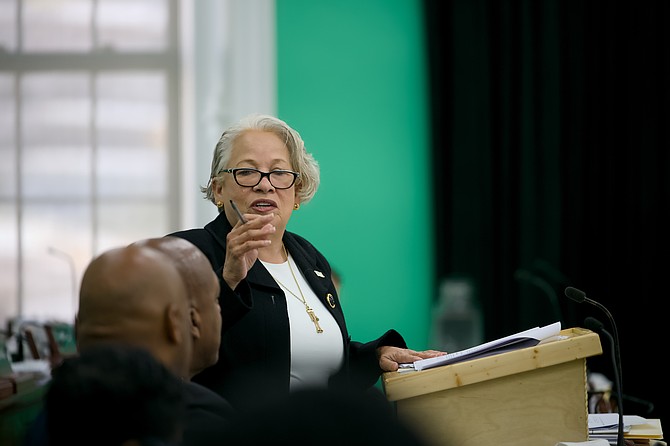
The Bahamas is witnessing an educational transformation as hundreds of academically at-risk students have made extraordinary progress, with many elevating their GPAs from below 1.0 to achieving a 3.0 average. Education Minister Glenys Hanna Martin announced these significant improvements during parliamentary debates on legislation aimed at modernizing the nation’s education system.
The data reveals a 7.3 percent increase in at-risk students achieving at least a 2.0 GPA in 2025 compared to the previous year. Particularly impressive is that 1,812 students—representing 16.3 percent of previously struggling learners—have dramatically improved their performance from approximately 1.0 to 3.0 GPAs. This marks a substantial increase from the 14.1 percent achievement rate recorded in 2024.
Minister Hanna-Martin credited these academic breakthroughs to targeted interventions and the dedicated work of academic coaches. The success extends across the archipelago, with nine of the nation’s ten education districts demonstrating GPA gains in December 2025 compared to the same period in 2024.
Academic improvements are evident across multiple subjects. Bahamian Junior Certificate results showed measurable gains in art, literature, craft, social studies, and family and consumer science. Notably, English language, chemistry, French, history, physics, religious studies, and graphical communications achieved exceptional cumulative achievement rates of 80 to 89 percent.
The ministry acknowledges ongoing challenges in mathematics but has conducted comprehensive research and is implementing specialized strategies to address this area. Further evidence of progress comes from Grade Level Assessment Test Examinations for grades three and six, which recorded gains in reading and listening comprehension. Grade six students achieved their highest GPA in ten years, and the national graduation rate reached a historic high of 59 percent.
Parallel to academic improvements, school violence has decreased dramatically by 46 percent since fall 2022, dropping from 142 incidents to 77 in fall 2025. This reduction includes a 74 percent decline in fights, complete elimination of stabbings (100 percent decrease), and a 41 percent reduction in unlawful carrying of weapons. Geographic analysis shows violence decreased 30 percent in New Providence, 73 percent in Grand Bahama, and 81 percent in the Family Islands.
Looking toward the future, the ministry has reached a landmark phase in developing an artificial intelligence policy for education. The draft policy outlines student-focused goals emphasizing both empowerment and responsibility. It envisions students not merely as AI users but as active contributors to innovation through hands-on projects, coding clubs, and national competitions. The ultimate objective is to prepare every learner, regardless of geographic location or socioeconomic status, to navigate and shape an AI-augmented future with confidence, creativity, and integrity.