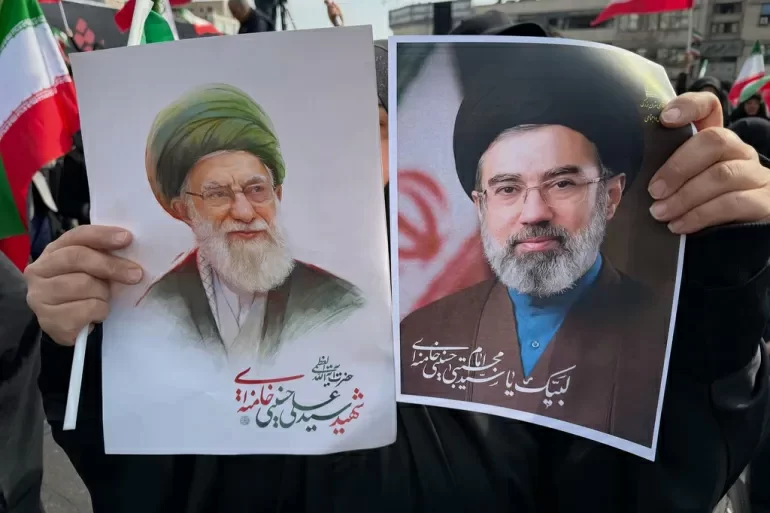
Iran is executing a calculated strategy of attrition against the United States and Israel, emphasizing economic disruption and psychological pressure over conventional military superiority, according to regional security analysts. The Islamic Revolutionary Guard Corps (IRGC) maintains firm control over battlefield operations despite the loss of Supreme Leader Ayatollah Ali Khamenei in initial attacks, with experts noting the organization’s consolidation of power through the appointment of Mojtaba Khamenei as new Supreme Leader.
The conflict has evolved into an existential struggle for Tehran, which analysts Fawaz Gerges of London School of Economics and Alex Vatanka of Middle East Institute describe as resembling a ‘wounded but increasingly dangerous animal.’ Iran’s military approach focuses on maximizing economic damage throughout the Gulf region, targeting energy infrastructure from Qatar to Saudi Arabia to increase costs for neighboring countries, European partners, and the United States while testing Washington’s political resolve.
Despite President Donald Trump’s commitment to continue hostilities until Iran’s complete defeat, the confrontation appears to be transforming into a prolonged war of endurance. U.S. intelligence sources indicate significant depletion of Iran’s missile arsenal, though regional assessments suggest Tehran retains more than half of its pre-war stockpile, sufficient to sustain attacks for several weeks.
Within Iran, daily life demonstrates remarkable resilience with shops and banks remaining operational during bombardements. The population shows no signs of mass protests or elite fragmentation, instead displaying strengthened national solidarity that potentially allows the regime to adapt to a war economy and consolidate control.
Global markets are already feeling the conflict’s impact, with oil prices reaching record highs not seen since 2022. Brent crude surged due to disruptions in the Strait of Hormuz, a critical chokepoint for global oil exports, while aluminum prices also rose significantly indicating broader commodity market instability.
Rising energy costs have triggered rationing measures and distribution restrictions worldwide, with multiple countries implementing temporary fuel sales regulations to prevent shortages. This creates increasing pressure on households and industries while heightening political tensions across multiple regions.
Chinese Foreign Minister Wang Yi recently emphasized the global necessity for peace, stability, and dialogue, describing the Middle East situation as entering a delicate and dangerous phase where military escalation offers no solution. China advocates for immediate ceasefire and political dialogue with respect for national sovereignty and non-interference principles.
The coming weeks will prove crucial as Iran bets on political exhaustion of its adversaries while the U.S. and Israel prepare to maintain military pressure. Regardless of outcome, the conflict has created an injured and unpredictable actor capable of further disrupting regional and global balance.