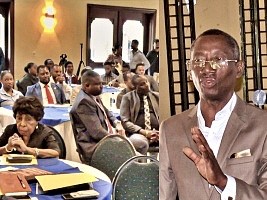
In a landmark initiative to strengthen Haiti’s democratic foundations, the State University of Haiti (UEH) and the Provisional Electoral Council (CEP) have launched a comprehensive academic-electoral partnership. The UEH-CEP Electoral Chair convened its inaugural symposium at Port-au-Prince’s Karibe Hotel, gathering electoral advisors, academic scholars, international experts, and civil society representatives to address the critical challenges facing Haiti’s 2026 general elections.
Established through a July 2025 agreement between UEH and CEP, this pioneering chair represents a strategic effort to inject scientific rigor into Haiti’s electoral processes. The symposium, themed ‘Challenges, Issues and Opportunities of the Next General Elections in Light of Electoral Experiences in Haiti,’ served as a platform for candid assessment and forward-looking solutions.
UEH Representative Me Florence Mathieu inaugurated proceedings by emphasizing the need for thoughtful dialogue, positioning the university as an intellectual compass guiding Haiti’s democratic future. Patrick Saint-Hilaire, representing Haiti’s Episcopal Conference at the CEP, underscored elections as fundamental acts of sovereignty, noting that credible elections remain the singular path to restoring state authority amid ongoing legitimacy crises and security challenges.
International electoral expert Dong Nguyen Huu provided historical context, observing that Haitian elections have typically been crisis-driven rather than periodically stable events. While acknowledging systemic weaknesses, he recognized the substantial institutional knowledge accumulated since 1990 that now requires modernization.
Former CEP member Me Carlos Hercule identified three primary obstacles for 2026: dysfunction within the National Identification Office (ONI), territorial control by armed groups, and excessive international financial dependence. He outlined essential success factors including executive branch neutrality, reliable voter rolls, and modernized litigation processes.
Security expert Me Paul Rachel Cadet presented alarming statistics showing voter participation plummeting from 70% in 1990 to approximately 20% in recent elections. His proposed solutions encompassed total transparency through digital traceability systems, comprehensive civic education reframing voting as an act of dignity, and stringent sanctions for electoral violence.
The consensus emerged that electoral success in 2026 transcends technical preparation, requiring fundamental governance overhaul. Professor Jean Eugène Pierre-Louis concluded by advocating for patriotic commitment across sectors to establish these elections as Haiti’s ‘royal road’ to lasting stability. The UEH-CEP Electoral Chair now stands as a strategic cornerstone for building Haitian democracy on sustainable, evidence-based foundations.