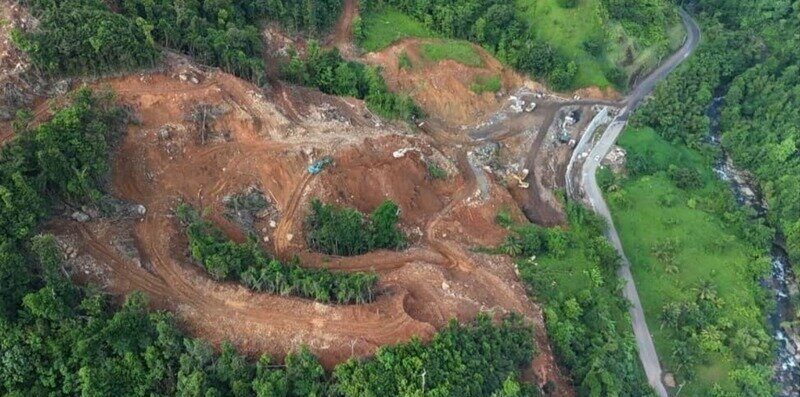
A comprehensive independent geological assessment has raised serious concerns about the Dominican government’s selection of the Deux Branches site as the primary source of construction materials for the country’s new international airport runway. Commissioned by the Save Deux Branches advocacy group and conducted in December 2025 by Professor Simon Mitchell, a distinguished Sedimentary Geology expert from the University of the West Indies, the study directly contradicts official claims regarding the site’s geological suitability.
The investigation reveals that the quarry contains a heterogeneous mixture of two fundamentally different rock types, contrary to the geological uniformity typically required for safe quarrying operations. Significant portions of the material have undergone hydrothermal alteration—a process wherein underground volcanic fluids weaken rock structures—with Dominica’s tropical climate further accelerating this deterioration.
Critically, the presence of golden-colored sulfide minerals throughout the rock formation indicates substantial metal contamination, particularly copper deposits. This finding gains historical significance as the site corresponds precisely to the area where mining giant BHP proposed copper exploration in 1996, a project that was ultimately abandoned following widespread opposition from trade unions, indigenous communities, religious organizations, and local businesses.
The report questions whether materials from Deux Branches meet international aviation safety standards, noting that mandatory rigorous testing and certification processes for airport-grade construction materials appear not to have been conducted at any Dominican quarry sites. Furthermore, the Save Deux Branches collective emphasizes that testing results have not been shared with affected local communities, despite legal requirements for transparency.
The study identifies alternative quarry locations at Crapaud Hall and along the West Coast that yield cleaner, more uniform geological materials without signs of contamination. Professor Mitchell’s concluding assessment suggests the selection of Deux Branches “is difficult to reconcile as simply by chance,” implying the possibility of ulterior motives behind the environmentally destructive choice.
The advocacy group now demands full disclosure of all project documentation, including site proposals, geotechnical studies, and the legally mandated Environmental and Social Impact Assessment, asserting that the people of Dominica deserve complete transparency regarding this significant infrastructure project.