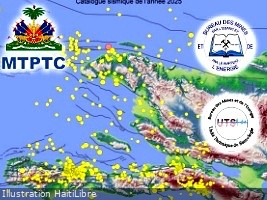
Haiti’s seismic landscape experienced significant activity throughout 2025, with national monitoring agencies documenting 553 distinct earthquakes across the Caribbean nation. According to the comprehensive report jointly released by the Ministry of the Environment, the Bureau of Mines and Energy, and the Technical Unit of Seismology, this figure represents a 12% decrease from the 628 tremors recorded in the previous year.
The seismic data, compiled from both local monitoring networks (Ayiti-séismes and UTS) and regional systems across Cuba, Jamaica, and the Dominican Republic, reveals intriguing patterns in earthquake distribution and intensity. The monthly average reached 46 earthquakes, with May and August emerging as the most seismically active months—each recording 60 distinct events.
Magnitude readings spanned from 0.2 to 4.2 on the Richter scale, with the overwhelming majority (90.9% or 503 earthquakes) registering at magnitude 3.0 or below—categorized as very minor tremors. Approximately 9% (50 earthquakes) measured between 3.1 and 4.2, falling into the minor to slight classification. The most powerful event, a magnitude 4.2 earthquake, occurred on August 23 off the coast of Jean Rabel in the Northwest region.
Geographical analysis uncovered uneven distribution across Haiti’s ten departments. The West department experienced the highest concentration with 138 quakes (24.9%), followed by Nippes with 115 (20.7%), and Northwest with 102 (18.4%). Collectively, these three regions accounted for 64% of the nation’s total seismic activity. Conversely, the Center, North, and Northeast departments recorded minimal activity with just 31 combined earthquakes, representing merely 5.6% of the annual total.
Notably, 206 earthquakes (37.25%) occurred offshore, particularly concentrated around the Northwest Peninsula. Depth measurements revealed that 263 events (47.5%) were shallow-focus earthquakes occurring at depths of 10 kilometers or less, making them more perceptible at the surface despite their typically lower magnitudes.